OCR · GCSE · Biology
Course version: J247 · Version from Sept 2018
Describe the main steps in the process of genetic engineering (to include:…
Full specification wording
Feeding the human race: describe the main steps in the process of genetic engineering (to include: restriction enzymes, sticky ends, ligase, host bacteria and selection using antibiotic resistance markers, vectors e.g. plasmids) (Higher tier only)
The molecular process of genetic engineering follows a precise enzymatic protocol.
- Point 6 of 8
- 4 key terms
Study notes
From the teaching notes for this specification point.
The idea
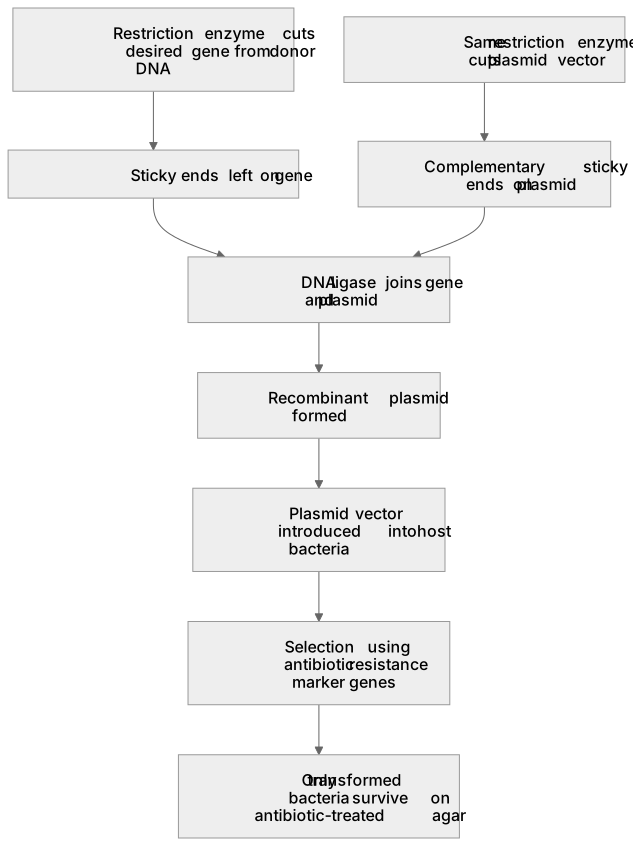
The molecular process of genetic engineering follows a precise enzymatic protocol. Restriction endonuclease enzymes cut the desired gene from donor DNA, cleaving staggered palindromic sequences to leave short, unpaired single-stranded overhangs termed sticky ends. The identical restriction enzyme cuts open a bacterial plasmid vector, generating complementary sticky ends. The enzyme DNA ligase joins the gene and plasmid together by forming covalent phosphodiester bonds, producing recombinant DNA. Recombinant plasmids are introduced into host bacteria. Successfully transformed bacteria are selected using antibiotic resistance marker genes on the plasmid; only bacteria carrying the recombinant vector survive when grown on antibiotic-treated agar.
What earns the marks
- Describe the use of restriction enzymes to cut the desired gene and plasmid vector, leaving complementary sticky ends.
- Explain that DNA ligase enzyme joins the sticky ends of the gene and plasmid together to create a recombinant plasmid.
- Explain the role of plasmids as vectors that transfer foreign DNA into host bacteria.
- Describe the selection of transformed bacteria using antibiotic resistance marker genes on the plasmid.
Common mistakes and how to put them right
Using two different restriction enzymes to cut the gene and plasmid, which produces non-complementary sticky ends that cannot anneal.
Confusing the roles of restriction enzymes (cutting DNA) and DNA ligase (joining DNA fragments).
Exam tips
- Emphasise that the SAME restriction enzyme must cut both the gene and the plasmid vector so their sticky ends are complementary.
- State clearly that plasmids serve as vectors, carrying the foreign recombinant DNA into the host bacterial cell.
Try the lesson
The start of the Feeding the human race: describe the main steps in the process of genetic engineering (to include: restriction enzymes, sticky ends, ligase, host bacteria and selection using antibiotic resistance markers, vectors e.g. plasmids) (Higher tier only) lesson, made from teaching notes for this specification point.
Have a go first
In genetic engineering, which enzyme is used to cut a gene out of a length of DNA?
Listen
The molecular process of genetic engineering follows a precise enzymatic protocol. Restriction endonuclease enzymes cut the desired gene from donor DNA, cleaving staggered palindromic sequences to leave short, unpaired single-stranded overhangs termed sticky ends. The identical restriction enzyme cuts open a bacterial plasmid vector, generating complementary sticky ends. The enzyme DNA ligase joins the gene and plasmid together by forming covalent phosphodiester bonds, producing recombinant DNA. Recombinant plasmids are introduced into host bacteria. Successfully transformed bacteria are selected using antibiotic resistance marker genes on the plasmid; only bacteria carrying the recombinant vector survive when grown on antibiotic-treated agar. A strong answer earns marks for these points. Describe the use of restriction enzymes to cut the desired gene and plasmid vector, leaving complementary sticky ends. Explain that DNA ligase enzyme joins the sticky ends of the gene and plasmid together to create a recombinant plasmid. Explain the role of plasmids as vectors that transfer foreign DNA into host bacteria. Describe the selection of transformed bacteria using antibiotic resistance marker genes on the plasmid. Exam tip: Emphasise that the SAME restriction enzyme must cut both the gene and the plasmid vector so their sticky ends are complementary.
See it
Key words
Say what each word means before you turn the card.
restriction enzymes
Try answering aloud or in your head before turning the card.
sticky ends
Try answering aloud or in your head before turning the card.
ligase
Try answering aloud or in your head before turning the card.
antibiotic resistance markers
Try answering aloud or in your head before turning the card.
See every definition
- restriction enzymes
- Enzymes that cut the desired gene from donor DNA and cut open a bacterial plasmid vector, leaving complementary sticky ends.
- sticky ends
- Short, unpaired single-stranded overhangs left when restriction enzymes cleave staggered palindromic sequences.
- ligase
- Enzyme that joins the gene and plasmid together by forming covalent phosphodiester bonds, producing recombinant DNA.
- antibiotic resistance markers
- Genes on the plasmid used to select successfully transformed bacteria, as only bacteria carrying the recombinant vector survive on antibiotic-treated agar.
Label the diagram
Some boxes have lost their names. Pick the right name for each number.
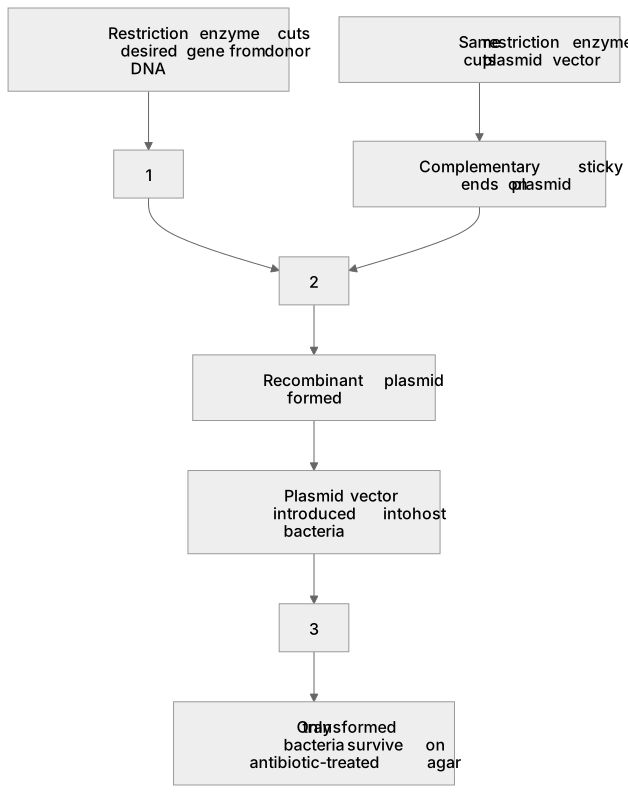
1Box 1
2Box 2
3Box 3
There is more to this lesson
The full lesson goes on to check your understanding and help you earn the marks. Create a free account to carry on, with your progress saved.
A week of Premium from your first lesson · Then the free plan continues · No card, no charge
Test your understanding of Feeding the human race: describe the main steps in the process of genetic engineering (to include: restriction enzymes, sticky ends, ligase, host bacteria and selection using antibiotic resistance markers, vectors e.g. plasmids) (Higher tier only)
Active recall beats re-reading. Take an instant quiz now to test what you’ve learned and lock it into long-term memory.
A week of Premium from your first lesson · Then the free plan continues · No card, no charge