OCR · GCSE · Biology
Course version: J247 · Version from Sept 2018
Describe the development of our understanding of genetics (to include: the…
Full specification wording
Inheritance: describe the development of our understanding of genetics (to include: the work of Mendel) (content found only in the biology separate science qualification)
The foundation of modern genetics was established in the 1860s by Gregor Mendel through quantitative breeding experiments on pea plants.
- Point 16 of 16
- 4 key terms
Study notes
From the teaching notes for this specification point.
The idea
The foundation of modern genetics was established in the 1860s by Gregor Mendel through quantitative breeding experiments on pea plants. Mendel discovered that characteristics are determined by inherited units that pass unchanged to offspring, rather than blending as previously believed. Mendel findings were not accepted during his lifetime because he could not explain the physical mechanism behind his factors, and chromosomes and DNA had not yet been discovered. In the early 20th century, the discovery of chromosome behaviour during meiosis provided the physical evidence validating Mendel laws, leading eventually to determination of DNA structure.
What earns the marks
- Describe Mendel breeding experiments on pea plants showing that characteristics are inherited in discrete, non-blending units.
- Explain why Mendel work was initially rejected or ignored: lack of understanding of chromosomes, genes, or the mechanism of meiosis.
- Describe how 20th-century discoveries of chromosome behaviour in cell division and the structure of DNA confirmed Mendel theories.
Common mistakes and how to put them right
Claiming Mendel discovered DNA or genes, rather than hereditary factors that we now recognise as alleles.
Assuming Mendel was instantly celebrated for his discoveries, overlooking the decades during which his papers were ignored.
Exam tips
- Remember that Mendel used the term hereditary factors; he did not know about genes, chromosomes, or DNA.
- When explaining why his ideas were not accepted at the time, mention that he was an Augustinian monk whose mathematical approach was unfamiliar to contemporary biologists.
Try the lesson
The start of the Inheritance: describe the development of our understanding of genetics (to include: the work of Mendel) (content found only in the biology separate science qualification) lesson, made from teaching notes for this specification point.
Have a go first
What did Gregor Mendel study in his experiments on inheritance?
Listen
The foundation of modern genetics was established in the 1860s by Gregor Mendel through quantitative breeding experiments on pea plants. Mendel discovered that characteristics are determined by inherited units that pass unchanged to offspring, rather than blending as previously believed. Mendel findings were not accepted during his lifetime because he could not explain the physical mechanism behind his factors, and chromosomes and DNA had not yet been discovered. In the early 20th century, the discovery of chromosome behaviour during meiosis provided the physical evidence validating Mendel laws, leading eventually to determination of DNA structure. A strong answer earns marks for these points. Describe Mendel breeding experiments on pea plants showing that characteristics are inherited in discrete, non-blending units. Explain why Mendel work was initially rejected or ignored: lack of understanding of chromosomes, genes, or the mechanism of meiosis. Describe how 20th-century discoveries of chromosome behaviour in cell division and the structure of DNA confirmed Mendel theories. Exam tip: Remember that Mendel used the term hereditary factors; he did not know about genes, chromosomes, or DNA.
See it
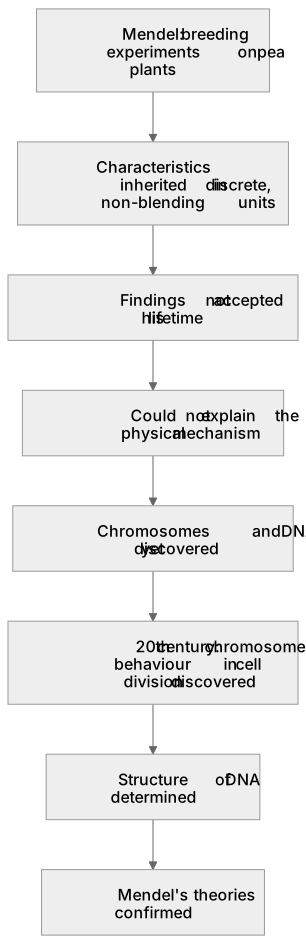
Put it in order
Put these steps in the order they happen.
- 1. Chromosomes and DNA not yet discovered
- 2. Mendel's theories confirmed
- 3. 20th century: chromosome behaviour in cell division discovered
- 4. Mendel: breeding experiments on pea plants
- 5. Characteristics inherited in discrete, non-blending units
- 6. Structure of DNA determined
- 7. Findings not accepted in his lifetime
- 8. Could not explain the physical mechanism
Key words
Say what each word means before you turn the card.
mendelian inheritance
Try answering aloud or in your head before turning the card.
scientific acceptance
Try answering aloud or in your head before turning the card.
chromosome theory
Try answering aloud or in your head before turning the card.
history of genetics
Try answering aloud or in your head before turning the card.
See every definition
- mendelian inheritance
- Characteristics are determined by inherited units that pass unchanged to offspring, rather than blending as previously believed.
- scientific acceptance
- Mendel findings were not accepted during his lifetime because he could not explain the physical mechanism behind his factors.
- chromosome theory
- The discovery of chromosome behaviour during meiosis provided the physical evidence validating Mendel laws.
- history of genetics
- The foundation of modern genetics was established in the 1860s by Gregor Mendel through quantitative breeding experiments on pea plants.
Label the diagram
Some boxes have lost their names. Pick the right name for each number.
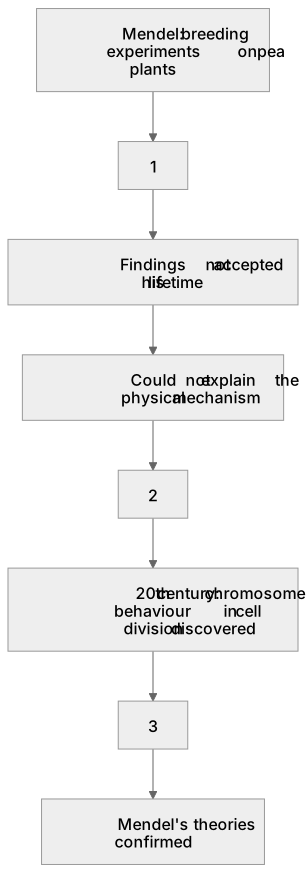
1Box 1
2Box 2
3Box 3
There is more to this lesson
The full lesson goes on to check your understanding and help you earn the marks. Create a free account to carry on, with your progress saved.
A week of Premium from your first lesson · Then the free plan continues · No card, no charge
Test your understanding of Inheritance: describe the development of our understanding of genetics (to include: the work of Mendel) (content found only in the biology separate science qualification)
Active recall beats re-reading. Take an instant quiz now to test what you’ve learned and lock it into long-term memory.
A week of Premium from your first lesson · Then the free plan continues · No card, no charge