OCR · GCSE · Biology
Course version: J247 · Version from Sept 2018
Recall that most phenotypic features are the result of multiple genes…
Full specification wording
Inheritance: recall that most phenotypic features are the result of multiple genes rather than single gene inheritance
While introductory genetics focuses on monohybrid crosses governed by a single gene locus, the vast majority of phenotypic characteristics in living organisms are polygenic.
- Point 15 of 16
- 2 key terms
Study notes
From the teaching notes for this specification point.
The idea
While introductory genetics focuses on monohybrid crosses governed by a single gene locus, the vast majority of phenotypic characteristics in living organisms are polygenic. Polygenic inheritance involves multiple distinct genes situated across different chromosomes exerting cumulative, additive effects on a single physical characteristic. Common human examples include height, skin pigmentation, eye colour, and body mass. Polygenic characteristics interact strongly with environmental factors, resulting in continuous variation that plots as a bell-shaped normal distribution curve.
What earns the marks
- Recall that most phenotypic features are polygenic, controlled by multiple interacting genes rather than a single gene.
- Give examples of polygenic characteristics in humans, such as height, eye colour, or skin colour.
- Explain that polygenic inheritance combined with environmental factors leads to continuous variation.
Common mistakes and how to put them right
Assuming complex human traits like adult height or intelligence are determined by a single dominant or recessive gene.
Believing that eye colour is simple single-gene inheritance, ignoring the multiple interacting genes responsible for iris pigmentation.
Exam tips
- Use the term polygenic when explaining characteristics that show a continuous range of phenotypes across a population.
- Be prepared to explain why characteristics controlled by multiple genes show a normal distribution curve.
Try the lesson
The start of the Inheritance: recall that most phenotypic features are the result of multiple genes rather than single gene inheritance lesson, made from teaching notes for this specification point.
Have a go first
Which statement best describes how most phenotypic features are inherited?
Listen
While introductory genetics focuses on monohybrid crosses governed by a single gene locus, the vast majority of phenotypic characteristics in living organisms are polygenic. Polygenic inheritance involves multiple distinct genes situated across different chromosomes exerting cumulative, additive effects on a single physical characteristic. Common human examples include height, skin pigmentation, eye colour, and body mass. Polygenic characteristics interact strongly with environmental factors, resulting in continuous variation that plots as a bell-shaped normal distribution curve. A strong answer earns marks for these points. Recall that most phenotypic features are polygenic, controlled by multiple interacting genes rather than a single gene. Give examples of polygenic characteristics in humans, such as height, eye colour, or skin colour. Explain that polygenic inheritance combined with environmental factors leads to continuous variation. Exam tip: Use the term polygenic when explaining characteristics that show a continuous range of phenotypes across a population.
See it
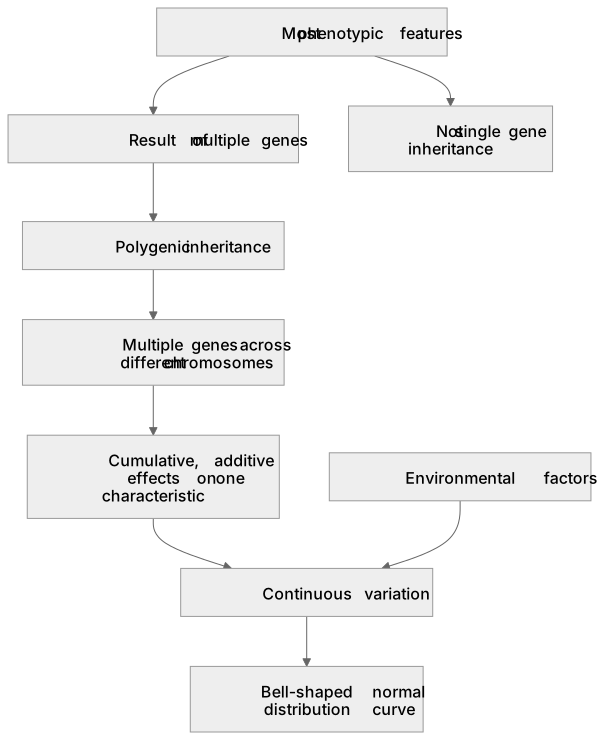
Key words
Say what each word means before you turn the card.
polygenic inheritance
Try answering aloud or in your head before turning the card.
continuous variation
Try answering aloud or in your head before turning the card.
See every definition
- polygenic inheritance
- Involves multiple distinct genes situated across different chromosomes exerting cumulative, additive effects on a single physical characteristic.
- continuous variation
- Results from polygenic characteristics interacting strongly with environmental factors, plotting as a bell-shaped normal distribution curve.
Label the diagram
Some boxes have lost their names. Pick the right name for each number.
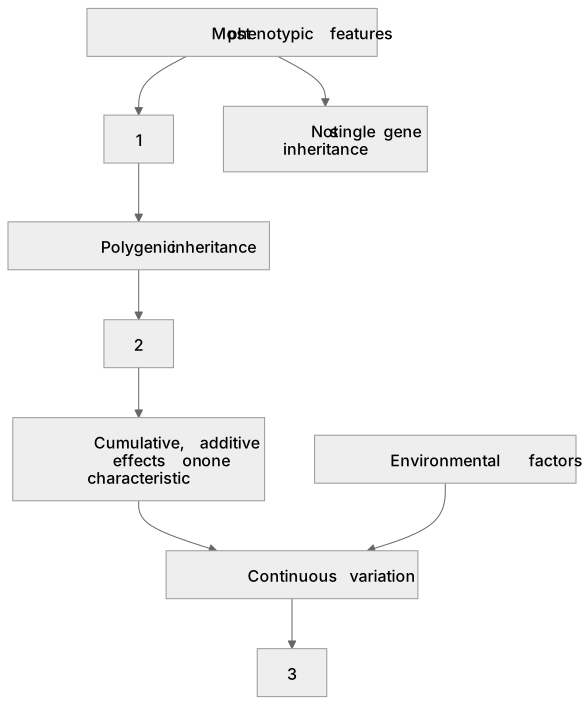
1Box 1
2Box 2
3Box 3
There is more to this lesson
The full lesson goes on to check your understanding and help you earn the marks. Create a free account to carry on, with your progress saved.
A week of Premium from your first lesson · Then the free plan continues · No card, no charge
Test your understanding of Inheritance: recall that most phenotypic features are the result of multiple genes rather than single gene inheritance
Active recall beats re-reading. Take an instant quiz now to test what you’ve learned and lock it into long-term memory.
A week of Premium from your first lesson · Then the free plan continues · No card, no charge