OCR · GCSE · Biology
Course version: J247 · Version from Sept 2018
Explain single gene inheritance (to include: the context of homozygous and…
Full specification wording
Inheritance: explain single gene inheritance (to include: the context of homozygous and heterozygous crosses involving dominant and recessive genes)
Single gene inheritance, or monohybrid inheritance, describes the transmission of characteristics controlled by a single genetic locus.
- Point 12 of 16
- 4 key terms
Study notes
From the teaching notes for this specification point.
The idea
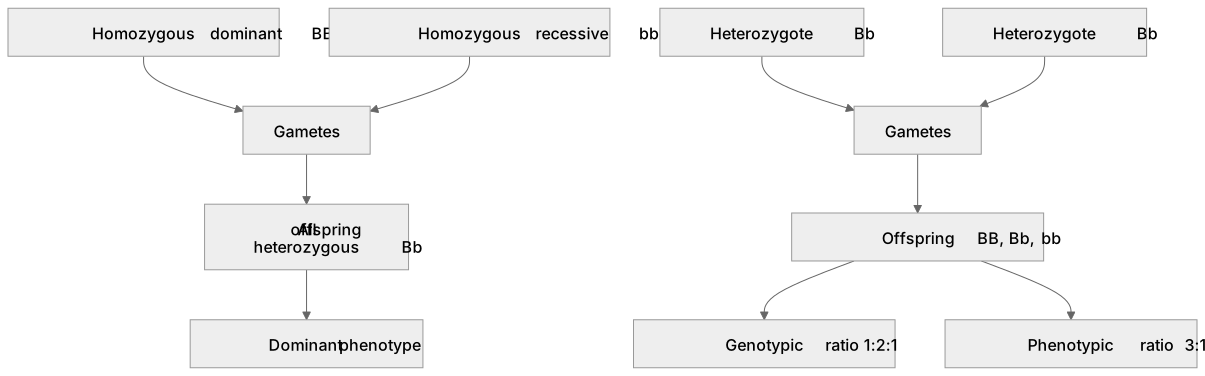
Single gene inheritance, or monohybrid inheritance, describes the transmission of characteristics controlled by a single genetic locus. Diploid organisms possess two alleles for each gene, situated at identical loci on homologous chromosomes. When crossing homozygous dominant (BB) with homozygous recessive (bb) individuals, all offspring inherit one allele from each parent, becoming heterozygous (Bb) and expressing the dominant phenotype. In a cross between two heterozygotes (Bb x Bb), alleles segregate into gametes, producing homozygous dominant, heterozygous, and homozygous recessive offspring in a 1:2:1 genotypic ratio and a 3:1 phenotypic ratio.
What earns the marks
- Explain that diploid organisms carry two alleles for each gene, which segregate into separate gametes during meiosis.
- Show that crossing homozygous dominant with homozygous recessive produces 100% heterozygous offspring displaying the dominant phenotype.
- Explain that crossing two heterozygotes produces a 1:2:1 genotypic ratio (BB:Bb:bb) and a 3:1 phenotypic ratio (dominant:recessive).
Common mistakes and how to put them right
Using different letters for alleles of the same gene (such as B for brown and b for blue), which causes confusion during crosses.
Failing to distinguish between genotypic ratios (1:2:1) and phenotypic ratios (3:1) in heterozygous crosses.
Exam tips
- Always choose a single letter where capital and lower case forms look distinct (e.g. B and b, rather than C and c).
- Clearly label parental genotypes, gametes, offspring genotypes, and final offspring phenotypes in every genetic cross.
Try the lesson
The start of the Inheritance: explain single gene inheritance (to include: the context of homozygous and heterozygous crosses involving dominant and recessive genes) lesson, made from teaching notes for this specification point.
Have a go first
What is the genotype of an organism that has two identical alleles for a gene?
Listen
Single gene inheritance, or monohybrid inheritance, describes the transmission of characteristics controlled by a single genetic locus. Diploid organisms possess two alleles for each gene, situated at identical loci on homologous chromosomes. When crossing homozygous dominant (BB) with homozygous recessive (bb) individuals, all offspring inherit one allele from each parent, becoming heterozygous (Bb) and expressing the dominant phenotype. In a cross between two heterozygotes (Bb x Bb), alleles segregate into gametes, producing homozygous dominant, heterozygous, and homozygous recessive offspring in a 1:2:1 genotypic ratio and a 3:1 phenotypic ratio. A strong answer earns marks for these points. Explain that diploid organisms carry two alleles for each gene, which segregate into separate gametes during meiosis. Show that crossing homozygous dominant with homozygous recessive produces 100% heterozygous offspring displaying the dominant phenotype. Explain that crossing two heterozygotes produces a 1:2:1 genotypic ratio (BB:Bb:bb) and a 3:1 phenotypic ratio (dominant:recessive). Exam tip: Always choose a single letter where capital and lower case forms look distinct (e.g. B and b, rather than C and c).
See it
Key words
Say what each word means before you turn the card.
monohybrid inheritance
Try answering aloud or in your head before turning the card.
allele segregation
Try answering aloud or in your head before turning the card.
dominant and recessive alleles
Try answering aloud or in your head before turning the card.
genotypic and phenotypic ratios
Try answering aloud or in your head before turning the card.
See every definition
- monohybrid inheritance
- Describes the transmission of characteristics controlled by a single genetic locus.
- allele segregation
- Alleles separate into gametes, so offspring inherit one allele from each parent.
- dominant and recessive alleles
- In crosses involving these, homozygous dominant crossed with homozygous recessive gives heterozygous offspring expressing the dominant phenotype.
- genotypic and phenotypic ratios
- Crossing two heterozygotes produces a 1:2:1 genotypic ratio and a 3:1 phenotypic ratio.
There is more to this lesson
The full lesson goes on to check your understanding and help you earn the marks. Create a free account to carry on, with your progress saved.
A week of Premium from your first lesson · Then the free plan continues · No card, no charge
Test your understanding of Inheritance: explain single gene inheritance (to include: the context of homozygous and heterozygous crosses involving dominant and recessive genes)
Active recall beats re-reading. Take an instant quiz now to test what you’ve learned and lock it into long-term memory.
A week of Premium from your first lesson · Then the free plan continues · No card, no charge