OCR · GCSE · Biology
Course version: J247 · Version from Sept 2018
Predict the results of single gene crosses (to include: the use of Punnett…
Full specification wording
Inheritance: predict the results of single gene crosses (to include: the use of Punnett squares)
Punnett squares are visual matrices used to model the random segregation and combination of alleles during sexual reproduction.
- Point 13 of 16
- 3 key terms
Study notes
From the teaching notes for this specification point.
The idea
Punnett squares are visual matrices used to model the random segregation and combination of alleles during sexual reproduction. To construct a Punnett square, parental genotypes are split to determine the alleles carried by individual gametes, which are placed along the top and left margins of a two-by-two grid. The internal cells are filled by pairing corresponding alleles, showing all possible zygotic genotypes. The resulting genotypes are translated into phenotypes to predict theoretical outcomes, expressed as simplified ratios, percentages, or decimal probabilities.
What earns the marks
- Correctly identify and separate parental alleles into gametes along the axes of a Punnett square grid.
- Complete the four interior cells of the Punnett square to show all possible offspring genotypes.
- Interpret the grid to state the predicted ratio, percentage, or probability of each resulting offspring phenotype.
Common mistakes and how to put them right
Putting diploid genotypes into individual gamete slots instead of single segregated alleles.
Stopping after completing the grid without writing down the corresponding phenotypes and probabilities requested by the question.
Exam tips
- Always re-read the question carefully to ensure whether the final answer requires a ratio, fraction, or percentage.
- Match each calculated probability clearly with the named phenotype (e.g. 75% normal, 25% cystic fibrosis).
Try the lesson
The start of the Inheritance: predict the results of single gene crosses (to include: the use of Punnett squares) lesson, made from teaching notes for this specification point.
Have a go first
In a single gene cross, a homozygous dominant parent (AA) is crossed with a homozygous recessive parent (aa). What percentage of the offspring are expected to show the recessive phenotype?
Listen
Punnett squares are visual matrices used to model the random segregation and combination of alleles during sexual reproduction. To construct a Punnett square, parental genotypes are split to determine the alleles carried by individual gametes, which are placed along the top and left margins of a two-by-two grid. The internal cells are filled by pairing corresponding alleles, showing all possible zygotic genotypes. The resulting genotypes are translated into phenotypes to predict theoretical outcomes, expressed as simplified ratios, percentages, or decimal probabilities. A strong answer earns marks for these points. Correctly identify and separate parental alleles into gametes along the axes of a Punnett square grid. Complete the four interior cells of the Punnett square to show all possible offspring genotypes. Interpret the grid to state the predicted ratio, percentage, or probability of each resulting offspring phenotype. Exam tip: Always re-read the question carefully to ensure whether the final answer requires a ratio, fraction, or percentage.
See it
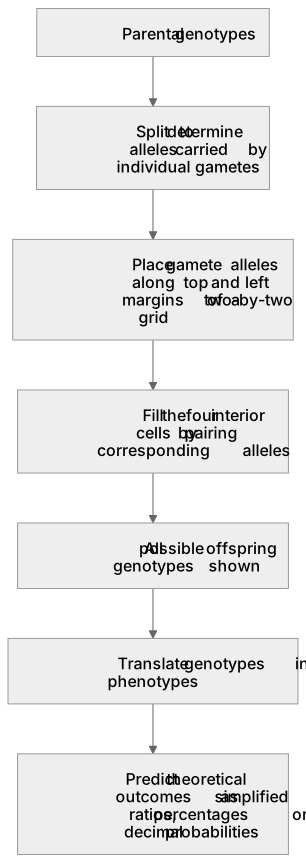
Put it in order
Put these steps in the order they happen.
- 1. Predict theoretical outcomes as simplified ratios, percentages or decimal probabilities
- 2. Translate genotypes into phenotypes
- 3. Place gamete alleles along top and left margins of a two-by-two grid
- 4. All possible offspring genotypes shown
- 5. Parental genotypes
- 6. Split to determine alleles carried by individual gametes
- 7. Fill the four interior cells by pairing corresponding alleles
Key words
Say what each word means before you turn the card.
Punnett squares
Try answering aloud or in your head before turning the card.
monohybrid crosses
Try answering aloud or in your head before turning the card.
predicting offspring phenotypes
Try answering aloud or in your head before turning the card.
See every definition
- Punnett squares
- Visual matrices used to model the random segregation and combination of alleles during sexual reproduction.
- monohybrid crosses
- Single gene crosses whose results are predicted using Punnett squares.
- predicting offspring phenotypes
- Translating the resulting genotypes into phenotypes to predict theoretical outcomes, expressed as simplified ratios, percentages, or decimal probabilities.
Label the diagram
Some boxes have lost their names. Pick the right name for each number.
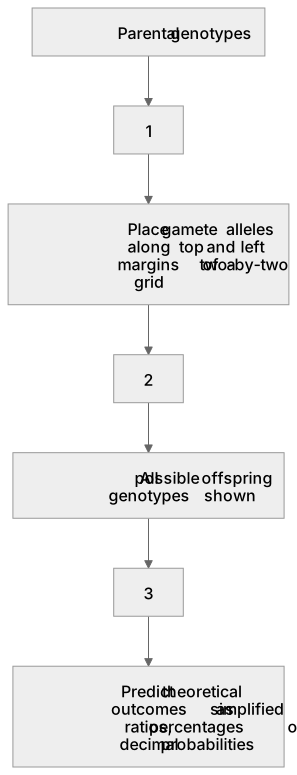
1Box 1
2Box 2
3Box 3
There is more to this lesson
The full lesson goes on to check your understanding and help you earn the marks. Create a free account to carry on, with your progress saved.
A week of Premium from your first lesson · Then the free plan continues · No card, no charge
Test your understanding of Inheritance: predict the results of single gene crosses (to include: the use of Punnett squares)
Active recall beats re-reading. Take an instant quiz now to test what you’ve learned and lock it into long-term memory.
A week of Premium from your first lesson · Then the free plan continues · No card, no charge