OCR · GCSE · Biology
Course version: J247 · Version from Sept 2018
Inheritance: explain the terms haploid and diploid
Chromosomal ploidy describes the number of complete sets of chromosomes within a cell.
- Point 10 of 16
- 4 key terms
Study notes
From the teaching notes for this specification point.
The idea
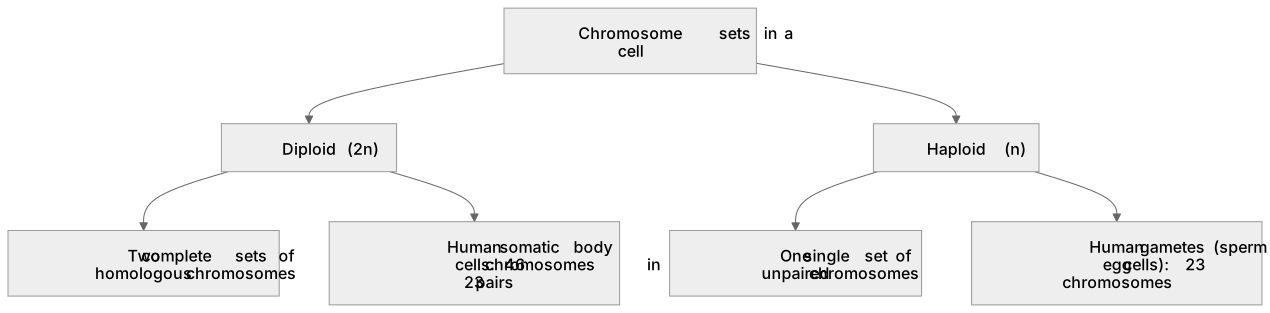
Chromosomal ploidy describes the number of complete sets of chromosomes within a cell. Diploid cells, denoted 2n, contain two complete sets of homologous chromosomes, with one chromosome of each homologous pair inherited from the maternal parent and the other from the paternal parent. In humans, somatic body cells are diploid, containing 46 chromosomes in 23 pairs. Haploid cells, denoted n, contain only one single set of unpaired chromosomes. Human gametes (sperm and egg cells) are haploid, possessing exactly 23 chromosomes produced through meiotic reduction division.
What earns the marks
- Define diploid as having two complete sets of chromosomes or chromosomes in pairs (46 in human somatic cells).
- Define haploid as having a single set of unpaired chromosomes (23 in human gametes).
- Identify gametes (sperm and ova) as haploid and normal body cells as diploid.
Common mistakes and how to put them right
Confusing haploid and diploid numbers, such as stating human gametes contain 46 chromosomes.
Believing haploid cells contain half a chromosome rather than half the total diploid chromosome number.
Exam tips
- Remember the letter trick: Di means two, so Diploid has Double the chromosomes; Ha means Half, so Haploid has half.
- Always state human chromosome numbers clearly: diploid = 46 (23 pairs), haploid = 23.
Try the lesson
The start of the Inheritance: explain the terms haploid and diploid lesson, made from teaching notes for this specification point.
Have a go first
What is the meaning of the term haploid?
Listen
Chromosomal ploidy describes the number of complete sets of chromosomes within a cell. Diploid cells, denoted 2n, contain two complete sets of homologous chromosomes, with one chromosome of each homologous pair inherited from the maternal parent and the other from the paternal parent. In humans, somatic body cells are diploid, containing 46 chromosomes in 23 pairs. Haploid cells, denoted n, contain only one single set of unpaired chromosomes. Human gametes (sperm and egg cells) are haploid, possessing exactly 23 chromosomes produced through meiotic reduction division. A strong answer earns marks for these points. Define diploid as having two complete sets of chromosomes or chromosomes in pairs (46 in human somatic cells). Define haploid as having a single set of unpaired chromosomes (23 in human gametes). Identify gametes (sperm and ova) as haploid and normal body cells as diploid. Exam tip: Remember the letter trick: Di means two, so Diploid has Double the chromosomes; Ha means Half, so Haploid has half.
See it
Key words
Say what each word means before you turn the card.
diploid
Try answering aloud or in your head before turning the card.
haploid
Try answering aloud or in your head before turning the card.
gametes
Try answering aloud or in your head before turning the card.
somatic cells
Try answering aloud or in your head before turning the card.
See every definition
- diploid
- Having two complete sets of chromosomes, or chromosomes in pairs, such as 46 chromosomes in human somatic cells.
- haploid
- Having a single set of unpaired chromosomes, such as 23 chromosomes in human gametes.
- gametes
- Sperm and ova, which are haploid, possessing exactly 23 chromosomes produced through meiotic reduction division.
- somatic cells
- Normal body cells, which are diploid, containing 46 chromosomes in 23 pairs.
Label the diagram
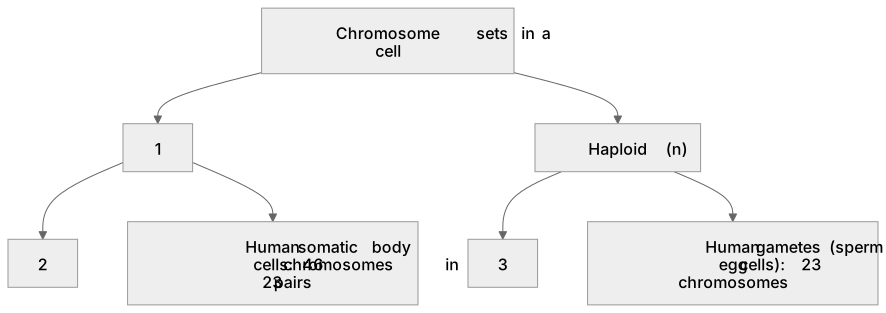
Some boxes have lost their names. Pick the right name for each number.
1Box 1
2Box 2
3Box 3
There is more to this lesson
The full lesson goes on to check your understanding and help you earn the marks. Create a free account to carry on, with your progress saved.
A week of Premium from your first lesson · Then the free plan continues · No card, no charge
Test your understanding of Inheritance: explain the terms haploid and diploid
Active recall beats re-reading. Take an instant quiz now to test what you’ve learned and lock it into long-term memory.
A week of Premium from your first lesson · Then the free plan continues · No card, no charge