OCR · GCSE · Biology
Course version: J247 · Version from Sept 2018
Explain some of the advantages and disadvantages of asexual and sexual…
Full specification wording
Inheritance: explain some of the advantages and disadvantages of asexual and sexual reproduction in a range of organisms (to include: the number of live offspring per birth, how quickly the organisms can reproduce verses the need for the introduction of variation in a population caused by environmental pressures) (content found only in the biology separate science qualification)
Reproductive strategies balance speed and offspring volume against genetic adaptability.
- Point 9 of 16
- 4 key terms
Study notes
From the teaching notes for this specification point.
The idea
Reproductive strategies balance speed and offspring volume against genetic adaptability. Asexual reproduction involves a single parent generating genetically identical offspring by mitosis. It enables organisms to reproduce rapidly, producing numerous offspring to exploit stable, resource-rich habitats without wasting time or energy finding a mate. However, the lack of genetic variation leaves the entire population vulnerable to disease outbreaks or environmental change. Sexual reproduction involves the fusion of haploid gametes, generating genetic diversity through meiosis and random fertilisation. Although slower, variation allows populations to survive shifting environmental pressures.
What earns the marks
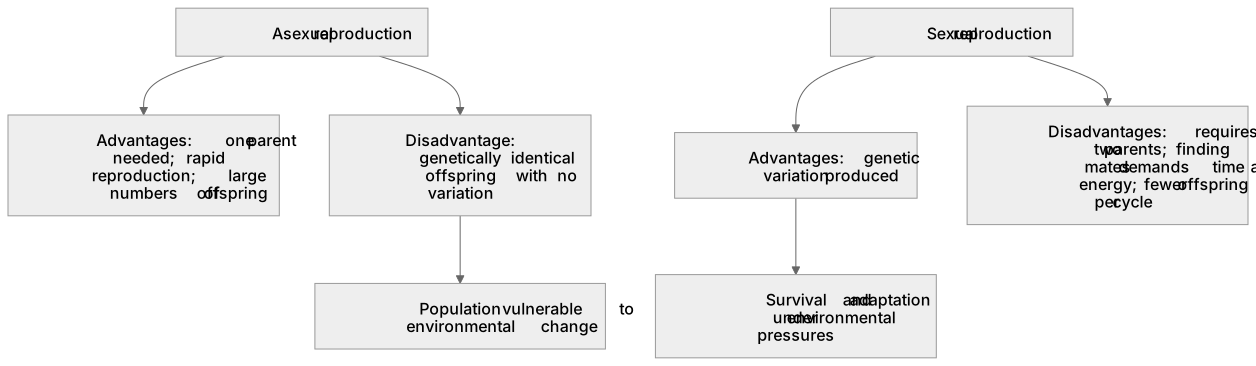
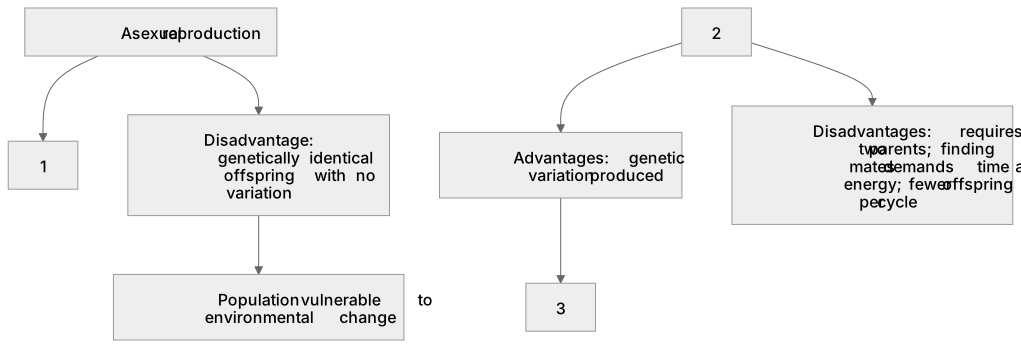
- State advantages of asexual reproduction: only one parent needed, rapid reproduction, and large numbers of offspring produced.
- State the disadvantage of asexual reproduction: genetically identical offspring with no variation, making populations vulnerable to environmental change.
- State advantages of sexual reproduction: genetic variation produced, enabling survival and adaptation under environmental pressures.
- State disadvantages of sexual reproduction: requires two parents, finding mates demands time and energy, and fewer offspring are produced per cycle.
Common mistakes and how to put them right
Stating asexual reproduction is always better because it is faster, ignoring the catastrophic risk of clonal populations being wiped out by a single pathogen.
Confusing mitosis with meiosis when identifying the cellular processes responsible for each reproductive mode.
Exam tips
- In comparison questions, structure your answer with paired statements: one advantage and one disadvantage for each reproductive method.
- Link genetic variation explicitly to survival when environmental conditions change or a new disease appears.
Try the lesson
The start of the Inheritance: explain some of the advantages and disadvantages of asexual and sexual reproduction in a range of organisms (to include: the number of live offspring per birth, how quickly the organisms can reproduce verses the need for the introduction of variation in a population caused by environmental pressures) (content found only in the biology separate science qualification) lesson, made from teaching notes for this specification point.
Have a go first
Which statement describes an advantage of asexual reproduction?
Listen
Reproductive strategies balance speed and offspring volume against genetic adaptability. Asexual reproduction involves a single parent generating genetically identical offspring by mitosis. It enables organisms to reproduce rapidly, producing numerous offspring to exploit stable, resource-rich habitats without wasting time or energy finding a mate. However, the lack of genetic variation leaves the entire population vulnerable to disease outbreaks or environmental change. Sexual reproduction involves the fusion of haploid gametes, generating genetic diversity through meiosis and random fertilisation. Although slower, variation allows populations to survive shifting environmental pressures. A strong answer earns marks for these points. State advantages of asexual reproduction: only one parent needed, rapid reproduction, and large numbers of offspring produced. State the disadvantage of asexual reproduction: genetically identical offspring with no variation, making populations vulnerable to environmental change. State advantages of sexual reproduction: genetic variation produced, enabling survival and adaptation under environmental pressures. State disadvantages of sexual reproduction: requires two parents, finding mates demands time and energy, and fewer offspring are produced per cycle. Exam tip: In comparison questions, structure your answer with paired statements: one advantage and one disadvantage for each reproductive method.
See it
Key words
Say what each word means before you turn the card.
asexual reproduction
Try answering aloud or in your head before turning the card.
sexual reproduction
Try answering aloud or in your head before turning the card.
genetic variation
Try answering aloud or in your head before turning the card.
environmental change
Try answering aloud or in your head before turning the card.
See every definition
- asexual reproduction
- Involves a single parent generating genetically identical offspring by mitosis, enabling organisms to reproduce rapidly and produce numerous offspring.
- sexual reproduction
- Involves the fusion of haploid gametes, generating genetic diversity through meiosis and random fertilisation, though it is slower.
- genetic variation
- Produced through meiosis and random fertilisation in sexual reproduction, allowing populations to survive shifting environmental pressures.
- environmental change
- A pressure to which populations of genetically identical offspring are vulnerable because they lack variation.
Label the diagram
Some boxes have lost their names. Pick the right name for each number.
1Box 1
2Box 2
3Box 3
There is more to this lesson
The full lesson goes on to check your understanding and help you earn the marks. Create a free account to carry on, with your progress saved.
A week of Premium from your first lesson · Then the free plan continues · No card, no charge
Test your understanding of Inheritance: explain some of the advantages and disadvantages of asexual and sexual reproduction in a range of organisms (to include: the number of live offspring per birth, how quickly the organisms can reproduce verses the need for the introduction of variation in a population caused by environmental pressures) (content found only in the biology separate science qualification)
Active recall beats re-reading. Take an instant quiz now to test what you’ve learned and lock it into long-term memory.
A week of Premium from your first lesson · Then the free plan continues · No card, no charge