OCR · GCSE · Biology
Course version: J247 · Version from Sept 2018
Understand and use direct proportions and simple ratios in genetic crosses
Full specification wording
Inheritance: understand and use direct proportions and simple ratios in genetic crosses
In monohybrid inheritance, offspring genotypes and phenotypes emerge in predictable numerical proportions governed by the random fusion of gametes.
- Point 1 of 16
- 4 key terms
Study notes
From the teaching notes for this specification point.
The idea
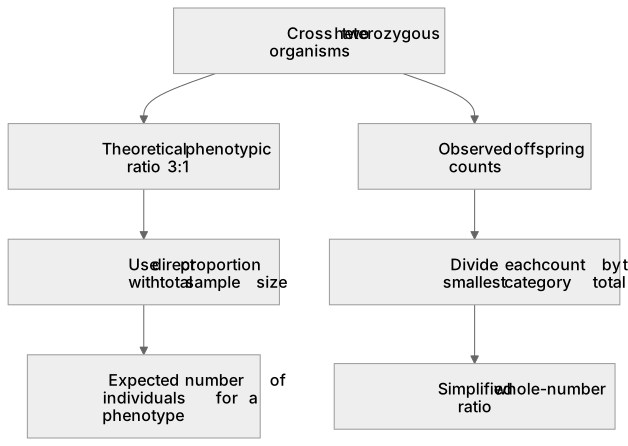
In monohybrid inheritance, offspring genotypes and phenotypes emerge in predictable numerical proportions governed by the random fusion of gametes. When two heterozygous organisms are crossed, the theoretical ratio of dominant to recessive phenotypes is 3 to 1. Learners must convert empirical counts into simplified whole-number ratios by dividing each observed frequency by the smallest value in the dataset. Direct proportion applies directly to breeding outcomes, as the expected number of individuals exhibiting a given trait scales in direct proportion with total sample size.
What earns the marks
- Divide observed numbers of each phenotype by the smallest category total to calculate the simplest whole-number ratio.
- State the theoretical 3:1 phenotypic ratio expected from a monohybrid cross between two heterozygous parents.
- Use direct proportion to calculate the expected frequency of a phenotype given the total number of offspring.
Common mistakes and how to put them right
Leaving calculated ratios in unsimplified fractions or decimals rather than standard lowest whole numbers like 3:1.
Expecting empirical counts from small breeding trials to match theoretical ratios exactly, failing to recognize statistical chance in fertilisation.
Exam tips
- Always divide every phenotype count by the lowest value and round sensibly to the nearest whole integer.
- Clearly write which phenotype corresponds to each number in the ratio, rather than writing isolated digits.
Try the lesson
The start of the Inheritance: understand and use direct proportions and simple ratios in genetic crosses lesson, made from teaching notes for this specification point.
Have a go first
A genetic cross produces offspring in the ratio 9:3:3:1. In a sample of 320 offspring, how many are expected in the largest group?
Listen
In monohybrid inheritance, offspring genotypes and phenotypes emerge in predictable numerical proportions governed by the random fusion of gametes. When two heterozygous organisms are crossed, the theoretical ratio of dominant to recessive phenotypes is 3 to 1. Learners must convert empirical counts into simplified whole-number ratios by dividing each observed frequency by the smallest value in the dataset. Direct proportion applies directly to breeding outcomes, as the expected number of individuals exhibiting a given trait scales in direct proportion with total sample size. A strong answer earns marks for these points. Divide observed numbers of each phenotype by the smallest category total to calculate the simplest whole-number ratio. State the theoretical 3:1 phenotypic ratio expected from a monohybrid cross between two heterozygous parents. Use direct proportion to calculate the expected frequency of a phenotype given the total number of offspring. Exam tip: Always divide every phenotype count by the lowest value and round sensibly to the nearest whole integer.
See it
Key words
Say what each word means before you turn the card.
monohybrid inheritance
Try answering aloud or in your head before turning the card.
phenotypic ratios
Try answering aloud or in your head before turning the card.
direct proportion
Try answering aloud or in your head before turning the card.
gamete fertilisation
Try answering aloud or in your head before turning the card.
See every definition
- monohybrid inheritance
- Offspring genotypes and phenotypes emerge in predictable numerical proportions governed by the random fusion of gametes.
- phenotypic ratios
- The theoretical ratio of dominant to recessive phenotypes from a cross between two heterozygous organisms is 3 to 1.
- direct proportion
- The expected number of individuals exhibiting a given trait scales in direct proportion with total sample size.
- gamete fertilisation
- Statistical chance in fertilisation means empirical counts from small breeding trials may not match theoretical ratios exactly.
Label the diagram
Some boxes have lost their names. Pick the right name for each number.
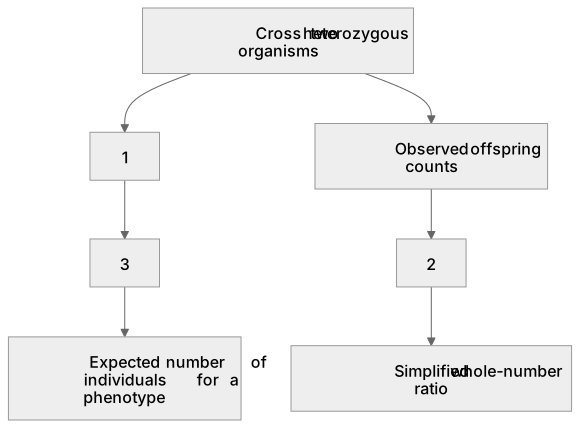
1Box 1
2Box 2
3Box 3
There is more to this lesson
The full lesson goes on to check your understanding and help you earn the marks. Create a free account to carry on, with your progress saved.
A week of Premium from your first lesson · Then the free plan continues · No card, no charge
Test your understanding of Inheritance: understand and use direct proportions and simple ratios in genetic crosses
Active recall beats re-reading. Take an instant quiz now to test what you’ve learned and lock it into long-term memory.
A week of Premium from your first lesson · Then the free plan continues · No card, no charge