OCR · GCSE · Biology
Course version: J247 · Version from Sept 2018
Understand and use the concept of probability in predicting the outcome of…
Full specification wording
Inheritance: understand and use the concept of probability in predicting the outcome of genetic crosses
Predicting the outcomes of genetic crosses relies fundamentally on the mathematics of probability.
- Point 2 of 16
- 4 key terms
Study notes
From the teaching notes for this specification point.
The idea
Predicting the outcomes of genetic crosses relies fundamentally on the mathematics of probability. Because gamete fusion is a random event, each fertilisation is completely independent of previous events. Probability can be expressed as a fraction such as one quarter, a decimal such as 0.25, or a percentage such as 25%. A common point of confusion is assuming previous offspring influence future births; if a heterozygous carrier couple has an affected child, the probability of their next child inheriting the condition remains strictly 25%.
What earns the marks
- Express genetic probabilities accurately as fractions, decimals, or percentages.
- State that each fertilisation event is independent of preceding fertilisation events.
- Determine the probability of an offspring inheriting a specific genotype or phenotype from a Punnett square.
Common mistakes and how to put them right
Believing that if parents have three unaffected children, the fourth child is guaranteed to be affected.
Confusing phenotypic probability (such as 75% dominant) with genotypic probability (such as 25% homozygous dominant).
Exam tips
- Check the question prompt to see whether the final probability must be given as a percentage, fraction, or ratio.
- Remember that each birth represents an independent trial with unchanged probabilities.
Try the lesson
The start of the Inheritance: understand and use the concept of probability in predicting the outcome of genetic crosses lesson, made from teaching notes for this specification point.
Have a go first
Two heterozygous parents (Bb × Bb) are crossed. What is the probability that an offspring will have the recessive phenotype (bb)?
Listen
Predicting the outcomes of genetic crosses relies fundamentally on the mathematics of probability. Because gamete fusion is a random event, each fertilisation is completely independent of previous events. Probability can be expressed as a fraction such as one quarter, a decimal such as 0.25, or a percentage such as 25%. A common point of confusion is assuming previous offspring influence future births; if a heterozygous carrier couple has an affected child, the probability of their next child inheriting the condition remains strictly 25%. A strong answer earns marks for these points. Express genetic probabilities accurately as fractions, decimals, or percentages. State that each fertilisation event is independent of preceding fertilisation events. Determine the probability of an offspring inheriting a specific genotype or phenotype from a Punnett square. Exam tip: Check the question prompt to see whether the final probability must be given as a percentage, fraction, or ratio.
See it
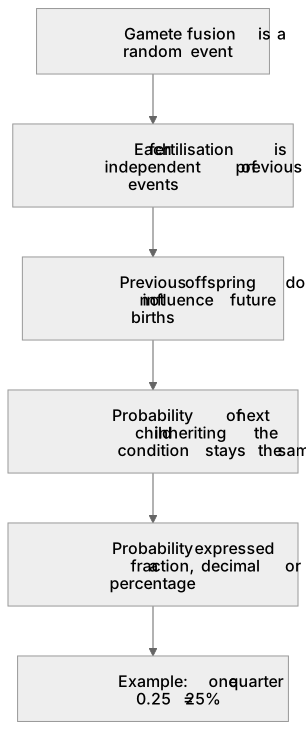
Put it in order
Put these steps in the order they happen.
- 1. Previous offspring do not influence future births
- 2. Each fertilisation is independent of previous events
- 3. Gamete fusion is a random event
- 4. Example: one quarter = 0.25 = 25%
- 5. Probability expressed as a fraction, decimal or percentage
- 6. Probability of next child inheriting the condition stays the same
Key words
Say what each word means before you turn the card.
genetic probability
Try answering aloud or in your head before turning the card.
independent events
Try answering aloud or in your head before turning the card.
punnett squares
Try answering aloud or in your head before turning the card.
inheritance risks
Try answering aloud or in your head before turning the card.
See every definition
- genetic probability
- Can be expressed as a fraction such as one quarter, a decimal such as 0.25, or a percentage such as 25%.
- independent events
- Each fertilisation is completely independent of previous events, so previous offspring do not influence future births.
- punnett squares
- Used to determine the probability of an offspring inheriting a specific genotype or phenotype.
- inheritance risks
- If a heterozygous carrier couple has an affected child, the probability of their next child inheriting the condition remains strictly 25%.
Label the diagram
Some boxes have lost their names. Pick the right name for each number.
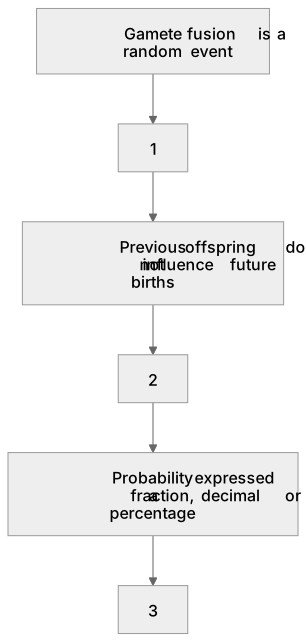
1Box 1
2Box 2
3Box 3
There is more to this lesson
The full lesson goes on to check your understanding and help you earn the marks. Create a free account to carry on, with your progress saved.
A week of Premium from your first lesson · Then the free plan continues · No card, no charge
Test your understanding of Inheritance: understand and use the concept of probability in predicting the outcome of genetic crosses
Active recall beats re-reading. Take an instant quiz now to test what you’ve learned and lock it into long-term memory.
A week of Premium from your first lesson · Then the free plan continues · No card, no charge