OCR · GCSE · Biology
Course version: J247 · Version from Sept 2018
Explain the response of the body to different temperature and osmotic…
Full specification wording
Maintaining internal environments: explain the response of the body to different temperature and osmotic challenges (to include: challenges to include high sweating and dehydration, excess water intake, high salt intake responses to include mechanism of kidney function, thirst) (content found only in the biology separate science qualification) (Higher tier only)
The body maintains homeostatic equilibrium through integrated neural, behavioural, and endocrine responses to physiological stress.
- Point 11 of 11
- 4 key terms
Study notes
From the teaching notes for this specification point.
The idea
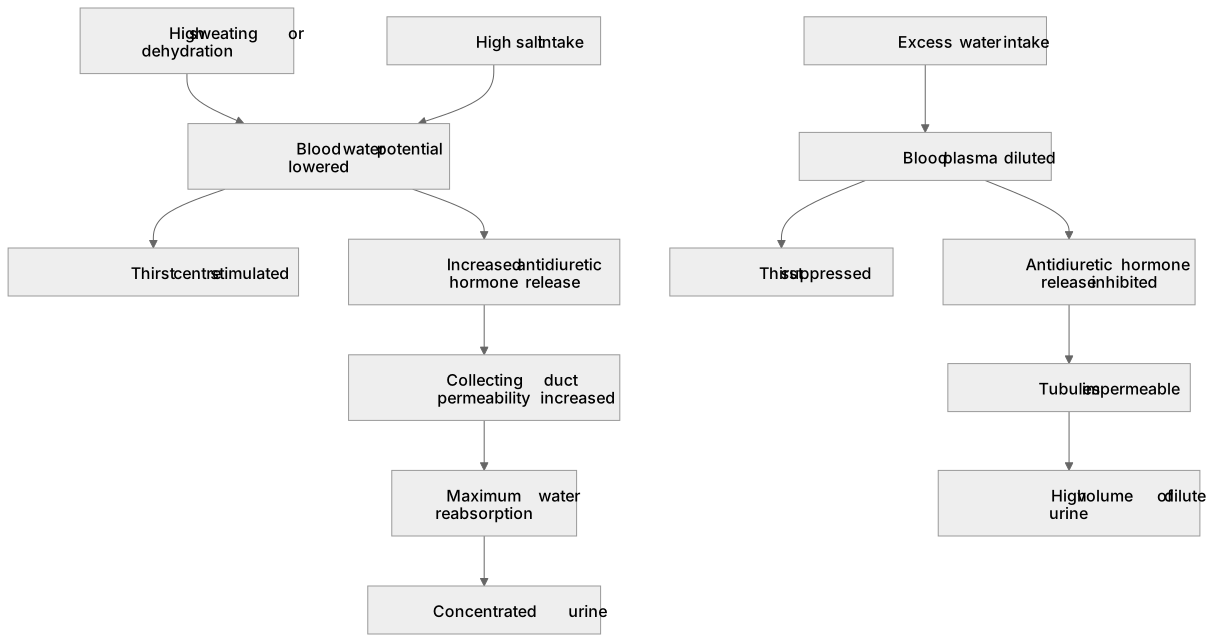
The body maintains homeostatic equilibrium through integrated neural, behavioural, and endocrine responses to physiological stress. During high temperatures or strenuous exercise, heavy sweating causes significant water loss, reducing blood water potential. Osmoreceptors detect this dehydration, triggering thirst to encourage drinking, while the pituitary releases more antidiuretic hormone so kidneys reabsorb maximum water, producing minimal concentrated urine. High salt intake also lowers blood water potential by adding solutes, eliciting thirst and elevated hormone secretion. Conversely, consuming excess water dilutes blood plasma; the hypothalamus suppresses thirst and inhibits hormone release, causing kidneys to produce a large volume of dilute urine.
What earns the marks
- Explain that high sweating or dehydration lowers blood water potential, stimulating the thirst centre and increasing antidiuretic hormone release.
- Describe kidney function during dehydration: increased collecting duct permeability leads to maximum water reabsorption and concentrated urine.
- Explain the response to excess water intake: suppressed antidiuretic hormone release makes tubules impermeable, causing high volumes of dilute urine.
- Describe the response to high salt intake: osmotic water movement out of cells triggers thirst and hormone release to dilute blood back to set point.
Common mistakes and how to put them right
Forgetting to mention behavioural responses, such as the activation of the hypothalamic thirst mechanism.
Assuming that high salt intake causes the body to excrete more water immediately, rather than conserving water to dilute hypertonic blood.
Failing to integrate skin cooling mechanisms with renal fluid conservation during thermal stress.
Exam tips
- Structure answers systematically: name the stimulus, state the change in blood water potential, identify the hypothalamic and pituitary response, and describe urine output.
- Always mention both the physiological kidney response (antidiuretic hormone changes) and the behavioural response (thirst stimulation).
Try the lesson
The start of the Maintaining internal environments: explain the response of the body to different temperature and osmotic challenges (to include: challenges to include high sweating and dehydration, excess water intake, high salt intake responses to include mechanism of kidney function, thirst) (content found only in the biology separate science qualification) (Higher tier only) lesson, made from teaching notes for this specification point.
Have a go first
After a long period of high sweating without drinking, which change in the blood is detected by the hypothalamus?
Listen
The body maintains homeostatic equilibrium through integrated neural, behavioural, and endocrine responses to physiological stress. During high temperatures or strenuous exercise, heavy sweating causes significant water loss, reducing blood water potential. Osmoreceptors detect this dehydration, triggering thirst to encourage drinking, while the pituitary releases more antidiuretic hormone so kidneys reabsorb maximum water, producing minimal concentrated urine. High salt intake also lowers blood water potential by adding solutes, eliciting thirst and elevated hormone secretion. Conversely, consuming excess water dilutes blood plasma; the hypothalamus suppresses thirst and inhibits hormone release, causing kidneys to produce a large volume of dilute urine. A strong answer earns marks for these points. explain that high sweating or dehydration lowers blood water potential, stimulating the thirst centre and increasing antidiuretic hormone release. describe kidney function during dehydration: increased collecting duct permeability leads to maximum water reabsorption and concentrated urine. explain the response to excess water intake: suppressed antidiuretic hormone release makes tubules impermeable, causing high volumes of dilute urine. describe the response to high salt intake: osmotic water movement out of cells triggers thirst and hormone release to dilute blood back to set point. Exam tip: Structure answers systematically: name the stimulus, state the change in blood water potential, identify the hypothalamic and pituitary response, and describe urine output.
See it
Key words
Say what each word means before you turn the card.
dehydration
Try answering aloud or in your head before turning the card.
thirst mechanism
Try answering aloud or in your head before turning the card.
integrated homeostasis
Try answering aloud or in your head before turning the card.
osmotic challenges
Try answering aloud or in your head before turning the card.
See every definition
- dehydration
- Heavy sweating causes significant water loss, reducing blood water potential, which osmoreceptors detect and which triggers thirst.
- thirst mechanism
- The hypothalamus stimulates thirst to encourage drinking when blood water potential falls, and suppresses it when excess water dilutes blood plasma.
- integrated homeostasis
- The body maintains homeostatic equilibrium through integrated neural, behavioural, and endocrine responses to physiological stress.
- osmotic challenges
- High sweating, dehydration, excess water intake and high salt intake are challenges to which the body responds by altering thirst and antidiuretic hormone release.
Label the diagram
Some boxes have lost their names. Pick the right name for each number.
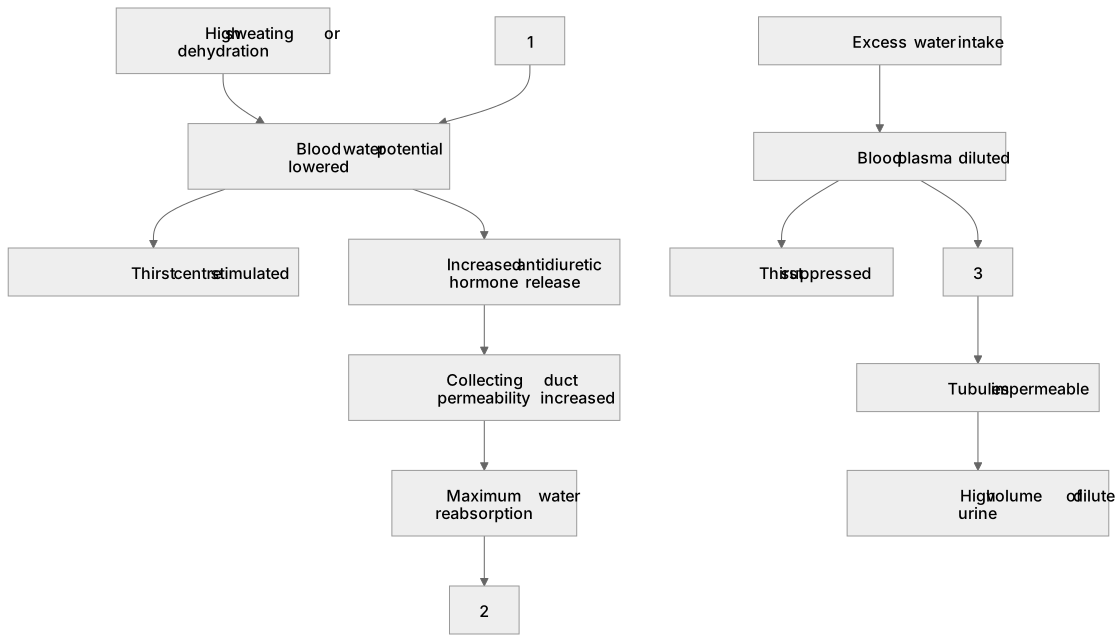
1Box 1
2Box 2
3Box 3
There is more to this lesson
The full lesson goes on to check your understanding and help you earn the marks. Create a free account to carry on, with your progress saved.
A week of Premium from your first lesson · Then the free plan continues · No card, no charge
Test your understanding of Maintaining internal environments: explain the response of the body to different temperature and osmotic challenges (to include: challenges to include high sweating and dehydration, excess water intake, high salt intake responses to include mechanism of kidney function, thirst) (content found only in the biology separate science qualification) (Higher tier only)
Active recall beats re-reading. Take an instant quiz now to test what you’ve learned and lock it into long-term memory.
A week of Premium from your first lesson · Then the free plan continues · No card, no charge