OCR · GCSE · Biology
Course version: J247 · Version from Sept 2018
Describe the effect of ADH on the permeability of the kidney tubules (to…
Full specification wording
Maintaining internal environments: describe the effect of ADH on the permeability of the kidney tubules (to include: amount of water reabsorbed and negative feedback) (content found only in the biology separate science qualification) (Higher tier only)
Antidiuretic hormone, synthesised by the hypothalamus and secreted by the posterior pituitary gland, regulates the water permeability of the kidney collecting ducts via negative feedback.
- Point 10 of 11
- 3 key terms
Study notes
From the teaching notes for this specification point.
The idea
Antidiuretic hormone, synthesised by the hypothalamus and secreted by the posterior pituitary gland, regulates the water permeability of the kidney collecting ducts via negative feedback. Osmoreceptors in the hypothalamus monitor the water potential of blood. When blood is too concentrated (low water potential), the pituitary secretes more antidiuretic hormone into the bloodstream. Antidiuretic hormone binds to receptors on the collecting duct walls, causing aquaporin channels to insert into cell membranes, increasing permeability to water. Water is reabsorbed by osmosis into medullary capillaries. Consequently, blood water potential rises back to normal, reducing further hormone secretion, while a small volume of concentrated urine is produced.
What earns the marks
- State that osmoreceptors in the hypothalamus detect a decrease in blood water potential, stimulating the pituitary to release antidiuretic hormone.
- Explain that antidiuretic hormone increases the permeability of collecting duct walls to water.
- Describe how increased permeability allows more water to be reabsorbed by osmosis from filtrate back into blood capillaries.
- Explain negative feedback: rising blood water potential inhibits antidiuretic hormone release, returning the system to its set point.
Common mistakes and how to put them right
Stating that antidiuretic hormone decreases water reabsorption, forgetting that 'antidiuretic' means opposing diuresis (water excretion).
Claiming antidiuretic hormone is produced and secreted solely by the kidney tubules rather than by the pituitary gland.
Omitting the negative feedback loop that shuts off hormone release once normal blood water potential is restored.
Exam tips
- Remember that high antidiuretic hormone means high collecting duct permeability, maximum water reabsorption, and concentrated urine.
- When blood water potential is high (dilute blood), less antidiuretic hormone is released, the ducts become impermeable, and dilute urine is formed.
Try the lesson
The start of the Maintaining internal environments: describe the effect of ADH on the permeability of the kidney tubules (to include: amount of water reabsorbed and negative feedback) (content found only in the biology separate science qualification) (Higher tier only) lesson, made from teaching notes for this specification point.
Have a go first
What effect does a high concentration of ADH have on the collecting duct?
Listen
Antidiuretic hormone, synthesised by the hypothalamus and secreted by the posterior pituitary gland, regulates the water permeability of the kidney collecting ducts via negative feedback. Osmoreceptors in the hypothalamus monitor the water potential of blood. When blood is too concentrated (low water potential), the pituitary secretes more antidiuretic hormone into the bloodstream. Antidiuretic hormone binds to receptors on the collecting duct walls, causing aquaporin channels to insert into cell membranes, increasing permeability to water. Water is reabsorbed by osmosis into medullary capillaries. Consequently, blood water potential rises back to normal, reducing further hormone secretion, while a small volume of concentrated urine is produced. A strong answer earns marks for these points. state that osmoreceptors in the hypothalamus detect a decrease in blood water potential, stimulating the pituitary to release antidiuretic hormone. explain that antidiuretic hormone increases the permeability of collecting duct walls to water. describe how increased permeability allows more water to be reabsorbed by osmosis from filtrate back into blood capillaries. explain negative feedback: rising blood water potential inhibits antidiuretic hormone release, returning the system to its set point. Exam tip: Remember that high antidiuretic hormone means high collecting duct permeability, maximum water reabsorption, and concentrated urine.
See it
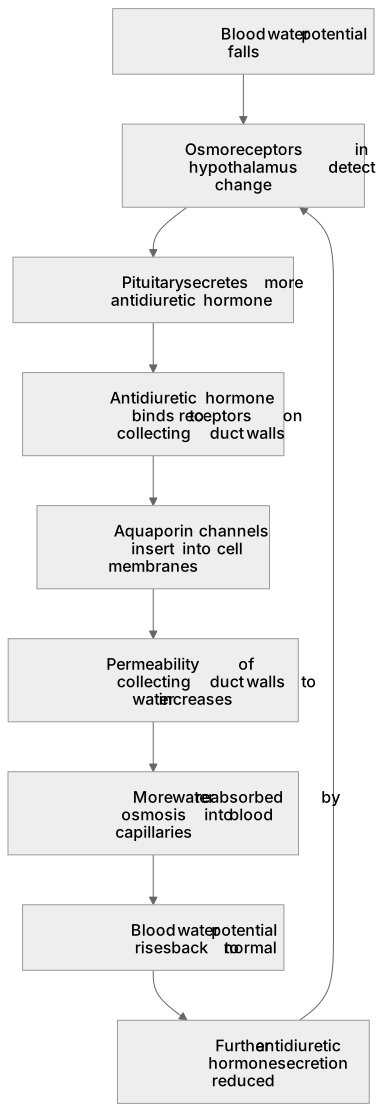
Key words
Say what each word means before you turn the card.
antidiuretic hormone
Try answering aloud or in your head before turning the card.
collecting duct permeability
Try answering aloud or in your head before turning the card.
negative feedback
Try answering aloud or in your head before turning the card.
See every definition
- antidiuretic hormone
- Synthesised by the hypothalamus and secreted by the posterior pituitary gland, it regulates the water permeability of the kidney collecting ducts.
- collecting duct permeability
- Increased when antidiuretic hormone binds to receptors on the collecting duct walls, causing aquaporin channels to insert into cell membranes.
- negative feedback
- Rising blood water potential inhibits antidiuretic hormone release, returning the system to its set point.
Label the diagram
Some boxes have lost their names. Pick the right name for each number.
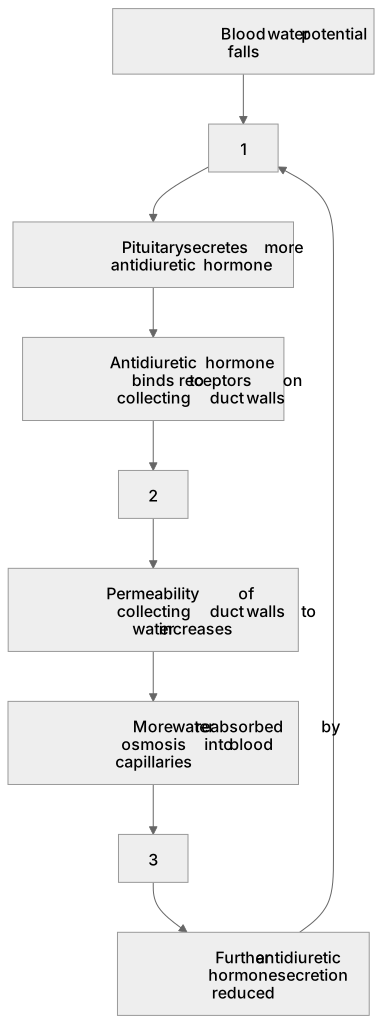
1Box 1
2Box 2
3Box 3
There is more to this lesson
The full lesson goes on to check your understanding and help you earn the marks. Create a free account to carry on, with your progress saved.
A week of Premium from your first lesson · Then the free plan continues · No card, no charge
Test your understanding of Maintaining internal environments: describe the effect of ADH on the permeability of the kidney tubules (to include: amount of water reabsorbed and negative feedback) (content found only in the biology separate science qualification) (Higher tier only)
Active recall beats re-reading. Take an instant quiz now to test what you’ve learned and lock it into long-term memory.
A week of Premium from your first lesson · Then the free plan continues · No card, no charge