OCR · GCSE · Biology
Course version: J247 · Version from Sept 2018
Use of appropriate apparatus to make and record a range of measurements…
Full specification wording
Microbiological techniques: Use of appropriate apparatus to make and record a range of measurements accurately, including length, area, mass, time, temperature, volume of liquids and gases, and pH
Quantitative microbiology requires accurate measurement of many parameters.
- Point 4 of 4
- 4 key terms
Study notes
From the teaching notes for this specification point.
The idea
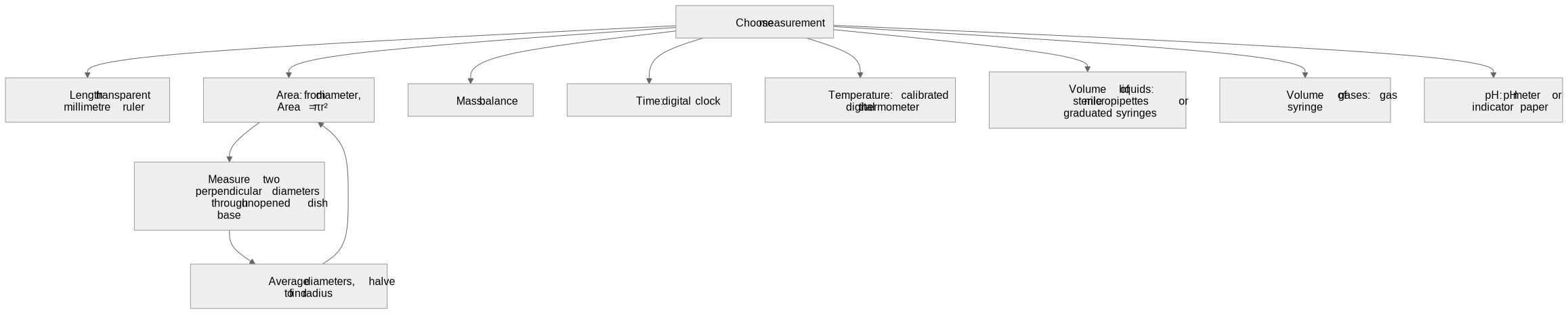
Quantitative microbiology requires accurate measurement of many parameters. Liquid culture volumes are transferred with sterile graduated micropipettes or syringes (e.g. 0.1 cm³) to give uniform lawns. Clear zones of inhibition are measured with a transparent millimetre ruler through the base of the inverted, unopened petri dish; two perpendicular diameters are averaged and area found using Area = πr². Mass is recorded with a balance, for example when weighing agar powder or a filter-paper disc. Time is timed with a digital clock over 24 to 48 hours, and temperature is checked with a calibrated digital thermometer at 25 °C. Gas volumes may be collected in a gas syringe, and pH is measured with a pH meter or indicator paper to check media or buffer solutions.
What earns the marks
- Dispense precise volumes of bacterial culture (e.g. 0.1 cm³) using sterile micropipettes or graduated syringes to produce uniform lawns.
- Measure zone of inhibition diameters through the bottom of the unopened petri dish to the nearest millimetre using a transparent ruler.
- Calculate mean diameter from perpendicular measurements and determine zone area using the equation Area = πr².
- Record mass with a balance, for example when weighing agar or filter-paper discs, and measure pH with a pH meter or indicator paper.
- Monitor and record incubation temperature with a digital thermometer (25 °C) and time the incubation period over 24 to 48 hours.
Common mistakes and how to put them right
Opening the lid of the petri dish after incubation to measure inhibition zones, releasing potentially hazardous cultured bacteria into the room.
Using the diameter instead of the radius in the area formula Area = πr², overestimating the clear zone area by a factor of four.
Dispensing unmeasured volumes of bacterial suspension onto agar plates, resulting in uneven lawn thickness and irregular diffusion zones.
Recording pH with a meter that has not been calibrated, or reading a meniscus at eye level incorrectly when measuring liquid volume.
Exam tips
- Always note that measurements of inhibition zones are taken without opening the lid, ensuring safety and containment of cultured microorganisms.
- Show all calculation steps clearly: state diameter, divide by 2 to find radius, then calculate πr² with correct units (mm²).
- Match each measurement to its apparatus: ruler for length, balance for mass, clock for time, thermometer for temperature, syringe for gas volume, pH meter for pH.
Try the lesson
The start of the Microbiological techniques: Use of appropriate apparatus to make and record a range of measurements accurately, including length, area, mass, time, temperature, volume of liquids and gases, and pH lesson, made from teaching notes for this specification point.
Have a go first
Which piece of apparatus should be used to measure the volume of liquid culture accurately during a microbiology practical?
Listen
Quantitative microbiology requires accurate measurement of many parameters. Liquid culture volumes are transferred with sterile graduated micropipettes or syringes (e.g. 0.1 cm³) to give uniform lawns. Clear zones of inhibition are measured with a transparent millimetre ruler through the base of the inverted, unopened petri dish; two perpendicular diameters are averaged and area found using Area = πr². Mass is recorded with a balance, for example when weighing agar powder or a filter-paper disc. Time is timed with a digital clock over 24 to 48 hours, and temperature is checked with a calibrated digital thermometer at 25 °C. Gas volumes may be collected in a gas syringe, and pH is measured with a pH meter or indicator paper to check media or buffer solutions. A strong answer earns marks for these points. Dispense precise volumes of bacterial culture (e.g. 0.1 cm³) using sterile micropipettes or graduated syringes to produce uniform lawns. Measure zone of inhibition diameters through the bottom of the unopened petri dish to the nearest millimetre using a transparent ruler. Calculate mean diameter from perpendicular measurements and determine zone area using the equation Area = πr². Record mass with a balance, for example when weighing agar or filter-paper discs, and measure pH with a pH meter or indicator paper. Exam tip: Always note that measurements of inhibition zones are taken without opening the lid, ensuring safety and containment of cultured microorganisms.
See it
Key words
Say what each word means before you turn the card.
sterile micropipette
Try answering aloud or in your head before turning the card.
safe zone measurement through closed dish
Try answering aloud or in your head before turning the card.
perpendicular diameter averaging and area calculation
Try answering aloud or in your head before turning the card.
mass, gas volume and pH measurement
Try answering aloud or in your head before turning the card.
See every definition
- sterile micropipette
- Used to dispense precise volumes of bacterial culture, for example 0.1 cm³, to produce uniform lawns.
- safe zone measurement through closed dish
- Zone of inhibition diameters are measured through the bottom of the unopened petri dish to the nearest millimetre using a transparent ruler.
- perpendicular diameter averaging and area calculation
- Mean diameter is calculated from perpendicular measurements and zone area is determined using the equation Area = πr².
- mass, gas volume and pH measurement
- Mass is recorded with a balance, gas volumes may be collected in a gas syringe, and pH is measured with a pH meter or indicator paper.
Label the diagram
Some boxes have lost their names. Pick the right name for each number.
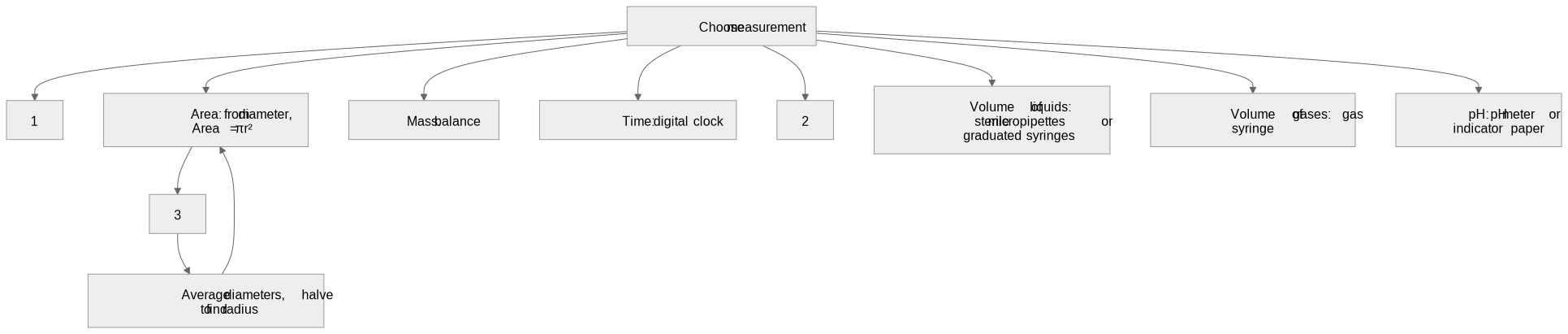
1Box 1
2Box 2
3Box 3
There is more to this lesson
The full lesson goes on to check your understanding and help you earn the marks. Create a free account to carry on, with your progress saved.
A week of Premium from your first lesson · Then the free plan continues · No card, no charge
Test your understanding of Microbiological techniques: Use of appropriate apparatus to make and record a range of measurements accurately, including length, area, mass, time, temperature, volume of liquids and gases, and pH
Active recall beats re-reading. Take an instant quiz now to test what you’ve learned and lock it into long-term memory.
A week of Premium from your first lesson · Then the free plan continues · No card, no charge