OCR · GCSE · Biology
Course version: J247 · Version from Sept 2018
Use of appropriate apparatus to make and record a range of measurements…
Full specification wording
Microscopy: Use of appropriate apparatus to make and record a range of measurements accurately, including length, area, mass, time, temperature, volume of liquids and gases, and pH
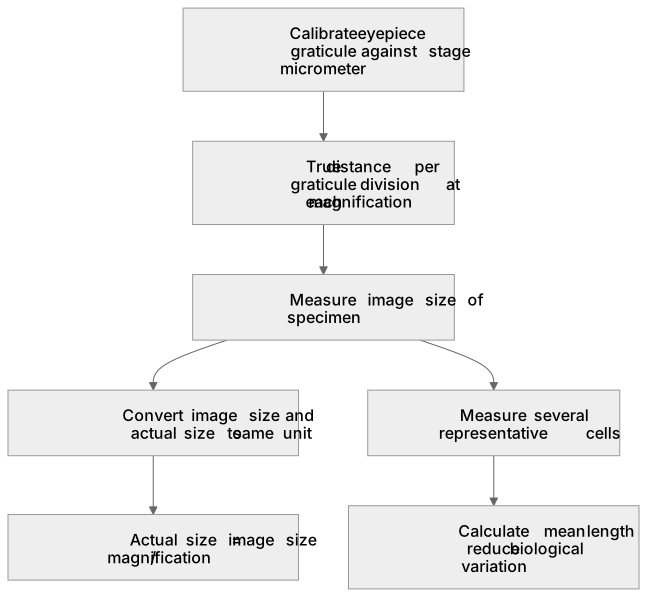
Microscopy measurements use an eyepiece graticule calibrated against a stage micrometer of known scale, giving the true value of each graticule division at a stated objective.
- Point 2 of 2
- 4 key terms
Study notes
From the teaching notes for this specification point.
The idea
Microscopy measurements use an eyepiece graticule calibrated against a stage micrometer of known scale, giving the true value of each graticule division at a stated objective. Actual size is found from actual size = image size / magnification (A = I / M), with all lengths in the same unit; convert mm to micrometres and micrometres to nanometres by multiplying by 1000. Repeating measurements on several randomly selected cells and calculating a mean reduces the effect of natural variation. The same practical skills cover other quantities: area by counting squares or using length x width, mass with a balance, time with a stopwatch, temperature with a thermometer, liquid volume with a measuring cylinder, gas volume by displacement or a syringe, and pH with a calibrated pH probe (universal indicator gives an approximate value).
What earns the marks
- Calibrate the eyepiece graticule against a stage micrometer to find the true distance per graticule division at each magnification.
- Calculate actual specimen size using actual size = image size / magnification, ensuring image size and actual size share the same unit.
- Convert millimetres to micrometres by multiplying by 1000, and micrometres to nanometres by multiplying by 1000.
- Measure several representative cells across the field of view and calculate a mean length to reduce the effect of biological variation.
- Record area by counting grid squares or multiplying measured length by width, and state units for physical measurements; pH is dimensionless.
Common mistakes and how to put them right
Forgetting to convert image size and actual size into matching units before using the magnification formula.
Put it right by converting both to the same unit first.
Assuming eyepiece graticule divisions represent a fixed distance without calibrating against a stage micrometer for each objective lens.
Put it right by recalibrating at each magnification.
Measuring only a single atypical cell rather than calculating a mean from multiple measurements.
Put it right by sampling several cells and averaging.
Recording a number without a unit, or reading a measuring cylinder from the wrong part of the meniscus.
Put it right by reading the bottom of the meniscus at eye level and stating units for physical measurements; pH has no unit.
Exam tips
- Use the formula triangle with Image size at the top, and Actual size and Magnification at the bottom to rearrange calculations easily.
- Always check unit prefixes carefully: 1 mm = 1000 µm, and 1 µm = 1000 nm. Convert both measurements to matching units before calculating magnification.
Try the lesson
The start of the Microscopy: Use of appropriate apparatus to make and record a range of measurements accurately, including length, area, mass, time, temperature, volume of liquids and gases, and pH lesson, made from teaching notes for this specification point.
Have a go first
Which piece of apparatus is used to measure the volume of a liquid accurately?
Listen
Microscopy measurements use an eyepiece graticule calibrated against a stage micrometer of known scale, giving the true value of each graticule division at a stated objective. Actual size is found from actual size = image size / magnification (A = I / M), with all lengths in the same unit; convert mm to micrometres and micrometres to nanometres by multiplying by 1000. Repeating measurements on several randomly selected cells and calculating a mean reduces the effect of natural variation. The same practical skills cover other quantities: area by counting squares or using length x width, mass with a balance, time with a stopwatch, temperature with a thermometer, liquid volume with a measuring cylinder, gas volume by displacement or a syringe, and pH with a calibrated pH probe (universal indicator gives an approximate value). A strong answer earns marks for these points. Calibrate the eyepiece graticule against a stage micrometer to find the true distance per graticule division at each magnification. Calculate actual specimen size using actual size = image size / magnification, ensuring image size and actual size share the same unit. Convert millimetres to micrometres by multiplying by 1000, and micrometres to nanometres by multiplying by 1000. Measure several representative cells across the field of view and calculate a mean length to reduce the effect of biological variation. A common slip: Forgetting to convert image size and actual size into matching units before using the magnification formula. Instead, converting both to the same unit first. Exam tip: Use the formula triangle with Image size at the top, and Actual size and Magnification at the bottom to rearrange calculations easily.
See it
Key words
Say what each word means before you turn the card.
eyepiece graticule calibration
Try answering aloud or in your head before turning the card.
magnification formula calculations
Try answering aloud or in your head before turning the card.
unit conversions in microscopy
Try answering aloud or in your head before turning the card.
mean cell dimensions
Try answering aloud or in your head before turning the card.
See every definition
- eyepiece graticule calibration
- Calibrating the eyepiece graticule against a stage micrometer gives the true distance per graticule division at each magnification.
- magnification formula calculations
- Actual size is found from actual size = image size / magnification, with image size and actual size in the same unit.
- unit conversions in microscopy
- Convert millimetres to micrometres by multiplying by 1000, and micrometres to nanometres by multiplying by 1000.
- mean cell dimensions
- Measuring several representative cells across the field of view and calculating a mean length reduces the effect of biological variation.
Label the diagram
Some boxes have lost their names. Pick the right name for each number.
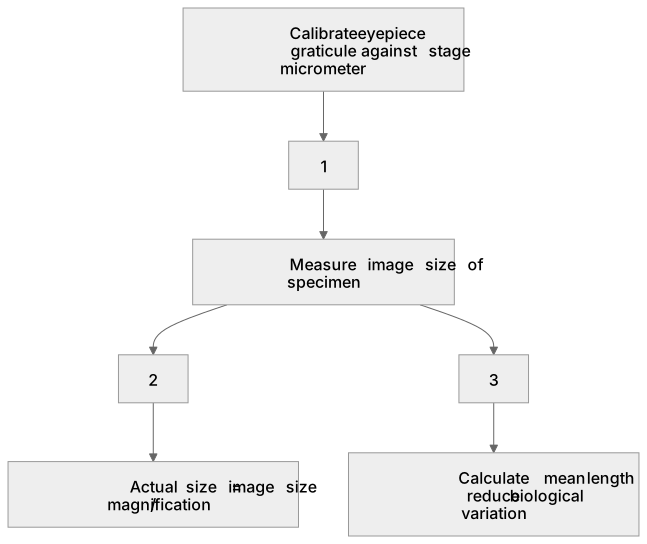
1Box 1
2Box 2
3Box 3
There is more to this lesson
The full lesson goes on to check your understanding and help you earn the marks. Create a free account to carry on, with your progress saved.
A week of Premium from your first lesson · Then the free plan continues · No card, no charge
Test your understanding of Microscopy: Use of appropriate apparatus to make and record a range of measurements accurately, including length, area, mass, time, temperature, volume of liquids and gases, and pH
Active recall beats re-reading. Take an instant quiz now to test what you’ve learned and lock it into long-term memory.
A week of Premium from your first lesson · Then the free plan continues · No card, no charge