OCR · GCSE · Biology
Course version: J247 · Version from Sept 2018
Describe the relationship between health and disease
Full specification wording
Monitoring and maintaining health: describe the relationship between health and disease
Health is defined by the World Health Organization as a state of complete physical, mental, and social well-being, rather than merely the absence of disease or infirmity.
- Point 6 of 29
- 3 key terms
Study notes
From the teaching notes for this specification point.
The idea
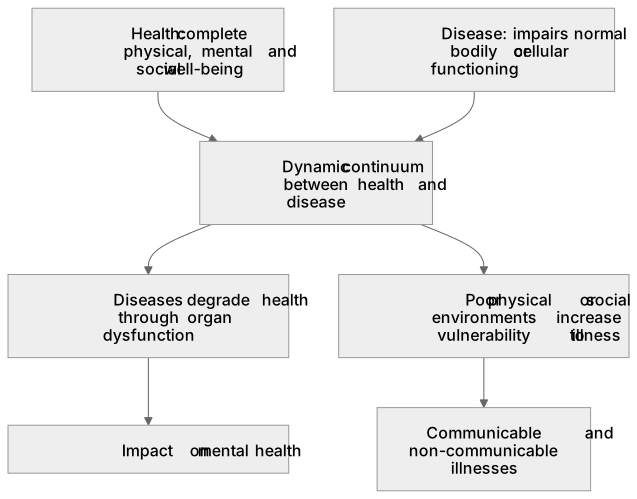
Health is defined by the World Health Organization as a state of complete physical, mental, and social well-being, rather than merely the absence of disease or infirmity. A disease is a physiological or psychological condition that impairs normal bodily or cellular functioning, producing characteristic clinical symptoms and signs. Health and disease exist along a dynamic continuum: diseases degrade overall health directly through organ dysfunction, while poor physical or social environments increase vulnerability to developing communicable and non-communicable illnesses.
What earns the marks
- Define health as a state of complete physical, mental, and social well-being, not just the absence of disease.
- Define disease as a disorder that impairs the normal physical or cellular functioning of an organism.
- Describe the relationship between health and disease as a dynamic balance influenced by biological and environmental factors.
Common mistakes and how to put them right
Defining health simply as not being sick, omitting mental and social components of well-being.
Assuming diseases only affect physical organs, ignoring the profound impact on mental health.
Exam tips
- Memorise the WHO definition: complete physical, mental, and social well-being.
- Be prepared to explain how poor physical health can lead to mental health disorders such as depression.
Try the lesson
The start of the Monitoring and maintaining health: describe the relationship between health and disease lesson, made from teaching notes for this specification point.
Have a go first
Which statement describes how health and disease are related?
Listen
Health is defined by the World Health Organization as a state of complete physical, mental, and social well-being, rather than merely the absence of disease or infirmity. A disease is a physiological or psychological condition that impairs normal bodily or cellular functioning, producing characteristic clinical symptoms and signs. Health and disease exist along a dynamic continuum: diseases degrade overall health directly through organ dysfunction, while poor physical or social environments increase vulnerability to developing communicable and non-communicable illnesses. A strong answer earns marks for these points. Define health as a state of complete physical, mental, and social well-being, not just the absence of disease. Define disease as a disorder that impairs the normal physical or cellular functioning of an organism. Describe the relationship between health and disease as a dynamic balance influenced by biological and environmental factors. Exam tip: Memorise the WHO definition: complete physical, mental, and social well-being.
See it
Key words
Say what each word means before you turn the card.
health
Try answering aloud or in your head before turning the card.
disease
Try answering aloud or in your head before turning the card.
health and disease
Try answering aloud or in your head before turning the card.
See every definition
- health
- A state of complete physical, mental, and social well-being, rather than merely the absence of disease or infirmity.
- disease
- A physiological or psychological condition that impairs normal bodily or cellular functioning, producing characteristic clinical symptoms and signs.
- health and disease
- A dynamic continuum in which diseases degrade overall health directly through organ dysfunction, while poor physical or social environments increase vulnerability to illnesses.
Label the diagram
Some boxes have lost their names. Pick the right name for each number.
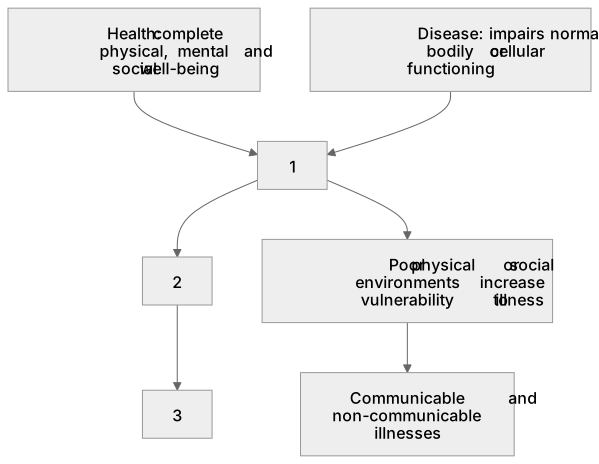
1Box 1
2Box 2
3Box 3
There is more to this lesson
The full lesson goes on to check your understanding and help you earn the marks. Create a free account to carry on, with your progress saved.
A week of Premium from your first lesson · Then the free plan continues · No card, no charge
Test your understanding of Monitoring and maintaining health: describe the relationship between health and disease
Active recall beats re-reading. Take an instant quiz now to test what you’ve learned and lock it into long-term memory.
A week of Premium from your first lesson · Then the free plan continues · No card, no charge