OCR · GCSE · Biology
Course version: J247 · Version from Sept 2018
Calculate cross-sectional areas of bacterial cultures and clear agar jelly…
Full specification wording
Monitoring and maintaining health: calculate cross-sectional areas of bacterial cultures and clear agar jelly using πr²
In microbiological assays testing antiseptic or antibiotic efficacy, filter paper discs soaked in antimicrobial agents are placed on inoculated agar lawns.
- Point 5 of 29
- 3 key terms
Study notes
From the teaching notes for this specification point.
The idea
In microbiological assays testing antiseptic or antibiotic efficacy, filter paper discs soaked in antimicrobial agents are placed on inoculated agar lawns. Clear circular zones of inhibition form where bacterial growth is prevented. To quantify antimicrobial potency, candidates measure the diameter across two perpendicular axes, divide by two to calculate the radius r, and apply the formula A = πr² to determine the cross-sectional area in mm². Larger clear zones indicate greater antimicrobial effectiveness against the cultured bacterial strain.
What earns the marks
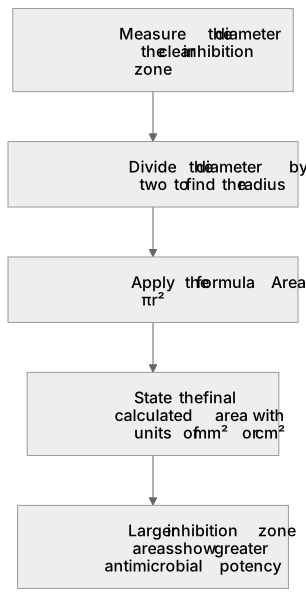
- Measure the diameter of the clear inhibition zone and divide by two to find the radius r.
- Apply the formula Area = πr² to calculate the cross-sectional area of clear agar or bacterial colonies.
- State the final calculated area with appropriate metric units (mm² or cm²) and significant figures.
- Conclude that larger inhibition zone areas demonstrate greater antimicrobial or antibiotic potency.
Common mistakes and how to put them right
Squaring the diameter directly in the formula rather than first halving it to find the radius.
Writing incorrect units such as mm rather than mm² for cross-sectional area.
Exam tips
- Always divide the measured diameter by 2 first to get the radius before squaring.
- Use the π button on your calculator or 3.142 as specified in the exam paper, and quote your answer with units of mm².
Try the lesson
The start of the Monitoring and maintaining health: calculate cross-sectional areas of bacterial cultures and clear agar jelly using πr² lesson, made from teaching notes for this specification point.
Have a go first
A circular bacterial culture has a radius of 3 cm. Using the formula for the area of a circle, A = πr², what is the cross-sectional area of the culture? Use the approximation π = 3.14.
Listen
In microbiological assays testing antiseptic or antibiotic efficacy, filter paper discs soaked in antimicrobial agents are placed on inoculated agar lawns. Clear circular zones of inhibition form where bacterial growth is prevented. To quantify antimicrobial potency, candidates measure the diameter across two perpendicular axes, divide by two to calculate the radius r, and apply the formula A = πr² to determine the cross-sectional area in mm². Larger clear zones indicate greater antimicrobial effectiveness against the cultured bacterial strain. A strong answer earns marks for these points. Measure the diameter of the clear inhibition zone and divide by two to find the radius r. Apply the formula Area = πr² to calculate the cross-sectional area of clear agar or bacterial colonies. State the final calculated area with appropriate metric units (mm² or cm²) and significant figures. Conclude that larger inhibition zone areas demonstrate greater antimicrobial or antibiotic potency. Exam tip: Always divide the measured diameter by 2 first to get the radius before squaring.
See it
Put it in order
Put these steps in the order they happen.
- 1. Divide the diameter by two to find the radius r
- 2. Apply the formula Area = πr²
- 3. Measure the diameter of the clear inhibition zone
- 4. Larger inhibition zone areas show greater antimicrobial potency
- 5. State the final calculated area with units of mm² or cm²
Key words
Say what each word means before you turn the card.
zones of inhibition
Try answering aloud or in your head before turning the card.
cross-sectional area calculation
Try answering aloud or in your head before turning the card.
microbiological assays
Try answering aloud or in your head before turning the card.
See every definition
- zones of inhibition
- Clear circular areas that form where bacterial growth is prevented on inoculated agar lawns.
- cross-sectional area calculation
- Applying the formula A = πr² to determine the area in mm², after dividing the measured diameter by two to find the radius r.
- microbiological assays
- Tests of antiseptic or antibiotic efficacy in which filter paper discs soaked in antimicrobial agents are placed on inoculated agar lawns.
Label the diagram
Some boxes have lost their names. Pick the right name for each number.
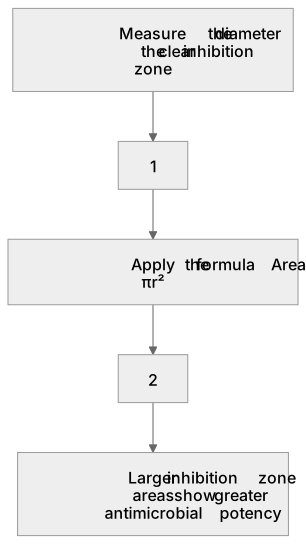
1Box 1
2Box 2
There is more to this lesson
The full lesson goes on to check your understanding and help you earn the marks. Create a free account to carry on, with your progress saved.
A week of Premium from your first lesson · Then the free plan continues · No card, no charge
Test your understanding of Monitoring and maintaining health: calculate cross-sectional areas of bacterial cultures and clear agar jelly using πr²
Active recall beats re-reading. Take an instant quiz now to test what you’ve learned and lock it into long-term memory.
A week of Premium from your first lesson · Then the free plan continues · No card, no charge