OCR · GCSE · Biology
Course version: J247 · Version from Sept 2018
Discuss the potential importance for medicine of our increasing…
Full specification wording
Monitoring and maintaining health: discuss the potential importance for medicine of our increasing understanding of the human genome (to include: the ideas of predicting the likelihood of diseases occurring and their treatment by drugs which are targeted to genomes)
The sequencing of the human genome has transformed clinical medicine.
- Point 29 of 29
- 4 key terms
Study notes
From the teaching notes for this specification point.
The idea
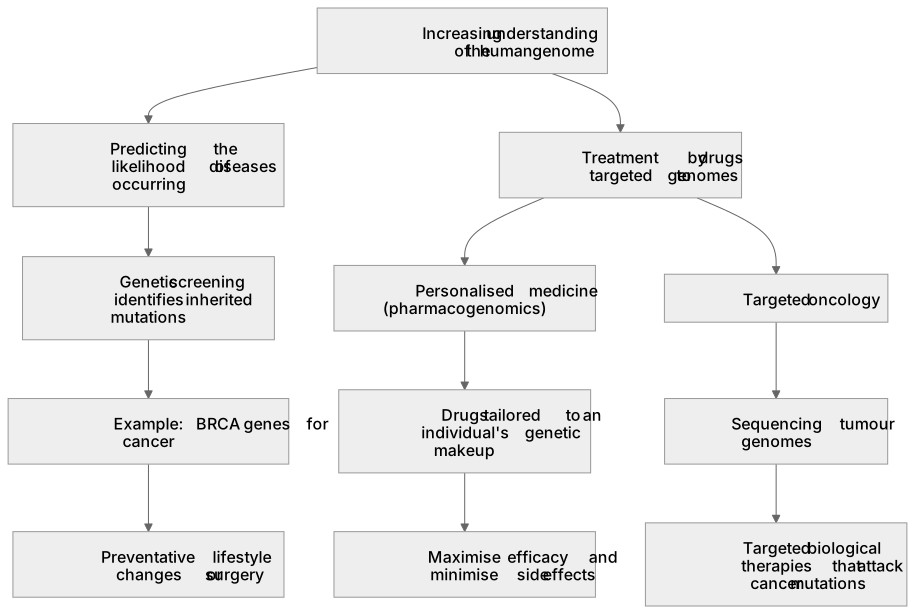
The sequencing of the human genome has transformed clinical medicine. Genomic understanding allows predicting an individual lifetime likelihood of developing non-communicable illnesses by screening for specific mutations, such as BRCA1 and BRCA2 alleles elevating breast and ovarian cancer risk, enabling proactive clinical screening or surgery. Furthermore, genomic insight underpins personalised medicine (pharmacogenomics), where drug selection and dosages are targeted to a patient specific genetic profile, optimising therapeutic efficacy while minimising adverse drug reactions. In oncology, tumour genome sequencing identifies driver mutations, allowing targeted biological therapies that selectively destroy cancer cells with minimal collateral damage.
What earns the marks
- Discuss predicting disease risk: genetic screening identifies inherited mutations (such as BRCA genes for cancer), enabling preventative lifestyle changes or surgery.
- Discuss personalised medicine (pharmacogenomics): designing and prescribing drugs tailored to an individual specific genetic makeup to maximize efficacy and minimize side effects.
- Discuss targeted oncology: sequencing tumour genomes to select targeted biological therapies that specifically attack cancer mutations.
- Identify ethical and social concerns: genetic discrimination by insurers or employers, and psychological anxiety caused by predicting incurable conditions.
Common mistakes and how to put them right
Assuming carrying a faulty allele like BRCA guarantees developing cancer, rather than indicating an elevated statistical risk.
Ignoring ethical concerns like genetic privacy and the psychological distress of knowing one has high risk for an incurable disease.
Exam tips
- Use the terms personalised medicine and targeted drugs when answering questions on the future of genomics in healthcare.
- Cite BRCA gene screening as a real-world example of predicting disease likelihood and guiding preventative clinical care.
Try the lesson
The start of the Monitoring and maintaining health: discuss the potential importance for medicine of our increasing understanding of the human genome (to include: the ideas of predicting the likelihood of diseases occurring and their treatment by drugs which are targeted to genomes) lesson, made from teaching notes for this specification point.
Have a go first
What is meant by the human genome?
Listen
The sequencing of the human genome has transformed clinical medicine. Genomic understanding allows predicting an individual lifetime likelihood of developing non-communicable illnesses by screening for specific mutations, such as BRCA1 and BRCA2 alleles elevating breast and ovarian cancer risk, enabling proactive clinical screening or surgery. Furthermore, genomic insight underpins personalised medicine (pharmacogenomics), where drug selection and dosages are targeted to a patient specific genetic profile, optimising therapeutic efficacy while minimising adverse drug reactions. In oncology, tumour genome sequencing identifies driver mutations, allowing targeted biological therapies that selectively destroy cancer cells with minimal collateral damage. A strong answer earns marks for these points. Discuss predicting disease risk: genetic screening identifies inherited mutations (such as BRCA genes for cancer), enabling preventative lifestyle changes or surgery. Discuss personalised medicine (pharmacogenomics): designing and prescribing drugs tailored to an individual specific genetic makeup to maximize efficacy and minimize side effects. Discuss targeted oncology: sequencing tumour genomes to select targeted biological therapies that specifically attack cancer mutations. Identify ethical and social concerns: genetic discrimination by insurers or employers, and psychological anxiety caused by predicting incurable conditions. Exam tip: Use the terms personalised medicine and targeted drugs when answering questions on the future of genomics in healthcare.
See it
Key words
Say what each word means before you turn the card.
predictive genetic screening
Try answering aloud or in your head before turning the card.
personalised medicine
Try answering aloud or in your head before turning the card.
pharmacogenomics
Try answering aloud or in your head before turning the card.
targeted cancer drugs
Try answering aloud or in your head before turning the card.
See every definition
- predictive genetic screening
- Screening for specific mutations allows predicting an individual lifetime likelihood of developing non-communicable illnesses.
- personalised medicine
- Drug selection and dosages are targeted to a patient specific genetic profile, optimising therapeutic efficacy while minimising adverse drug reactions.
- pharmacogenomics
- Genomic insight underpins the targeting of drug selection and dosages to a patient specific genetic profile.
- targeted cancer drugs
- Tumour genome sequencing identifies driver mutations, allowing targeted biological therapies that selectively destroy cancer cells with minimal collateral damage.
Label the diagram
Some boxes have lost their names. Pick the right name for each number.
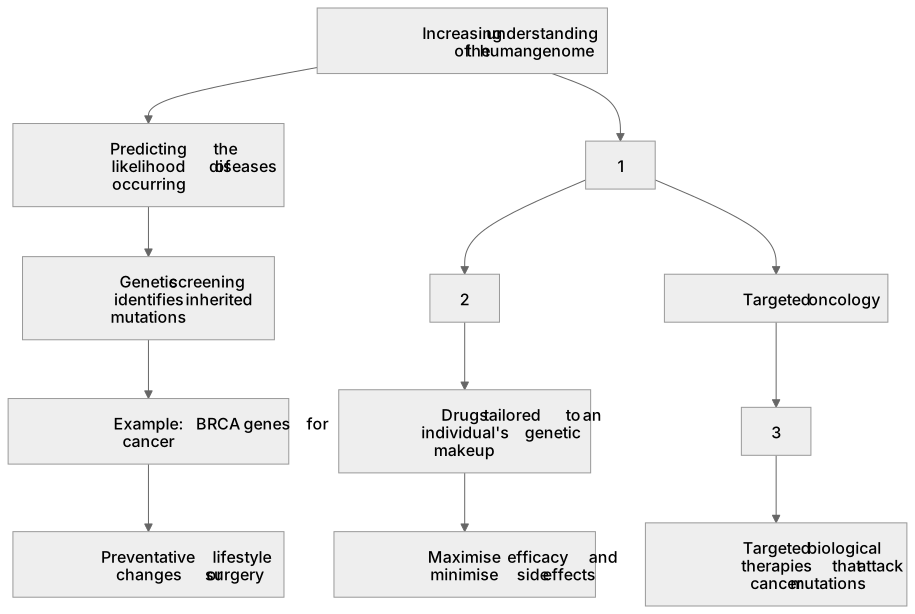
1Box 1
2Box 2
3Box 3
There is more to this lesson
The full lesson goes on to check your understanding and help you earn the marks. Create a free account to carry on, with your progress saved.
A week of Premium from your first lesson · Then the free plan continues · No card, no charge
Test your understanding of Monitoring and maintaining health: discuss the potential importance for medicine of our increasing understanding of the human genome (to include: the ideas of predicting the likelihood of diseases occurring and their treatment by drugs which are targeted to genomes)
Active recall beats re-reading. Take an instant quiz now to test what you’ve learned and lock it into long-term memory.
A week of Premium from your first lesson · Then the free plan continues · No card, no charge