OCR · GCSE · Biology
Course version: J247 · Version from Sept 2018
Explain the role of the immune system of the human body in defence against…
Full specification wording
Monitoring and maintaining health: explain the role of the immune system of the human body in defence against disease
The specific immune system mounts targeted cellular and chemical defences against foreign pathogens that bypass non-specific primary barriers.
- Point 17 of 29
- 4 key terms
Study notes
From the teaching notes for this specification point.
The idea
The specific immune system mounts targeted cellular and chemical defences against foreign pathogens that bypass non-specific primary barriers. Pathogens display unique molecular markers called antigens on their surface. Specific B lymphocytes recognise complementary antigens, stimulating these cells to divide by mitosis into clones of plasma cells that secrete large quantities of targeted antibodies. These antibodies bind to antigens, neutralizing pathogens, causing agglutination, or tagging them for destruction by phagocytic cells. Crucially, a subset of lymphocytes develops into long-lived memory cells that persist in lymphatic tissue, enabling a much faster, higher-titre secondary immune response upon reinfection, conferring lasting immunity.
What earns the marks
- Explain that antigens are unique molecular surface markers on pathogens recognised as non-self by lymphocytes.
- Describe how lymphocytes produce specific antibodies complementary to antigens, causing agglutination and tagging pathogens for phagocytosis.
- Explain that memory cells persist after infection, producing a faster and greater antibody response upon secondary exposure (immunity).
Common mistakes and how to put them right
Confusing antigens (pathogen markers) with antibodies (proteins secreted by white blood cells).
Stating that memory cells remember how to fight rather than explaining they divide rapidly into antibody-producing plasma cells.
Exam tips
- Contrast primary and secondary immune responses: primary is slow and produces low antibody titres; secondary is rapid, producing higher antibody levels that destroy pathogens before symptoms appear.
- Always state that antibodies have a complementary shape that binds specifically to the pathogen antigen.
Try the lesson
The start of the Monitoring and maintaining health: explain the role of the immune system of the human body in defence against disease lesson, made from teaching notes for this specification point.
Have a go first
Which type of white blood cell produces antibodies that help to destroy pathogens?
Listen
The specific immune system mounts targeted cellular and chemical defences against foreign pathogens that bypass non-specific primary barriers. Pathogens display unique molecular markers called antigens on their surface. Specific B lymphocytes recognise complementary antigens, stimulating these cells to divide by mitosis into clones of plasma cells that secrete large quantities of targeted antibodies. These antibodies bind to antigens, neutralizing pathogens, causing agglutination, or tagging them for destruction by phagocytic cells. Crucially, a subset of lymphocytes develops into long-lived memory cells that persist in lymphatic tissue, enabling a much faster, higher-titre secondary immune response upon reinfection, conferring lasting immunity. A strong answer earns marks for these points. Explain that antigens are unique molecular surface markers on pathogens recognised as non-self by lymphocytes. Describe how lymphocytes produce specific antibodies complementary to antigens, causing agglutination and tagging pathogens for phagocytosis. Explain that memory cells persist after infection, producing a faster and greater antibody response upon secondary exposure (immunity). Exam tip: Contrast primary and secondary immune responses: primary is slow and produces low antibody titres; secondary is rapid, producing higher antibody levels that destroy pathogens before symptoms appear.
See it
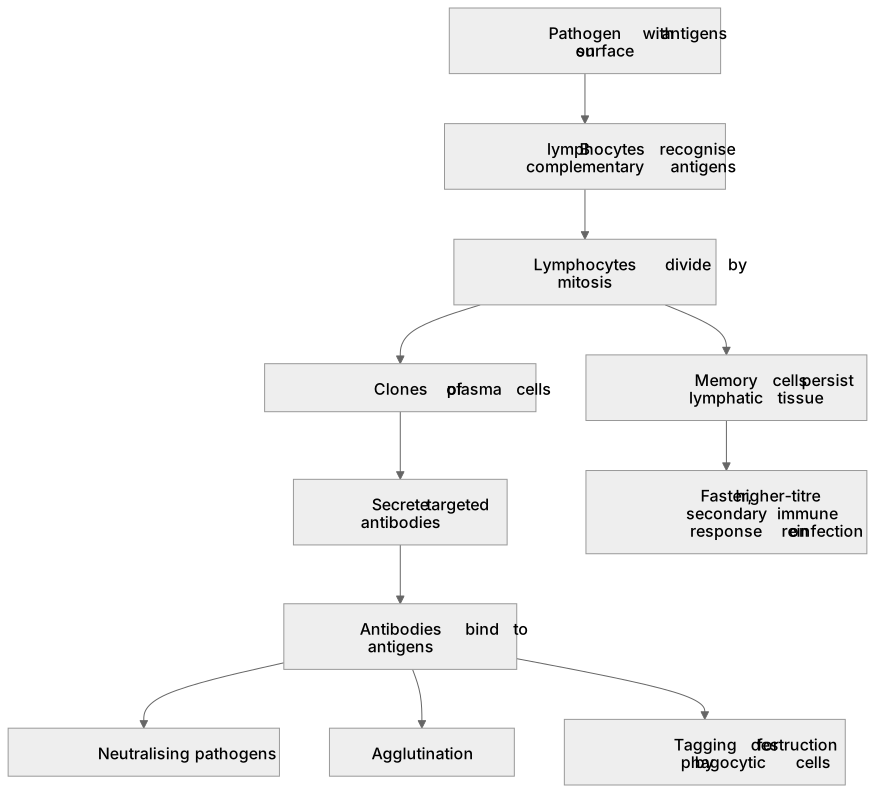
Key words
Say what each word means before you turn the card.
antigens
Try answering aloud or in your head before turning the card.
antibodies
Try answering aloud or in your head before turning the card.
memory cells
Try answering aloud or in your head before turning the card.
immunological memory
Try answering aloud or in your head before turning the card.
See every definition
- antigens
- Unique molecular markers on the surface of pathogens that lymphocytes recognise as non-self.
- antibodies
- Proteins secreted by plasma cells that bind specifically to antigens, causing agglutination or tagging pathogens for phagocytosis.
- memory cells
- Long-lived lymphocytes that persist in lymphatic tissue and divide rapidly into antibody-producing plasma cells upon secondary exposure.
- immunological memory
- A faster, higher-titre secondary immune response upon reinfection, conferred by memory cells persisting after infection.
Label the diagram
Some boxes have lost their names. Pick the right name for each number.
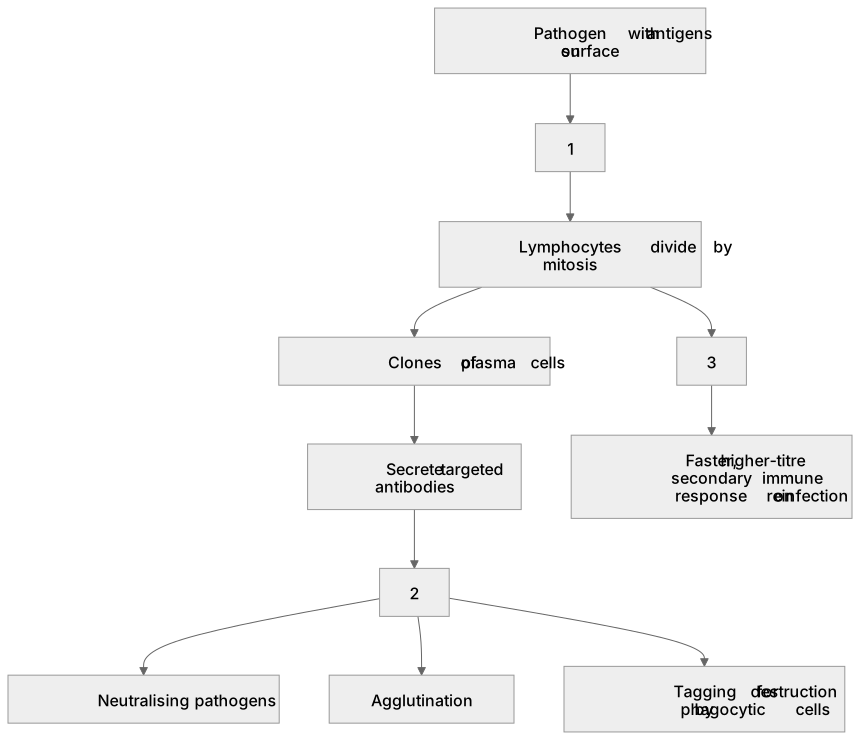
1Box 1
2Box 2
3Box 3
There is more to this lesson
The full lesson goes on to check your understanding and help you earn the marks. Create a free account to carry on, with your progress saved.
A week of Premium from your first lesson · Then the free plan continues · No card, no charge
Test your understanding of Monitoring and maintaining health: explain the role of the immune system of the human body in defence against disease
Active recall beats re-reading. Take an instant quiz now to test what you’ve learned and lock it into long-term memory.
A week of Premium from your first lesson · Then the free plan continues · No card, no charge