OCR · GCSE · Biology
Course version: J247 · Version from Sept 2018
Monitoring and maintaining the environment: understand and use percentiles
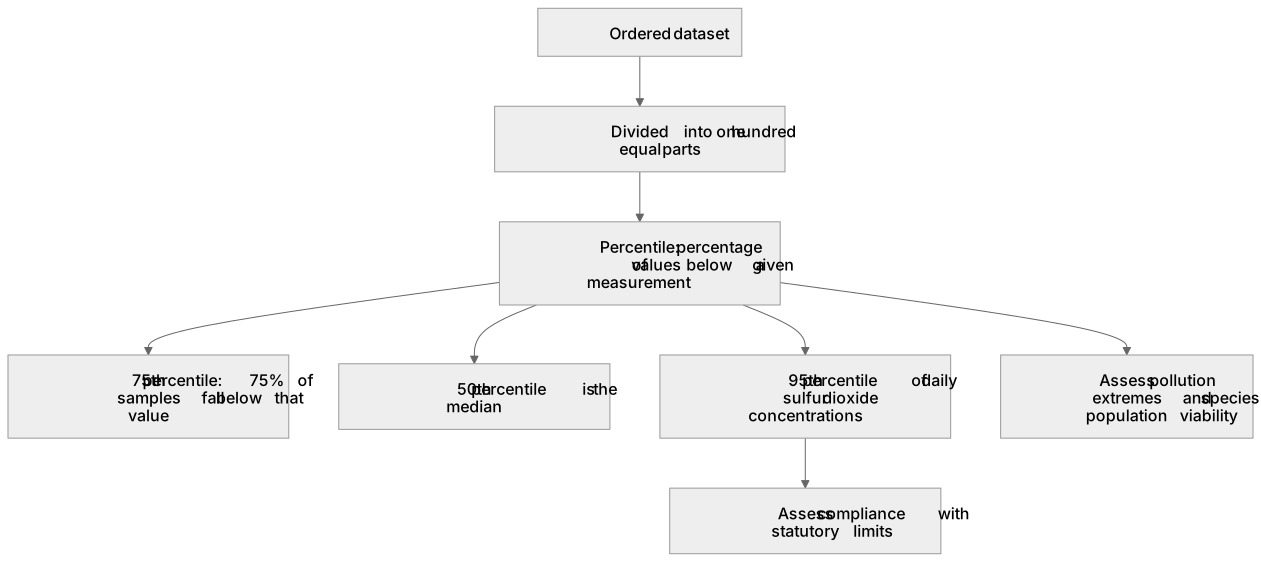
Percentiles divide an ordered dataset into one hundred equal parts, providing a standard measure of relative position within a biological distribution.
- Point 3 of 9
- 3 key terms
Study notes
From the teaching notes for this specification point.
The idea
Percentiles divide an ordered dataset into one hundred equal parts, providing a standard measure of relative position within a biological distribution. In environmental monitoring, percentiles assess compliance with ecological safety benchmarks; for example, air quality regulations specify that the 95th percentile of daily sulfur dioxide concentrations must not breach statutory limits. A data point at the 75th percentile indicates that 75% of all recorded samples fall below that value, allowing scientists to assess environmental pollution extremes and species population viability.
What earns the marks
- Explain that a percentile represents the percentage of values in a distribution that fall below a given measurement.
- Extract and interpret percentile values from environmental quality tables and distribution charts.
- Use percentiles to evaluate compliance with statutory environmental pollution thresholds.
Common mistakes and how to put them right
Confusing percentiles with plain percentages, failing to realise percentiles represent rank order within an ordered population.
Misinterpreting the 50th percentile as the arithmetic mean rather than the median value.
Exam tips
- Remember that the 50th percentile is the median of the dataset.
- Read percentile questions carefully to identify whether they refer to values above or below the threshold.
Try the lesson
The start of the Monitoring and maintaining the environment: understand and use percentiles lesson, made from teaching notes for this specification point.
Have a go first
A set of 100 ordered measurements has the 10th percentile equal to 14 and the 90th percentile equal to 32. What does the 10th percentile value of 14 tell you?
Listen
Percentiles divide an ordered dataset into one hundred equal parts, providing a standard measure of relative position within a biological distribution. In environmental monitoring, percentiles assess compliance with ecological safety benchmarks; for example, air quality regulations specify that the 95th percentile of daily sulfur dioxide concentrations must not breach statutory limits. A data point at the 75th percentile indicates that 75% of all recorded samples fall below that value, allowing scientists to assess environmental pollution extremes and species population viability. A strong answer earns marks for these points. Explain that a percentile represents the percentage of values in a distribution that fall below a given measurement. Extract and interpret percentile values from environmental quality tables and distribution charts. Use percentiles to evaluate compliance with statutory environmental pollution thresholds. Exam tip: Remember that the 50th percentile is the median of the dataset.
See it
Key words
Say what each word means before you turn the card.
percentiles
Try answering aloud or in your head before turning the card.
environmental monitoring
Try answering aloud or in your head before turning the card.
pollution standards
Try answering aloud or in your head before turning the card.
See every definition
- percentiles
- Values that divide an ordered dataset into one hundred equal parts, providing a standard measure of relative position within a biological distribution.
- environmental monitoring
- Assessing compliance with ecological safety benchmarks, for example where air quality regulations specify that the 95th percentile of daily sulfur dioxide concentrations must not breach statutory limits.
- pollution standards
- Statutory environmental pollution thresholds used to evaluate compliance, assessed using percentiles.
Label the diagram
Some boxes have lost their names. Pick the right name for each number.
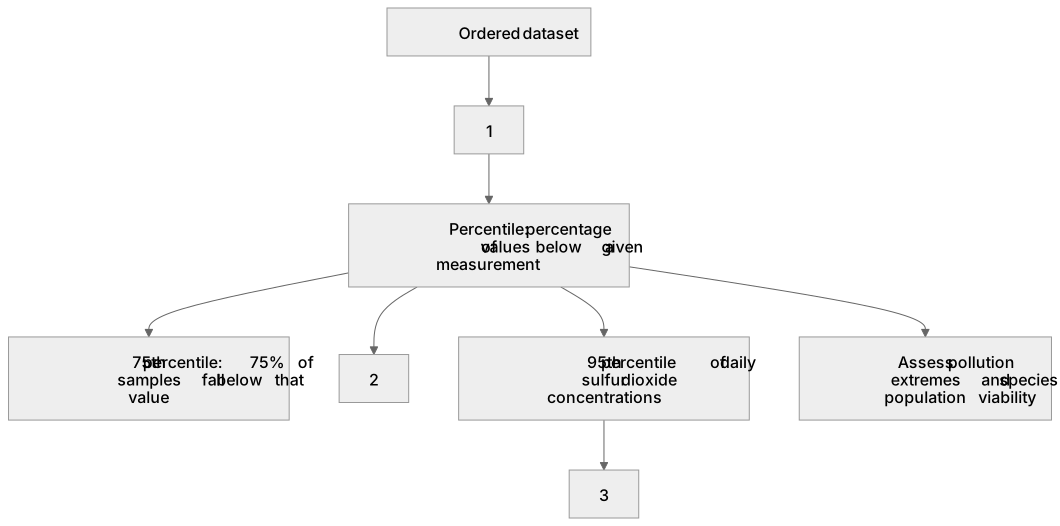
1Box 1
2Box 2
3Box 3
There is more to this lesson
The full lesson goes on to check your understanding and help you earn the marks. Create a free account to carry on, with your progress saved.
A week of Premium from your first lesson · Then the free plan continues · No card, no charge
Test your understanding of Monitoring and maintaining the environment: understand and use percentiles
Active recall beats re-reading. Take an instant quiz now to test what you’ve learned and lock it into long-term memory.
A week of Premium from your first lesson · Then the free plan continues · No card, no charge