OCR · GCSE · Biology
Course version: J247 · Version from Sept 2018
Understand the principles of sampling as applied to scientific data
Full specification wording
Monitoring and maintaining the environment: understand the principles of sampling as applied to scientific data
Sampling enables ecologists to investigate large habitats where counting every individual organism is physically impossible.
- Point 5 of 9
- 3 key terms
Study notes
From the teaching notes for this specification point.
The idea
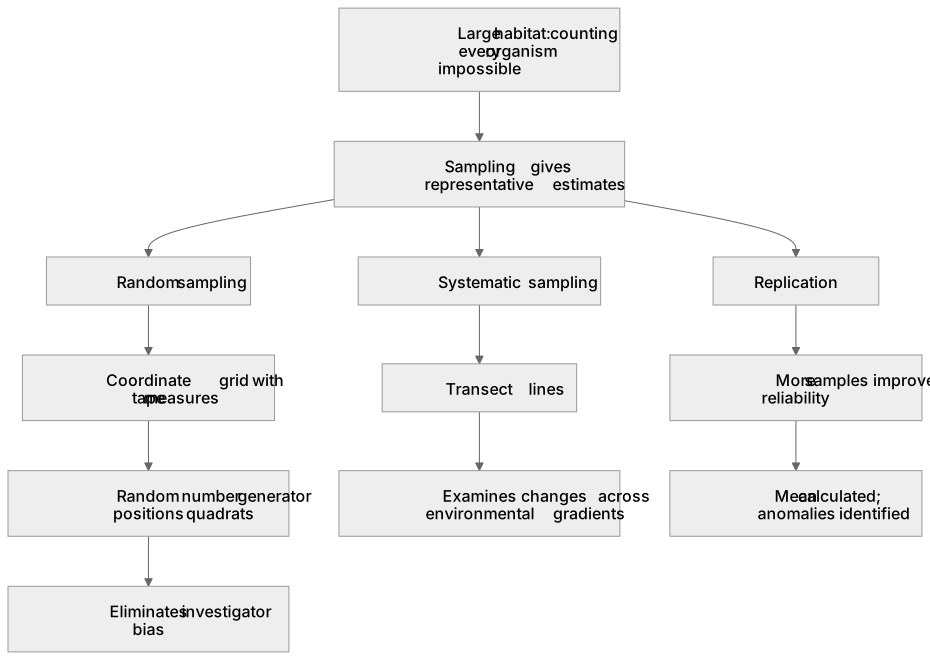
Sampling enables ecologists to investigate large habitats where counting every individual organism is physically impossible. Key sampling principles dictate that data collection must be representative, unbiased, and sufficiently replicated. Random sampling uses grid coordinates generated by random number tables to position quadrats, preventing investigator bias in uniform environments. Systematic sampling along transect lines investigates changes in species abundance across environmental gradients. Adequate sample sizes ensure mean values are reliable, reducing the impact of anomalies.
What earns the marks
- Explain that sampling provides representative estimates of populations when whole-habitat census is impossible.
- Describe how random coordinate generation eliminates investigator bias in quadrat placement.
- Explain that systematic sampling along a transect is necessary to examine changes across environmental gradients.
- Explain why increasing the number of samples improves the reliability of the estimated population size.
Common mistakes and how to put them right
Thinking random sampling means throwing quadrats over your shoulder, which is neither truly random nor safe.
Using random sampling to investigate an environmental gradient, which requires systematic transect lines.
Exam tips
- Always explain random sampling by describing establishing a coordinate grid with tape measures and using a random number generator.
- State that repeating samples and calculating a mean improves reliability and allows anomalous results to be identified.
Try the lesson
The start of the Monitoring and maintaining the environment: understand the principles of sampling as applied to scientific data lesson, made from teaching notes for this specification point.
Have a go first
Why is a quadrat used when sampling plants in a field?
Listen
Sampling enables ecologists to investigate large habitats where counting every individual organism is physically impossible. Key sampling principles dictate that data collection must be representative, unbiased, and sufficiently replicated. Random sampling uses grid coordinates generated by random number tables to position quadrats, preventing investigator bias in uniform environments. Systematic sampling along transect lines investigates changes in species abundance across environmental gradients. Adequate sample sizes ensure mean values are reliable, reducing the impact of anomalies. A strong answer earns marks for these points. Explain that sampling provides representative estimates of populations when whole-habitat census is impossible. Describe how random coordinate generation eliminates investigator bias in quadrat placement. Explain that systematic sampling along a transect is necessary to examine changes across environmental gradients. Explain why increasing the number of samples improves the reliability of the estimated population size. Exam tip: Always explain random sampling by describing establishing a coordinate grid with tape measures and using a random number generator.
See it
Key words
Say what each word means before you turn the card.
random sampling
Try answering aloud or in your head before turning the card.
systematic sampling
Try answering aloud or in your head before turning the card.
sample size and reliability
Try answering aloud or in your head before turning the card.
See every definition
- random sampling
- Uses grid coordinates generated by random number tables to position quadrats, preventing investigator bias in uniform environments.
- systematic sampling
- Along transect lines investigates changes in species abundance across environmental gradients.
- sample size and reliability
- Adequate sample sizes ensure mean values are reliable, reducing the impact of anomalies.
Label the diagram
Some boxes have lost their names. Pick the right name for each number.
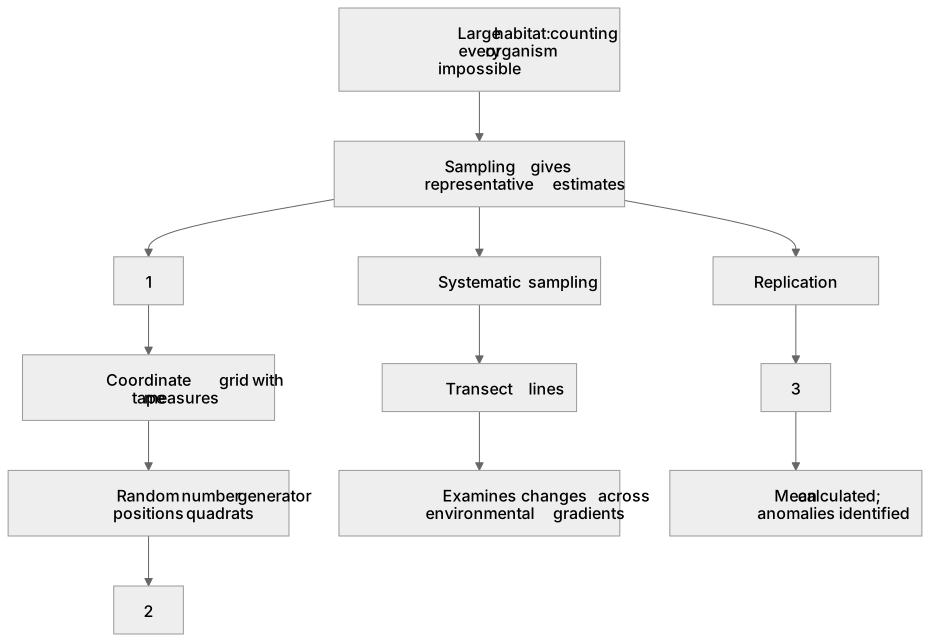
1Box 1
2Box 2
3Box 3
There is more to this lesson
The full lesson goes on to check your understanding and help you earn the marks. Create a free account to carry on, with your progress saved.
A week of Premium from your first lesson · Then the free plan continues · No card, no charge
Test your understanding of Monitoring and maintaining the environment: understand the principles of sampling as applied to scientific data
Active recall beats re-reading. Take an instant quiz now to test what you’ve learned and lock it into long-term memory.
A week of Premium from your first lesson · Then the free plan continues · No card, no charge