OCR · GCSE · Biology
Course version: J247 · Version from Sept 2018
Describe the work of Darwin and Wallace in the development of the theory…
Full specification wording
Natural selection and evolution: describe the work of Darwin and Wallace in the development of the theory of evolution by natural selection and explain the impact of these ideas on modern biology (to include: seedbanks being used as a store of biodiversity) (content found only in the biology separate science qualification)
Charles Darwin and Alfred Russel Wallace independently formulated the theory of evolution by natural selection.
- Point 6 of 6
- 3 key terms
Study notes
From the teaching notes for this specification point.
The idea
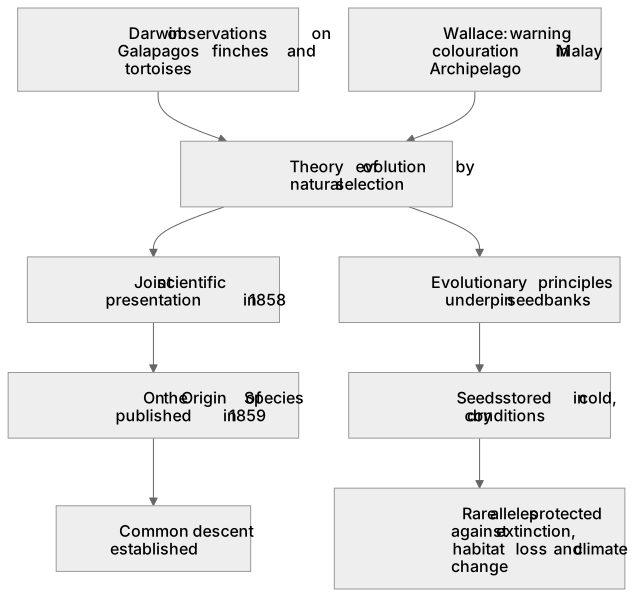
Charles Darwin and Alfred Russel Wallace independently formulated the theory of evolution by natural selection. Darwin gathered observations on Galapagos finches and tortoises, while Wallace studied warning coloration in the Malay Archipelago, leading to their joint scientific presentation in 1858 and Darwin publication of On the Origin of Species in 1859. Their work revolutionised biology by establishing common descent. In modern conservation, these evolutionary principles underpin seedbanks, such as the Millennium Seed Bank, which preserve global plant biodiversity by storing viable seeds in cold, dry conditions to protect rare alleles against extinction, habitat loss, and climate change.
What earns the marks
- Describe the joint contributions of Darwin and Wallace in developing and publishing the theory of evolution by natural selection.
- Explain how Wallace work on warning colouration in animals contributed to evolutionary theory.
- Explain how evolutionary principles guide modern conservation, using seedbanks to store plant seeds and preserve genetic diversity.
- Describe how seedbanks protect rare alleles from extinction, climate change, or agricultural crop diseases.
Common mistakes and how to put them right
Attributing the theory of natural selection exclusively to Darwin, omitting the vital contribution of Alfred Russel Wallace.
Believing seedbanks grow plants continuously, rather than storing dormant seeds under cold, dehydrated conditions.
Exam tips
- Remember to credit Wallace specifically for warning colouration in animals and collecting specimens in the Malay Archipelago.
- When explaining seedbanks, emphasise that they conserve genetic diversity and alleles that may provide resistance to future crop diseases.
Try the lesson
The start of the Natural selection and evolution: describe the work of Darwin and Wallace in the development of the theory of evolution by natural selection and explain the impact of these ideas on modern biology (to include: seedbanks being used as a store of biodiversity) (content found only in the biology separate science qualification) lesson, made from teaching notes for this specification point.
Have a go first
Which two scientists developed the theory of evolution by natural selection?
Listen
Charles Darwin and Alfred Russel Wallace independently formulated the theory of evolution by natural selection. Darwin gathered observations on Galapagos finches and tortoises, while Wallace studied warning coloration in the Malay Archipelago, leading to their joint scientific presentation in 1858 and Darwin publication of On the Origin of Species in 1859. Their work revolutionised biology by establishing common descent. In modern conservation, these evolutionary principles underpin seedbanks, such as the Millennium Seed Bank, which preserve global plant biodiversity by storing viable seeds in cold, dry conditions to protect rare alleles against extinction, habitat loss, and climate change. A strong answer earns marks for these points. Describe the joint contributions of Darwin and Wallace in developing and publishing the theory of evolution by natural selection. Explain how Wallace work on warning colouration in animals contributed to evolutionary theory. Explain how evolutionary principles guide modern conservation, using seedbanks to store plant seeds and preserve genetic diversity. Describe how seedbanks protect rare alleles from extinction, climate change, or agricultural crop diseases. Exam tip: Remember to credit Wallace specifically for warning colouration in animals and collecting specimens in the Malay Archipelago.
See it
Key words
Say what each word means before you turn the card.
Darwin and Wallace
Try answering aloud or in your head before turning the card.
biodiversity conservation
Try answering aloud or in your head before turning the card.
seedbanks and genetic resources
Try answering aloud or in your head before turning the card.
See every definition
- Darwin and Wallace
- Independently formulated the theory of evolution by natural selection, leading to a joint scientific presentation in 1858 and Darwin's publication of On the Origin of Species in 1859.
- biodiversity conservation
- Modern conservation guided by evolutionary principles, using seedbanks to store plant seeds and preserve genetic diversity.
- seedbanks and genetic resources
- Store viable seeds in cold, dry conditions to protect rare alleles against extinction, habitat loss and climate change.
Label the diagram
Some boxes have lost their names. Pick the right name for each number.
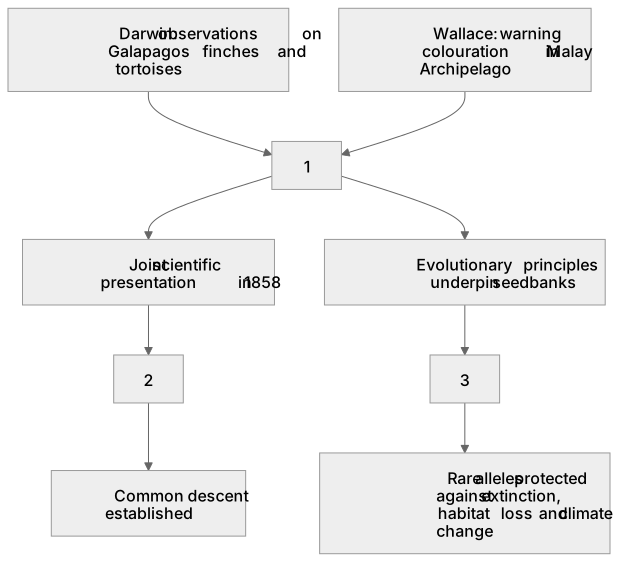
1Box 1
2Box 2
3Box 3
There is more to this lesson
The full lesson goes on to check your understanding and help you earn the marks. Create a free account to carry on, with your progress saved.
A week of Premium from your first lesson · Then the free plan continues · No card, no charge
Test your understanding of Natural selection and evolution: describe the work of Darwin and Wallace in the development of the theory of evolution by natural selection and explain the impact of these ideas on modern biology (to include: seedbanks being used as a store of biodiversity) (content found only in the biology separate science qualification)
Active recall beats re-reading. Take an instant quiz now to test what you’ve learned and lock it into long-term memory.
A week of Premium from your first lesson · Then the free plan continues · No card, no charge