OCR · GCSE · Biology
Course version: J247 · Version from Sept 2018
Describe the evidence for evolution (to include: fossils and antibiotic…
Full specification wording
Natural selection and evolution: describe the evidence for evolution (to include: fossils and antibiotic resistance in bacteria)
Robust empirical evidence confirms evolutionary theory across historical and contemporary timescales.
- Point 5 of 6
- 4 key terms
Study notes
From the teaching notes for this specification point.
The idea
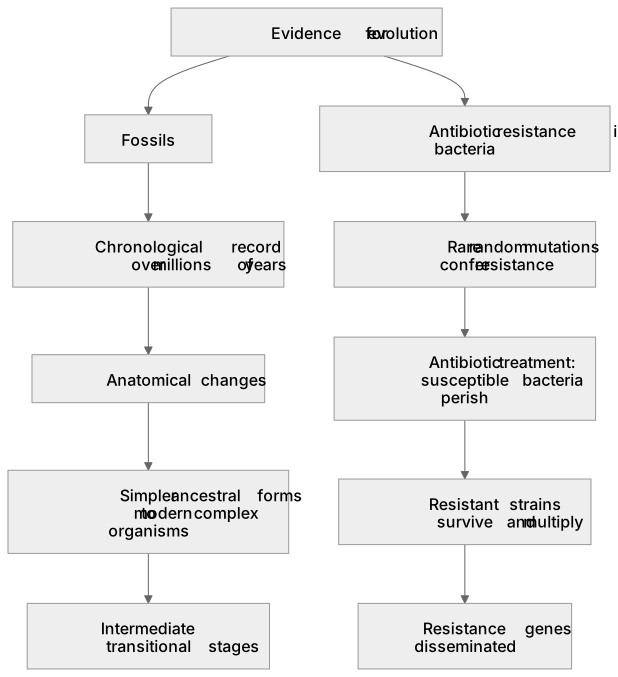
Robust empirical evidence confirms evolutionary theory across historical and contemporary timescales. The fossil record documents chronological transitions in anatomy over millions of years, illustrating how simpler ancestral forms gave rise to modern complex organisms through intermediate transitional stages, such as horse limb evolution. In contemporary microbiology, bacteria demonstrate rapid evolution in real time: rare random mutations confer resistance to specific antibiotics; when treated, susceptible bacteria perish while resistant strains survive, multiply rapidly without competition, and disseminate resistance genes.
What earns the marks
- Describe the fossil record as chronological evidence showing structural anatomical changes over millions of years.
- Explain how random mutations in bacteria can produce alleles conferring resistance to specific antibiotics.
- Describe how non-resistant bacteria are killed by antibiotics while resistant bacteria survive, reproduce, and pass on resistance alleles.
Common mistakes and how to put them right
Claiming that antibiotics cause the mutation to occur, rather than acting as a selective agent on pre-existing random mutations.
Stating that the human patient becomes immune to the antibiotic, rather than the bacterial population developing resistance.
Exam tips
- State explicitly that bacteria become resistant to the antibiotic, never the human patient.
- Point out that bacterial reproduction is extremely rapid, allowing natural selection to be observed over days rather than millennia.
Try the lesson
The start of the Natural selection and evolution: describe the evidence for evolution (to include: fossils and antibiotic resistance in bacteria) lesson, made from teaching notes for this specification point.
Have a go first
Which type of evidence comes from the preserved remains of organisms that lived long ago?
Listen
Robust empirical evidence confirms evolutionary theory across historical and contemporary timescales. The fossil record documents chronological transitions in anatomy over millions of years, illustrating how simpler ancestral forms gave rise to modern complex organisms through intermediate transitional stages, such as horse limb evolution. In contemporary microbiology, bacteria demonstrate rapid evolution in real time: rare random mutations confer resistance to specific antibiotics; when treated, susceptible bacteria perish while resistant strains survive, multiply rapidly without competition, and disseminate resistance genes. A strong answer earns marks for these points. Describe the fossil record as chronological evidence showing structural anatomical changes over millions of years. Explain how random mutations in bacteria can produce alleles conferring resistance to specific antibiotics. Describe how non-resistant bacteria are killed by antibiotics while resistant bacteria survive, reproduce, and pass on resistance alleles. Exam tip: State explicitly that bacteria become resistant to the antibiotic, never the human patient.
See it
Key words
Say what each word means before you turn the card.
fossil record
Try answering aloud or in your head before turning the card.
antibiotic resistance
Try answering aloud or in your head before turning the card.
bacterial selection
Try answering aloud or in your head before turning the card.
evidence for evolution
Try answering aloud or in your head before turning the card.
See every definition
- fossil record
- Chronological evidence showing structural anatomical changes over millions of years, documenting transitions in anatomy over evolutionary time.
- antibiotic resistance
- Rare random mutations in bacteria produce alleles conferring resistance to specific antibiotics, so resistant strains survive and multiply.
- bacterial selection
- Non-resistant bacteria are killed by antibiotics while resistant bacteria survive, reproduce, and pass on resistance alleles.
- evidence for evolution
- Fossils and antibiotic resistance in bacteria are evidence supporting the theory of evolution.
Label the diagram
Some boxes have lost their names. Pick the right name for each number.
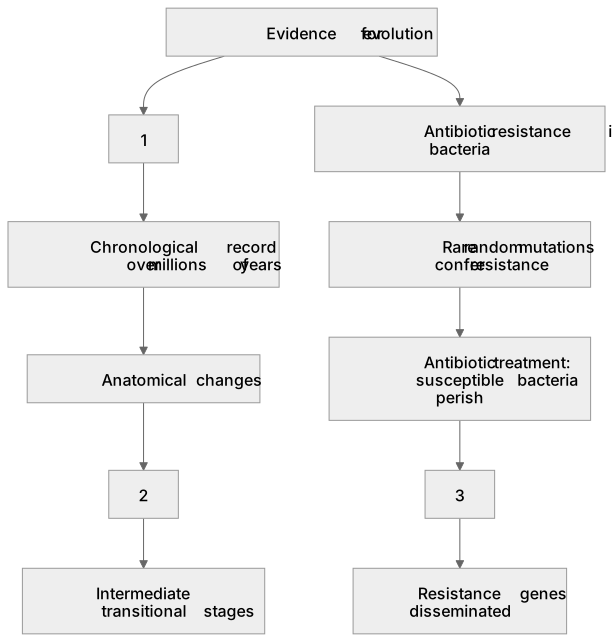
1Box 1
2Box 2
3Box 3
There is more to this lesson
The full lesson goes on to check your understanding and help you earn the marks. Create a free account to carry on, with your progress saved.
A week of Premium from your first lesson · Then the free plan continues · No card, no charge
Test your understanding of Natural selection and evolution: describe the evidence for evolution (to include: fossils and antibiotic resistance in bacteria)
Active recall beats re-reading. Take an instant quiz now to test what you’ve learned and lock it into long-term memory.
A week of Premium from your first lesson · Then the free plan continues · No card, no charge