OCR · GCSE · Biology
Course version: J247 · Version from Sept 2018
State that there is usually extensive genetic variation within a…
Full specification wording
Natural selection and evolution: state that there is usually extensive genetic variation within a population of a species
Except for clones and identical twins, biological populations show wide genetic diversity.
- Point 1 of 6
- 3 key terms
Study notes
From the teaching notes for this specification point.
The idea
Except for clones and identical twins, biological populations show wide genetic diversity. This wide variation arises fundamentally through spontaneous mutations in DNA, creating new alleles that are continually shuffled through sexual reproduction during meiosis and random fertilisation. High genetic diversity is crucial for population resilience; it ensures that if an environmental disturbance occurs, such as a novel infectious disease or climate shift, some individuals will possess alleles conferring survival advantages.
What earns the marks
- State that populations of a species naturally exhibit extensive genetic variation.
- Identify spontaneous gene mutations as the primary origin of all new genetic variants.
- Explain that sexual reproduction reshuffles alleles to create novel combinations within a population.
Common mistakes and how to put them right
Believing that organisms in a wild population are genetically identical if they look physically similar.
Assuming that genetic diversity is created in response to environmental demands rather than existing beforehand.
Exam tips
- Always state that variation arises through random mutations before selection pressures occur.
- Link high genetic variation directly to the long-term survival capacity of a population facing disease.
Try the lesson
The start of the Natural selection and evolution: state that there is usually extensive genetic variation within a population of a species lesson, made from teaching notes for this specification point.
Have a go first
Which statement describes the genetic variation usually found within a population of a species?
Listen
Except for clones and identical twins, biological populations show wide genetic diversity. This wide variation arises fundamentally through spontaneous mutations in DNA, creating new alleles that are continually shuffled through sexual reproduction during meiosis and random fertilisation. High genetic diversity is crucial for population resilience; it ensures that if an environmental disturbance occurs, such as a novel infectious disease or climate shift, some individuals will possess alleles conferring survival advantages. A strong answer earns marks for these points. State that populations of a species naturally exhibit extensive genetic variation. Identify spontaneous gene mutations as the primary origin of all new genetic variants. Explain that sexual reproduction reshuffles alleles to create novel combinations within a population. Exam tip: Always state that variation arises through random mutations before selection pressures occur.
See it
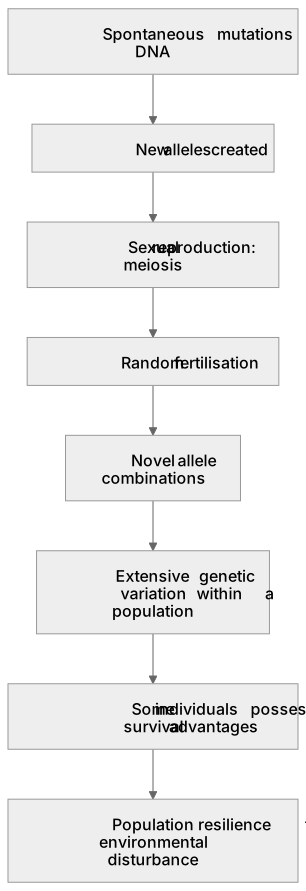
Put it in order
Put these steps in the order they happen.
- 1. Novel allele combinations
- 2. Population resilience to environmental disturbance
- 3. Extensive genetic variation within a population
- 4. Spontaneous mutations in DNA
- 5. New alleles created
- 6. Some individuals possess survival advantages
- 7. Sexual reproduction: meiosis
- 8. Random fertilisation
Key words
Say what each word means before you turn the card.
genetic variation
Try answering aloud or in your head before turning the card.
mutations
Try answering aloud or in your head before turning the card.
allele diversity
Try answering aloud or in your head before turning the card.
See every definition
- genetic variation
- There is usually extensive genetic variation within a population of a species, arising fundamentally through spontaneous mutations in DNA.
- mutations
- Spontaneous mutations in DNA create new alleles that are continually shuffled through sexual reproduction during meiosis and random fertilisation.
- allele diversity
- High genetic diversity ensures that if an environmental disturbance occurs, some individuals will possess alleles conferring survival advantages.
Label the diagram
Some boxes have lost their names. Pick the right name for each number.
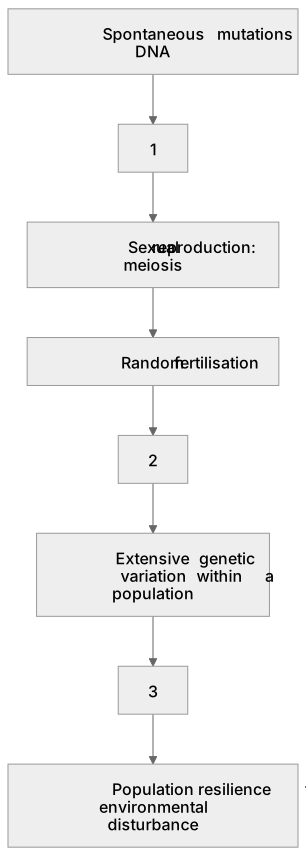
1Box 1
2Box 2
3Box 3
There is more to this lesson
The full lesson goes on to check your understanding and help you earn the marks. Create a free account to carry on, with your progress saved.
A week of Premium from your first lesson · Then the free plan continues · No card, no charge
Test your understanding of Natural selection and evolution: state that there is usually extensive genetic variation within a population of a species
Active recall beats re-reading. Take an instant quiz now to test what you’ve learned and lock it into long-term memory.
A week of Premium from your first lesson · Then the free plan continues · No card, no charge