OCR · GCSE · Biology
Course version: J247 · Version from Sept 2018
Explain the effect of temperature, light intensity and carbon dioxide…
Full specification wording
Photosynthesis: explain the effect of temperature, light intensity and carbon dioxide concentration on the rate of photosynthesis
Three environmental factors directly govern photosynthetic rate.
- Point 10 of 15
- 4 key terms
Study notes
From the teaching notes for this specification point.
The idea
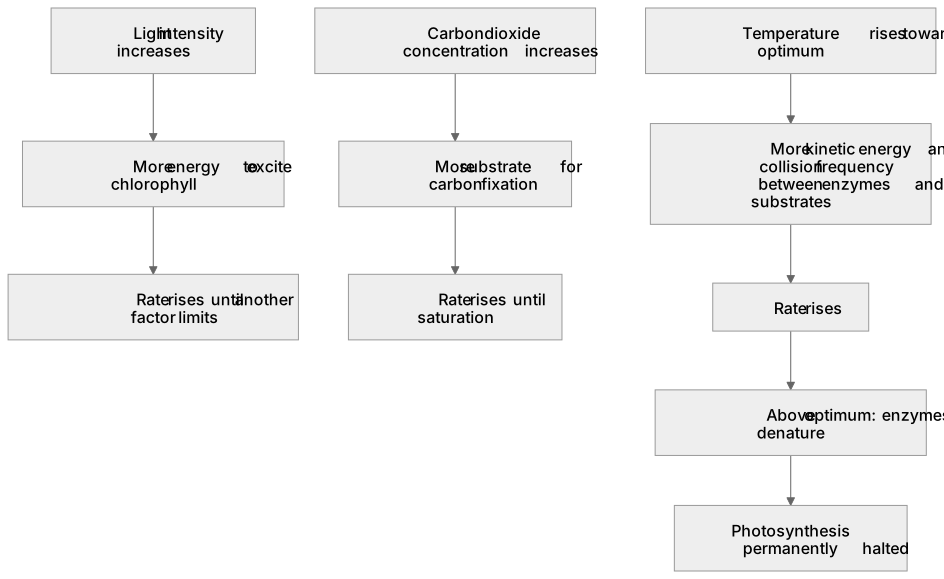
Three environmental factors directly govern photosynthetic rate. Increasing light intensity supplies more radiant energy to excite electrons in chlorophyll, raising rate proportionally until another factor limits. Increasing carbon dioxide concentration provides more carbon substrate for fixation into glucose, linearly accelerating rate until saturation. Temperature affects the kinetic energy of photosynthetic enzymes: as temperature rises toward the optimum, enzyme-substrate collision frequency increases; above optimum (typically around 40 °C), thermal agitation breaks hydrogen bonds, denaturing enzyme active sites.
What earns the marks
- Explaining that increasing light intensity provides more energy to excite chlorophyll until another factor limits.
- Explaining that increasing CO₂ concentration increases substrate available for carbon fixation until saturation.
- Explaining that increasing temperature increases kinetic energy and collision frequency between enzymes and substrates.
- Stating that temperatures exceeding the optimum cause enzymes to denature, permanently halting photosynthesis.
Common mistakes and how to put them right
Stating that rate continues to rise indefinitely with increasing light intensity, ignoring plateaus caused by other limiting factors.
Saying high temperatures kill the plant rather than specifically explaining that photosynthetic enzymes denature.
Exam tips
- Explain each factor in terms of biological mechanism: energy for light, substrate for CO₂, and enzyme kinetics for temperature.
- When describing temperature curves, distinguish between the rising kinetic slope and the steep denaturation drop.
Try the lesson
The start of the Photosynthesis: explain the effect of temperature, light intensity and carbon dioxide concentration on the rate of photosynthesis lesson, made from teaching notes for this specification point.
Have a go first
Which factor is a reactant needed for photosynthesis that, if increased, can raise the rate of photosynthesis?
Listen
Three environmental factors directly govern photosynthetic rate. Increasing light intensity supplies more radiant energy to excite electrons in chlorophyll, raising rate proportionally until another factor limits. Increasing carbon dioxide concentration provides more carbon substrate for fixation into glucose, linearly accelerating rate until saturation. Temperature affects the kinetic energy of photosynthetic enzymes: as temperature rises toward the optimum, enzyme-substrate collision frequency increases; above optimum (typically around 40 °C), thermal agitation breaks hydrogen bonds, denaturing enzyme active sites. A strong answer earns marks for these points. explaining that increasing light intensity provides more energy to excite chlorophyll until another factor limits. explaining that increasing CO₂ concentration increases substrate available for carbon fixation until saturation. explaining that increasing temperature increases kinetic energy and collision frequency between enzymes and substrates. stating that temperatures exceeding the optimum cause enzymes to denature, permanently halting photosynthesis. Exam tip: Explain each factor in terms of biological mechanism: energy for light, substrate for CO₂, and enzyme kinetics for temperature.
See it
Key words
Say what each word means before you turn the card.
limiting factors
Try answering aloud or in your head before turning the card.
light intensity
Try answering aloud or in your head before turning the card.
carbon dioxide concentration
Try answering aloud or in your head before turning the card.
denaturation
Try answering aloud or in your head before turning the card.
See every definition
- limiting factors
- Factors that govern the rate of photosynthesis, so that increasing light intensity raises the rate until another factor limits.
- light intensity
- Increasing this supplies more radiant energy to excite electrons in chlorophyll, raising the rate proportionally until another factor limits.
- carbon dioxide concentration
- Increasing this provides more carbon substrate for fixation into glucose, linearly accelerating the rate until saturation.
- denaturation
- Above the optimum temperature, thermal agitation breaks hydrogen bonds, damaging enzyme active sites and permanently halting photosynthesis.
Label the diagram
Some boxes have lost their names. Pick the right name for each number.
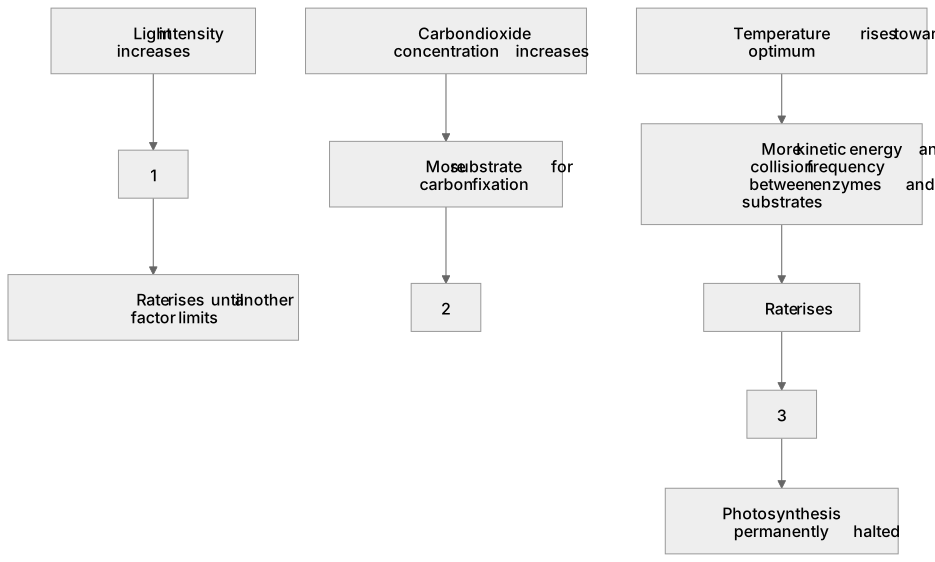
1Box 1
2Box 2
3Box 3
There is more to this lesson
The full lesson goes on to check your understanding and help you earn the marks. Create a free account to carry on, with your progress saved.
A week of Premium from your first lesson · Then the free plan continues · No card, no charge
Test your understanding of Photosynthesis: explain the effect of temperature, light intensity and carbon dioxide concentration on the rate of photosynthesis
Active recall beats re-reading. Take an instant quiz now to test what you’ve learned and lock it into long-term memory.
A week of Premium from your first lesson · Then the free plan continues · No card, no charge