OCR · GCSE · Biology
Course version: J247 · Version from Sept 2018
Use of appropriate apparatus to make and record a range of measurements…
Full specification wording
Rates of enzyme-controlled reactions: Use of appropriate apparatus to make and record a range of measurements accurately, including length, area, mass, time, temperature, volume of liquids and gases, and pH
High precision in quantitative enzyme kinetics requires choosing apparatus that minimizes percentage measurement error.
- Point 4 of 4
- 4 key terms
Study notes
From the teaching notes for this specification point.
The idea
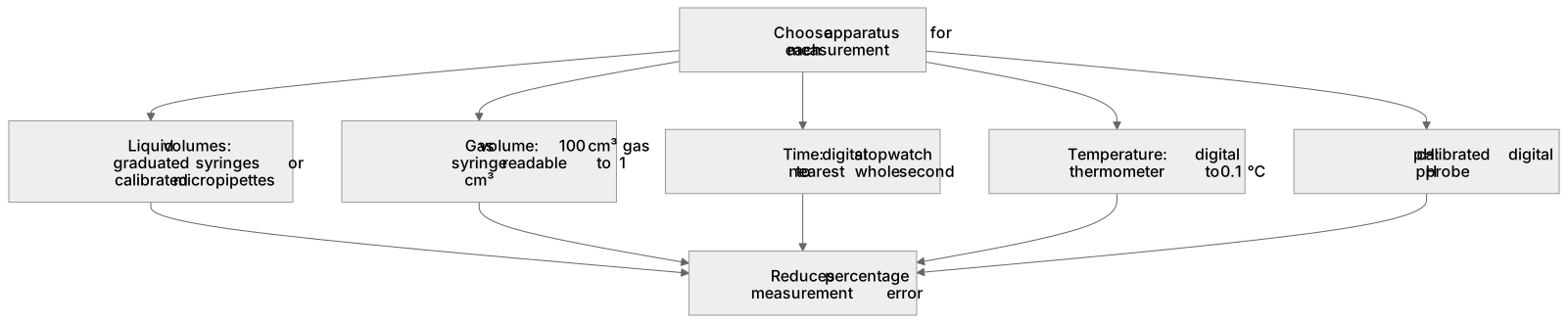
High precision in quantitative enzyme kinetics requires choosing apparatus that minimizes percentage measurement error. Liquid volumes of enzymes, substrates, and buffers are dispensed using graduated measuring syringes (such as 1 cm³ or 5 cm³ syringes marked in 0.1 cm³ divisions) or calibrated micropipettes, which provide higher precision than wide measuring cylinders. Reaction duration is timed using a digital stopwatch, recorded to the nearest second to reflect human reaction time limitations. Gas volumes are collected in a 100 cm³ gas syringe readable to 1 cm³. Temperature is monitored using a digital thermometer to 0.1 °C, and pH is confirmed using a calibrated digital pH probe.
What earns the marks
- Dispense enzyme, substrate, and buffer volumes using graduated syringes (e.g. 1 cm³ or 5 cm³) to reduce percentage measurement error.
- Record gas production in a precision gas syringe readable to 1 cm³ rather than counting irregularly sized bubbles.
- Measure reaction intervals using a digital stopwatch, recording times to the nearest whole second.
- Confirm solution pH and incubation temperatures using calibrated digital meters to ensure high experimental precision.
Common mistakes and how to put them right
Using a large 100 cm³ measuring cylinder to dispense small liquid volumes like 2 cm³, introducing severe percentage measurement errors.
Recording reaction times to hundredths of a second from a digital stopwatch, which falsely implies precision beyond human reaction time.
Parallax error when reading liquid levels in graduated syringes or gas syringes without aligning the eye horizontally with the meniscus.
Exam tips
- When asked how to improve the accuracy of volume measurements in an enzyme experiment, suggest replacing measuring cylinders with graduated syringes or volumetric pipettes.
- State that using a gas syringe is more accurate than counting bubbles because bubble size varies, whereas a gas syringe measures exact gas volume.
Try the lesson
The start of the Rates of enzyme-controlled reactions: Use of appropriate apparatus to make and record a range of measurements accurately, including length, area, mass, time, temperature, volume of liquids and gases, and pH lesson, made from teaching notes for this specification point.
Have a go first
Which piece of apparatus is most suitable for measuring the volume of a liquid accurately in an enzyme-controlled reaction?
Listen
High precision in quantitative enzyme kinetics requires choosing apparatus that minimizes percentage measurement error. Liquid volumes of enzymes, substrates, and buffers are dispensed using graduated measuring syringes (such as 1 cm³ or 5 cm³ syringes marked in 0.1 cm³ divisions) or calibrated micropipettes, which provide higher precision than wide measuring cylinders. Reaction duration is timed using a digital stopwatch, recorded to the nearest second to reflect human reaction time limitations. Gas volumes are collected in a 100 cm³ gas syringe readable to 1 cm³. Temperature is monitored using a digital thermometer to 0.1 °C, and pH is confirmed using a calibrated digital pH probe. A strong answer earns marks for these points. Dispense enzyme, substrate, and buffer volumes using graduated syringes (e.g. 1 cm³ or 5 cm³) to reduce percentage measurement error. Record gas production in a precision gas syringe readable to 1 cm³ rather than counting irregularly sized bubbles. Measure reaction intervals using a digital stopwatch, recording times to the nearest whole second. Confirm solution pH and incubation temperatures using calibrated digital meters to ensure high experimental precision. Exam tip: When asked how to improve the accuracy of volume measurements in an enzyme experiment, suggest replacing measuring cylinders with graduated syringes or volumetric pipettes.
See it
Key words
Say what each word means before you turn the card.
graduated measuring syringes
Try answering aloud or in your head before turning the card.
digital stopwatch
Try answering aloud or in your head before turning the card.
gas syringe
Try answering aloud or in your head before turning the card.
parallax error
Try answering aloud or in your head before turning the card.
See every definition
- graduated measuring syringes
- Apparatus marked in divisions, such as 1 cm³ or 5 cm³ syringes marked in 0.1 cm³ divisions, used to dispense liquid volumes of enzymes, substrates and buffers.
- digital stopwatch
- Device used to time reaction duration, with times recorded to the nearest second to reflect human reaction time limitations.
- gas syringe
- A 100 cm³ syringe readable to 1 cm³ in which gas volumes are collected, rather than counting irregularly sized bubbles.
- parallax error
- An error when reading liquid levels in graduated syringes or gas syringes without aligning the eye horizontally with the meniscus.
Label the diagram
Some boxes have lost their names. Pick the right name for each number.
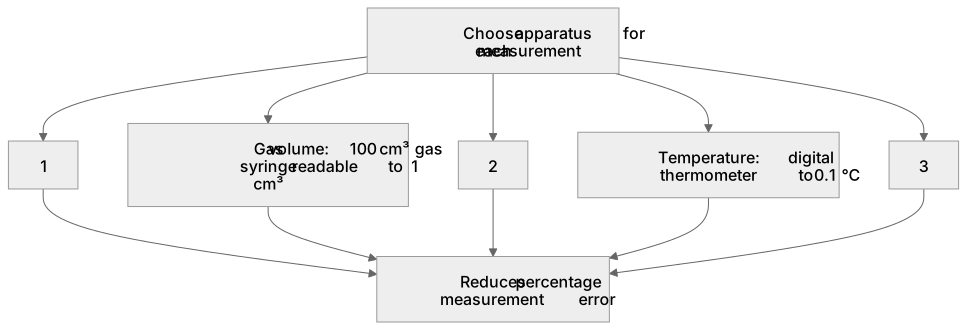
1Box 1
2Box 2
3Box 3
There is more to this lesson
The full lesson goes on to check your understanding and help you earn the marks. Create a free account to carry on, with your progress saved.
A week of Premium from your first lesson · Then the free plan continues · No card, no charge
Test your understanding of Rates of enzyme-controlled reactions: Use of appropriate apparatus to make and record a range of measurements accurately, including length, area, mass, time, temperature, volume of liquids and gases, and pH
Active recall beats re-reading. Take an instant quiz now to test what you’ve learned and lock it into long-term memory.
A week of Premium from your first lesson · Then the free plan continues · No card, no charge