OCR · GCSE · Biology
Course version: J247 · Version from Sept 2018
Use of appropriate apparatus to make and record a range of measurements…
Full specification wording
Sampling techniques: Use of appropriate apparatus to make and record a range of measurements accurately, including length, area, mass, time, temperature, volume of liquids and gases, and pH
Accurate field investigations depend on calibrated instruments to measure abiotic variables alongside biological data.
- Point 2 of 2
- 4 key terms
Study notes
From the teaching notes for this specification point.
The idea
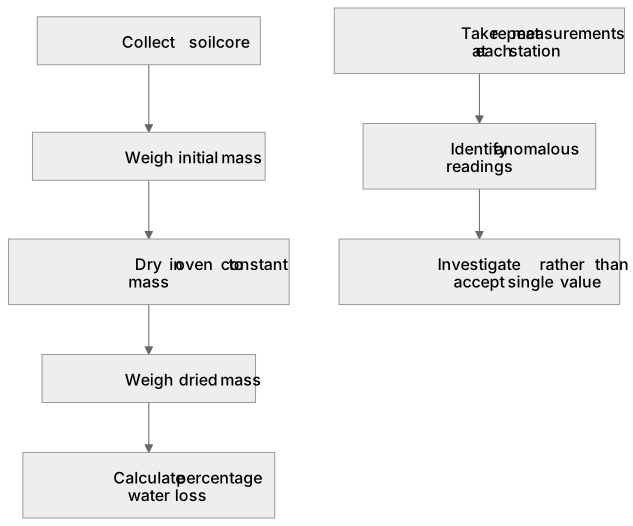
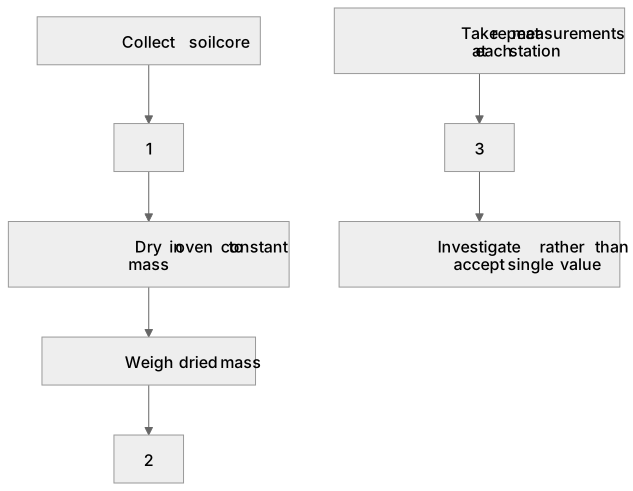
Accurate field investigations depend on calibrated instruments to measure abiotic variables alongside biological data. Transect tape measures record horizontal distance (length in metres), while quadrat frames define known sampling boundaries (area in square metres). Digital lux meters measure incident light intensity at ground level without shading the sensor. Digital soil thermometers measure temperature at consistent depths. Soil pH is determined using calibrated electronic probes or universal indicator chemical extraction kits. Soil moisture is measured with electronic resistance probes or gravimetrically: collect a soil core, weigh its initial mass, dry in an oven to constant mass, then calculate percentage water loss. Repeats at each station help identify anomalous readings, though they cannot eliminate all random error.
What earns the marks
- Measure spatial distances with a calibrated tape measure and define sampling areas using standard square quadrats (e.g. 0.25 m²).
- Measure light intensity with a digital lux meter, ensuring the operator does not cast a shadow over the sensor.
- Record soil temperature at a fixed depth using a digital probe, allowing the reading to stabilise before recording.
- Determine soil water content gravimetrically: measure initial mass of soil, dry to constant mass in an oven, and calculate percentage mass loss.
- Take repeat measurements at each station so anomalous field readings can be identified and investigated rather than accepted from a single value.
Common mistakes and how to put them right
Holding the light sensor incorrectly, such as allowing body shadow to fall over the light probe and skewing lux readings.
Failing to clean soil probes between different sample locations, leading to cross-contamination of pH and chemical measurements.
Assuming a single measurement at each station is representative, omitting repeats needed to identify anomalous field readings.
Describing soil drying as simply 'until dry' rather than 'to constant mass', which weakens the reliability of the moisture calculation.
Exam tips
- When describing soil moisture measurement, state drying to 'constant mass' rather than simply 'until dry' to secure full marks.
- Always specify that electronic probes must be inserted to the same depth and given sufficient time to stabilise before recording values.
Try the lesson
The start of the Sampling techniques: Use of appropriate apparatus to make and record a range of measurements accurately, including length, area, mass, time, temperature, volume of liquids and gases, and pH lesson, made from teaching notes for this specification point.
Have a go first
Which piece of apparatus is most suitable for measuring the volume of a liquid accurately?
Listen
Accurate field investigations depend on calibrated instruments to measure abiotic variables alongside biological data. Transect tape measures record horizontal distance (length in metres), while quadrat frames define known sampling boundaries (area in square metres). Digital lux meters measure incident light intensity at ground level without shading the sensor. Digital soil thermometers measure temperature at consistent depths. Soil pH is determined using calibrated electronic probes or universal indicator chemical extraction kits. Soil moisture is measured with electronic resistance probes or gravimetrically: collect a soil core, weigh its initial mass, dry in an oven to constant mass, then calculate percentage water loss. Repeats at each station help identify anomalous readings, though they cannot eliminate all random error. A strong answer earns marks for these points. Measure spatial distances with a calibrated tape measure and define sampling areas using standard square quadrats (e.g. 0.25 m²). Measure light intensity with a digital lux meter, ensuring the operator does not cast a shadow over the sensor. Record soil temperature at a fixed depth using a digital probe, allowing the reading to stabilise before recording. Determine soil water content gravimetrically: measure initial mass of soil, dry to constant mass in an oven, and calculate percentage mass loss. Exam tip: When describing soil moisture measurement, state drying to 'constant mass' rather than simply 'until dry' to secure full marks.
See it
Key words
Say what each word means before you turn the card.
soil moisture
Try answering aloud or in your head before turning the card.
repeats
Try answering aloud or in your head before turning the card.
pH
Try answering aloud or in your head before turning the card.
temperature
Try answering aloud or in your head before turning the card.
See every definition
- soil moisture
- Measured with electronic resistance probes or gravimetrically by weighing a soil core, drying it in an oven to constant mass and calculating percentage water loss.
- repeats
- Measurements taken at each station so that anomalous field readings can be identified and investigated rather than accepted from a single value.
- pH
- Determined using calibrated electronic probes or universal indicator chemical extraction kits.
- temperature
- Recorded at a fixed depth using a digital probe, allowing the reading to stabilise before recording.
Label the diagram
Some boxes have lost their names. Pick the right name for each number.
1Box 1
2Box 2
3Box 3
There is more to this lesson
The full lesson goes on to check your understanding and help you earn the marks. Create a free account to carry on, with your progress saved.
A week of Premium from your first lesson · Then the free plan continues · No card, no charge
Test your understanding of Sampling techniques: Use of appropriate apparatus to make and record a range of measurements accurately, including length, area, mass, time, temperature, volume of liquids and gases, and pH
Active recall beats re-reading. Take an instant quiz now to test what you’ve learned and lock it into long-term memory.
A week of Premium from your first lesson · Then the free plan continues · No card, no charge