OCR · GCSE · Biology
Course version: J247 · Version from Sept 2018
Explain the importance of cell differentiation (to include: the production…
Full specification wording
Supplying the cell: explain the importance of cell differentiation (to include: the production of specialised cells allowing organisms to become more efficient and examples of specialised cells)
Cell differentiation is the process by which undifferentiated cells develop specific structures and functions.
- Point 4 of 7
- 4 key terms
Study notes
From the teaching notes for this specification point.
The idea
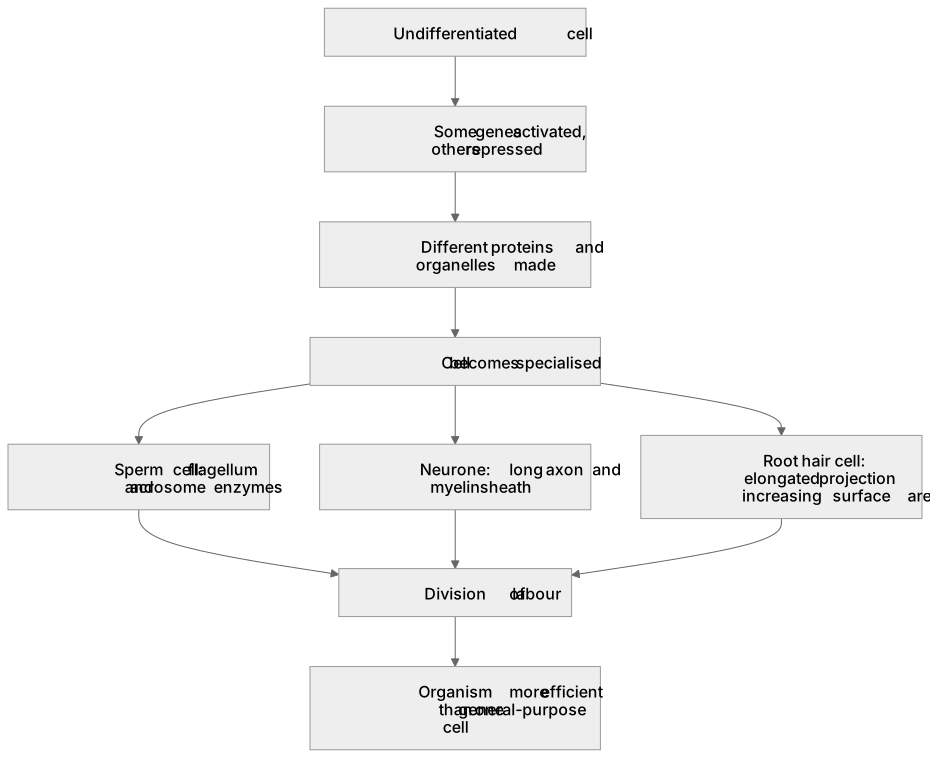
Cell differentiation is the process by which undifferentiated cells develop specific structures and functions. Particular genes are activated while others are repressed, so each cell produces the proteins and organelles needed for its role. This specialisation allows multicellular organisms to divide labour among cell types, so each job is done more efficiently than if one general-purpose cell attempted everything. Examples include sperm cells with a flagellum and acrosome enzymes, neurones with a long axon and myelin sheath, and root hair cells with an elongated projection that increases surface area for water uptake. Differentiated cells keep all their genes; they simply express different subsets of them.
What earns the marks
- Defining cell differentiation as the process by which cells become specialised to carry out a particular function.
- Explaining that differentiation involves activating some genes and repressing others, so different proteins are made.
- Explaining that specialised cells allow division of labour, making the organism more efficient than one general-purpose cell could be.
- Describing structural adaptations of named specialised cells, such as the sperm cell flagellum, the neurone axon, or the root hair cell projection.
- Stating that differentiated cells retain all their genes and differ only in which genes are expressed.
Common mistakes and how to put them right
Believing differentiated cells lose genes permanently.
Put it right by stating that all genes remain present but only some are expressed.
Naming a tissue or organ, such as blood or heart, when asked for a specialised cell.
Put it right by naming a single cell type, such as a red blood cell or a cardiac muscle cell.
Giving an adaptation without linking it to function.
Put it right by writing, for example, 'the root hair cell has a long projection, which increases surface area for absorption of water'.
Exam tips
- Link structure directly to function for every example: for instance, a neurone's myelin sheath insulates the axon so impulses travel faster.
- Use the phrase division of labour to explain why differentiation makes a multicellular organism efficient, and contrast this with a single-celled organism carrying out all processes in one cell.
Try the lesson
The start of the Supplying the cell: explain the importance of cell differentiation (to include: the production of specialised cells allowing organisms to become more efficient and examples of specialised cells) lesson, made from teaching notes for this specification point.
Have a go first
What is meant by cell differentiation?
Listen
Cell differentiation is the process by which undifferentiated cells develop specific structures and functions. Particular genes are activated while others are repressed, so each cell produces the proteins and organelles needed for its role. This specialisation allows multicellular organisms to divide labour among cell types, so each job is done more efficiently than if one general-purpose cell attempted everything. Examples include sperm cells with a flagellum and acrosome enzymes, neurones with a long axon and myelin sheath, and root hair cells with an elongated projection that increases surface area for water uptake. Differentiated cells keep all their genes; they simply express different subsets of them. A strong answer earns marks for these points. Defining cell differentiation as the process by which cells become specialised to carry out a particular function. Explaining that differentiation involves activating some genes and repressing others, so different proteins are made. Explaining that specialised cells allow division of labour, making the organism more efficient than one general-purpose cell could be. Describing structural adaptations of named specialised cells, such as the sperm cell flagellum, the neurone axon, or the root hair cell projection. A common slip: Believing differentiated cells lose genes permanently. Instead, stating that all genes remain present but only some are expressed. Exam tip: Link structure directly to function for every example: for instance, a neurone's myelin sheath insulates the axon so impulses travel faster.
See it
Key words
Say what each word means before you turn the card.
cell differentiation
Try answering aloud or in your head before turning the card.
specialised cells
Try answering aloud or in your head before turning the card.
division of labour
Try answering aloud or in your head before turning the card.
structural adaptations
Try answering aloud or in your head before turning the card.
See every definition
- cell differentiation
- The process by which undifferentiated cells develop specific structures and functions.
- specialised cells
- Cells that have developed particular structures and functions for a specific role.
- division of labour
- The sharing of jobs among cell types so each job is done more efficiently.
- structural adaptations
- Features of named specialised cells, such as a flagellum, a long axon or an elongated projection.
Label the diagram
Some boxes have lost their names. Pick the right name for each number.
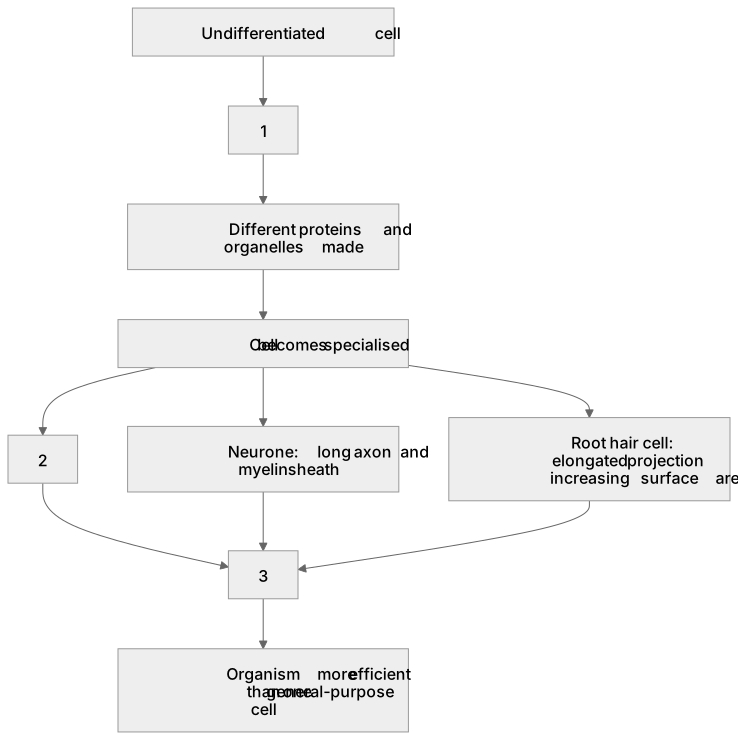
1Box 1
2Box 2
3Box 3
There is more to this lesson
The full lesson goes on to check your understanding and help you earn the marks. Create a free account to carry on, with your progress saved.
A week of Premium from your first lesson · Then the free plan continues · No card, no charge
Test your understanding of Supplying the cell: explain the importance of cell differentiation (to include: the production of specialised cells allowing organisms to become more efficient and examples of specialised cells)
Active recall beats re-reading. Take an instant quiz now to test what you’ve learned and lock it into long-term memory.
A week of Premium from your first lesson · Then the free plan continues · No card, no charge