OCR · GCSE · Biology
Course version: J247 · Version from Sept 2018
Use percentiles and calculate percentage gain and loss of mass
Full specification wording
Supplying the cell: use percentiles and calculate percentage gain and loss of mass
In osmosis experiments with potato cylinders, percentage change in mass standardises results because pieces cannot be cut to identical starting masses.
- Point 1 of 7
- 3 key terms
Study notes
From the teaching notes for this specification point.
The idea
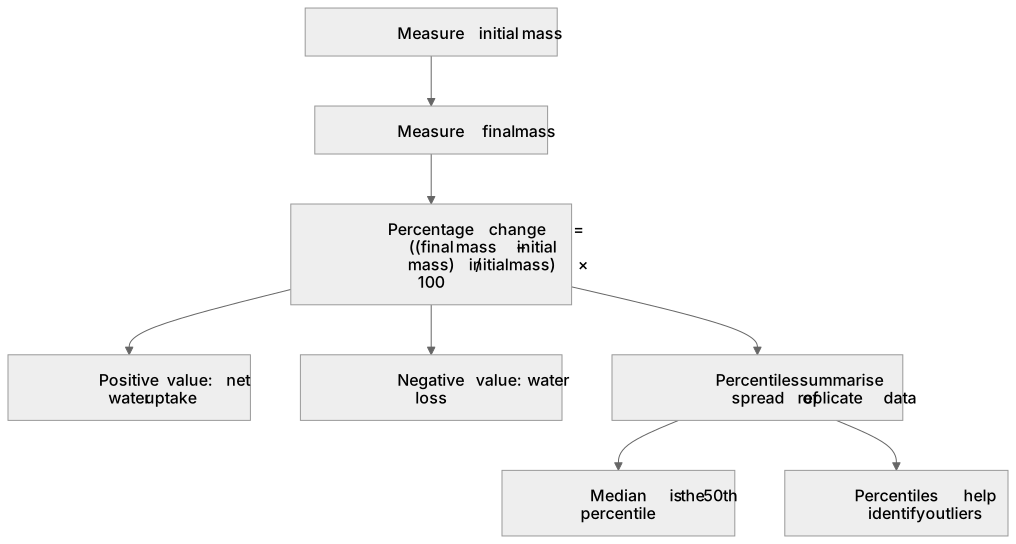
In osmosis experiments with potato cylinders, percentage change in mass standardises results because pieces cannot be cut to identical starting masses. Use: percentage change = ((final mass − initial mass) / initial mass) × 100. A positive value indicates net water uptake; a negative value indicates water loss. A percentile is the value below which a given percentage of observations fall. For example, the 25th percentile of percentage mass changes is the value below which 25% of cylinders lie. Percentiles summarise the spread of replicate data and help identify outliers. The median is the 50th percentile. Comparing percentiles between salt concentrations shows how the distribution of mass changes shifts as water potential changes.
What earns the marks
- Using the formula percentage change = ((final mass − initial mass) / initial mass) × 100.
- Explaining that percentage change standardises data when starting masses of tissue cylinders differ.
- Indicating mass gain as a positive percentage and mass loss as a negative percentage with the correct sign.
- Defining a percentile as the value below which a given percentage of observations fall, and identifying the median as the 50th percentile.
- Using percentiles to describe the spread of replicate percentage mass changes and to identify outliers.
Common mistakes and how to put them right
Dividing by the final mass instead of the initial mass in the denominator.
Put it right: Divide by the starting mass.
Omitting the negative sign when tissue experiences a loss in mass.
Put it right: If final mass is smaller than initial mass, write a minus sign before the percentage.
Confusing a percentile with a percentage.
Put it right: A percentile is a position in a ranked data set, while a percentage is a fraction out of 100.
Exam tips
- Memorise the formula: (change in mass / initial mass) × 100. Always divide by the starting mass.
- If final mass is smaller than initial mass, make sure you write a minus sign in front of the percentage.
- When asked to use percentiles, state the percentage of values below the given value, e.g. the 25th percentile has 25% of results below it.
Try the lesson
The start of the Supplying the cell: use percentiles and calculate percentage gain and loss of mass lesson, made from teaching notes for this specification point.
Have a go first
A potato cylinder has an initial mass of 2.50 g and a final mass of 2.85 g after soaking in dilute sucrose solution. What is the percentage change in mass?
Listen
In osmosis experiments with potato cylinders, percentage change in mass standardises results because pieces cannot be cut to identical starting masses. Use: percentage change = ((final mass − initial mass) / initial mass) × 100. A positive value indicates net water uptake; a negative value indicates water loss. A percentile is the value below which a given percentage of observations fall. For example, the 25th percentile of percentage mass changes is the value below which 25% of cylinders lie. Percentiles summarise the spread of replicate data and help identify outliers. The median is the 50th percentile. Comparing percentiles between salt concentrations shows how the distribution of mass changes shifts as water potential changes. A strong answer earns marks for these points. Using the formula percentage change = ((final mass − initial mass) / initial mass) × 100. Explaining that percentage change standardises data when starting masses of tissue cylinders differ. Indicating mass gain as a positive percentage and mass loss as a negative percentage with the correct sign. Defining a percentile as the value below which a given percentage of observations fall, and identifying the median as the 50th percentile. A common slip: Dividing by the final mass instead of the initial mass in the denominator. Instead, divide by the starting mass. Exam tip: Memorise the formula: (change in mass / initial mass) × 100. Always divide by the starting mass.
See it
Key words
Say what each word means before you turn the card.
percentage change
Try answering aloud or in your head before turning the card.
percentile
Try answering aloud or in your head before turning the card.
percentage gain and loss of mass
Try answering aloud or in your head before turning the card.
See every definition
- percentage change
- Calculated as ((final mass − initial mass) / initial mass) × 100, standardising results because pieces cannot be cut to identical starting masses.
- percentile
- The value below which a given percentage of observations fall, summarising the spread of replicate data and helping identify outliers.
- percentage gain and loss of mass
- A positive value indicates net water uptake, while a negative value indicates water loss.
Label the diagram
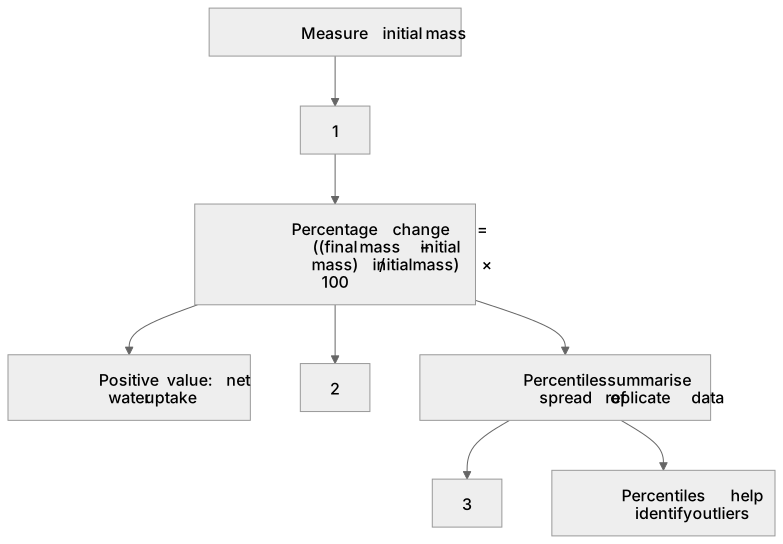
Some boxes have lost their names. Pick the right name for each number.
1Box 1
2Box 2
3Box 3
There is more to this lesson
The full lesson goes on to check your understanding and help you earn the marks. Create a free account to carry on, with your progress saved.
A week of Premium from your first lesson · Then the free plan continues · No card, no charge
Test your understanding of Supplying the cell: use percentiles and calculate percentage gain and loss of mass
Active recall beats re-reading. Take an instant quiz now to test what you’ve learned and lock it into long-term memory.
A week of Premium from your first lesson · Then the free plan continues · No card, no charge