OCR · GCSE · Biology
Course version: J247 · Version from Sept 2018
Explain how substances are transported into and out of cells through…
Full specification wording
Supplying the cell: explain how substances are transported into and out of cells through diffusion, osmosis and active transport (to include: examples of substances moved, direction of movement, concentration gradients and use of the term water potential (no mathematical use of water potential required))
Substances traverse cell membranes via three core mechanisms.
- Point 2 of 7
- 3 key terms
Study notes
From the teaching notes for this specification point.
The idea
Substances traverse cell membranes via three core mechanisms. Diffusion is the passive net movement of particles from high to low concentration down a concentration gradient, such as oxygen and carbon dioxide exchanging across alveoli. Osmosis is the passive net movement of water molecules from a region of higher water potential (dilute solution) to a lower water potential (concentrated solution) across a partially permeable membrane. Active transport moves substances against their concentration gradient (from low to high concentration) using carrier proteins and energy from ATP, like mineral uptake in roots.
What earns the marks
- Defining diffusion as passive particle movement down a concentration gradient with an example such as oxygen.
- Defining osmosis as passive water movement from higher to lower water potential across a partially permeable membrane.
- Defining active transport as particle movement against a concentration gradient using carrier proteins and ATP.
- Contrasting energy requirements: diffusion and osmosis are passive, whereas active transport requires cellular energy.
Common mistakes and how to put them right
Stating that water moves from low to high concentration without referencing water potential or solute concentration.
Thinking active transport occurs down a concentration gradient or does not require cellular energy from ATP.
Exam tips
- Always state three details for each process: substance moved, direction relative to gradient, and energy requirement.
- For osmosis, always refer to water molecules moving across a partially permeable membrane from higher to lower water potential.
Try the lesson
The start of the Supplying the cell: explain how substances are transported into and out of cells through diffusion, osmosis and active transport (to include: examples of substances moved, direction of movement, concentration gradients and use of the term water potential (no mathematical use of water potential required)) lesson, made from teaching notes for this specification point.
Have a go first
Which process describes the movement of oxygen into a cell from a region of higher oxygen concentration outside the cell?
Listen
Substances traverse cell membranes via three core mechanisms. Diffusion is the passive net movement of particles from high to low concentration down a concentration gradient, such as oxygen and carbon dioxide exchanging across alveoli. Osmosis is the passive net movement of water molecules from a region of higher water potential (dilute solution) to a lower water potential (concentrated solution) across a partially permeable membrane. Active transport moves substances against their concentration gradient (from low to high concentration) using carrier proteins and energy from ATP, like mineral uptake in roots. A strong answer earns marks for these points. defining diffusion as passive particle movement down a concentration gradient with an example such as oxygen. defining osmosis as passive water movement from higher to lower water potential across a partially permeable membrane. defining active transport as particle movement against a concentration gradient using carrier proteins and ATP. contrasting energy requirements: diffusion and osmosis are passive, whereas active transport requires cellular energy. Exam tip: Always state three details for each process: substance moved, direction relative to gradient, and energy requirement.
See it

Key words
Say what each word means before you turn the card.
diffusion
Try answering aloud or in your head before turning the card.
osmosis
Try answering aloud or in your head before turning the card.
active transport
Try answering aloud or in your head before turning the card.
See every definition
- diffusion
- The passive net movement of particles from high to low concentration down a concentration gradient, such as oxygen and carbon dioxide exchanging across alveoli.
- osmosis
- The passive net movement of water molecules from a region of higher water potential to a lower water potential across a partially permeable membrane.
- active transport
- The movement of substances against their concentration gradient from low to high concentration using carrier proteins and energy from ATP.
Label the diagram
Some boxes have lost their names. Pick the right name for each number.
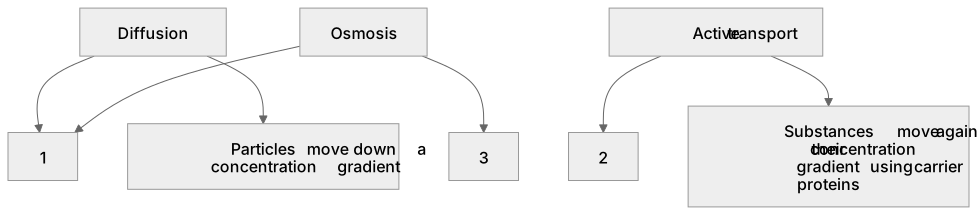
1Box 1
2Box 2
3Box 3
There is more to this lesson
The full lesson goes on to check your understanding and help you earn the marks. Create a free account to carry on, with your progress saved.
A week of Premium from your first lesson · Then the free plan continues · No card, no charge
Test your understanding of Supplying the cell: explain how substances are transported into and out of cells through diffusion, osmosis and active transport (to include: examples of substances moved, direction of movement, concentration gradients and use of the term water potential (no mathematical use of water potential required))
Active recall beats re-reading. Take an instant quiz now to test what you’ve learned and lock it into long-term memory.
A week of Premium from your first lesson · Then the free plan continues · No card, no charge