OCR · GCSE · Biology
Course version: J247 · Version from Sept 2018
The challenges of size: carry out rate calculations
Carrying out rate calculations in transport systems requires applying mathematical equations to experimental and anatomical data.
- Point 3 of 14
- 3 key terms
Study notes
From the teaching notes for this specification point.
The idea
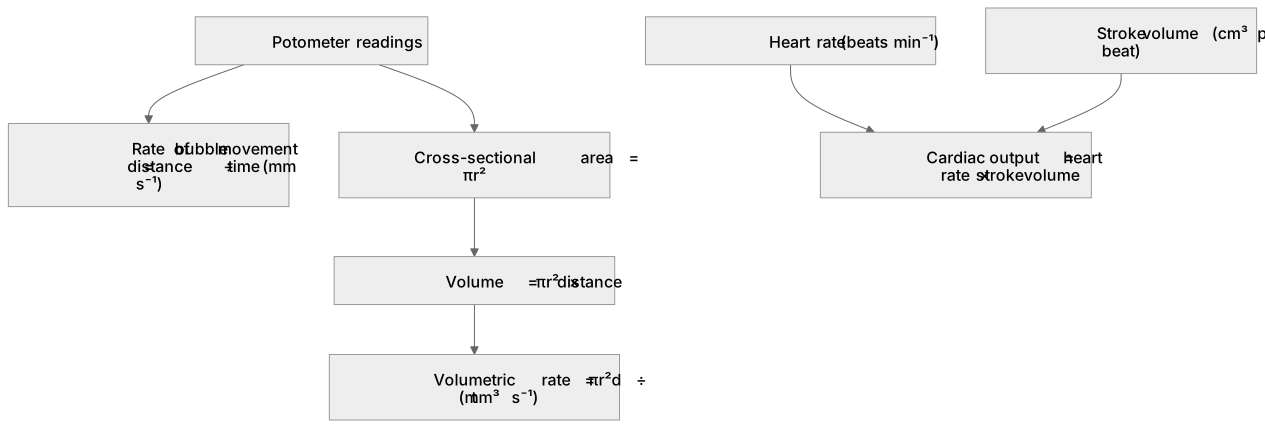
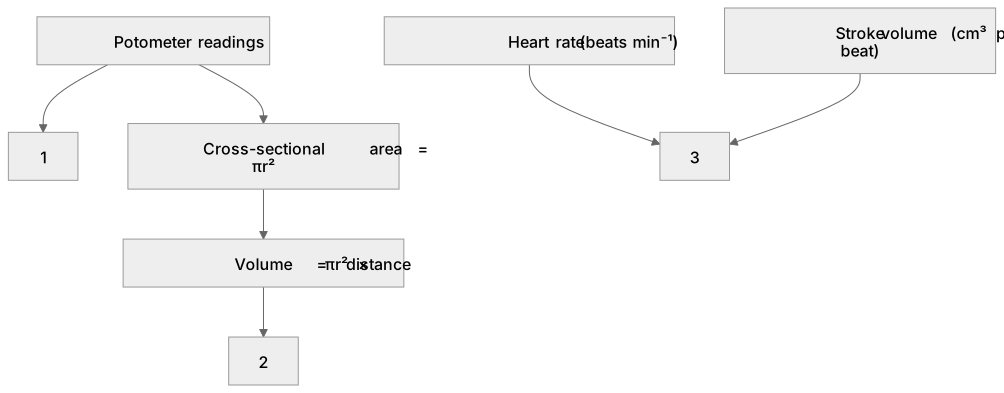
Carrying out rate calculations in transport systems requires applying mathematical equations to experimental and anatomical data. For a bubble potometer measuring water uptake, rate of movement is calculated as distance moved by the air bubble divided by time taken (mm s⁻¹). To determine volumetric rate of uptake, the cross-sectional area of the capillary tube (πr²) is multiplied by distance to find volume, then divided by time: rate = πr²d / t (in mm³ s⁻¹). In human cardiovascular physiology, cardiac output is calculated by multiplying heart rate (beats min⁻¹) by stroke volume (cm³ per beat).
What earns the marks
- Calculating rate of bubble movement as distance divided by time with appropriate units.
- Calculating volume of water absorbed using πr² × distance and dividing by time.
- Calculating cardiac output using heart rate multiplied by stroke volume.
Common mistakes and how to put them right
Forgetting to halve diameter to find radius r before calculating capillary cross-sectional area πr².
Multiplying rather than dividing by time when computing rate from total distance or volume.
Exam tips
- When calculating volume from capillary movement, remember Volume = πr² × distance; ensure r and d share matching units.
- For cardiac output problems, use the equation: Cardiac Output = Heart Rate × Stroke Volume.
Try the lesson
The start of the The challenges of size: carry out rate calculations lesson, made from teaching notes for this specification point.
Have a go first
A reaction produces 60 cm³ of gas in 20 seconds. What is the rate of gas production in cm³ per second?
Listen
Carrying out rate calculations in transport systems requires applying mathematical equations to experimental and anatomical data. For a bubble potometer measuring water uptake, rate of movement is calculated as distance moved by the air bubble divided by time taken (mm s⁻¹). To determine volumetric rate of uptake, the cross-sectional area of the capillary tube (πr²) is multiplied by distance to find volume, then divided by time: rate = πr²d / t (in mm³ s⁻¹). In human cardiovascular physiology, cardiac output is calculated by multiplying heart rate (beats min⁻¹) by stroke volume (cm³ per beat). A strong answer earns marks for these points. calculating rate of bubble movement as distance divided by time with appropriate units. calculating volume of water absorbed using πr² × distance and dividing by time. calculating cardiac output using heart rate multiplied by stroke volume. Exam tip: When calculating volume from capillary movement, remember Volume = πr² × distance; ensure r and d share matching units.
See it
Key words
Say what each word means before you turn the card.
rate calculations
Try answering aloud or in your head before turning the card.
potometer calculations
Try answering aloud or in your head before turning the card.
cardiac output
Try answering aloud or in your head before turning the card.
See every definition
- rate calculations
- Applying mathematical equations to experimental and anatomical data in transport systems, such as dividing distance by time or multiplying heart rate by stroke volume.
- potometer calculations
- For a bubble potometer, rate of movement is distance moved by the air bubble divided by time taken, and volumetric rate is πr²d divided by t.
- cardiac output
- Calculated by multiplying heart rate in beats min⁻¹ by stroke volume in cm³ per beat.
Label the diagram
Some boxes have lost their names. Pick the right name for each number.
1Box 1
2Box 2
3Box 3
There is more to this lesson
The full lesson goes on to check your understanding and help you earn the marks. Create a free account to carry on, with your progress saved.
A week of Premium from your first lesson · Then the free plan continues · No card, no charge
Test your understanding of The challenges of size: carry out rate calculations
Active recall beats re-reading. Take an instant quiz now to test what you’ve learned and lock it into long-term memory.
A week of Premium from your first lesson · Then the free plan continues · No card, no charge