OCR · GCSE · Biology
Course version: J247 · Version from Sept 2018
Describe the processes of transpiration and translocation (to include: the…
Full specification wording
The challenges of size: describe the processes of transpiration and translocation (to include: the structure and function of the stomata)
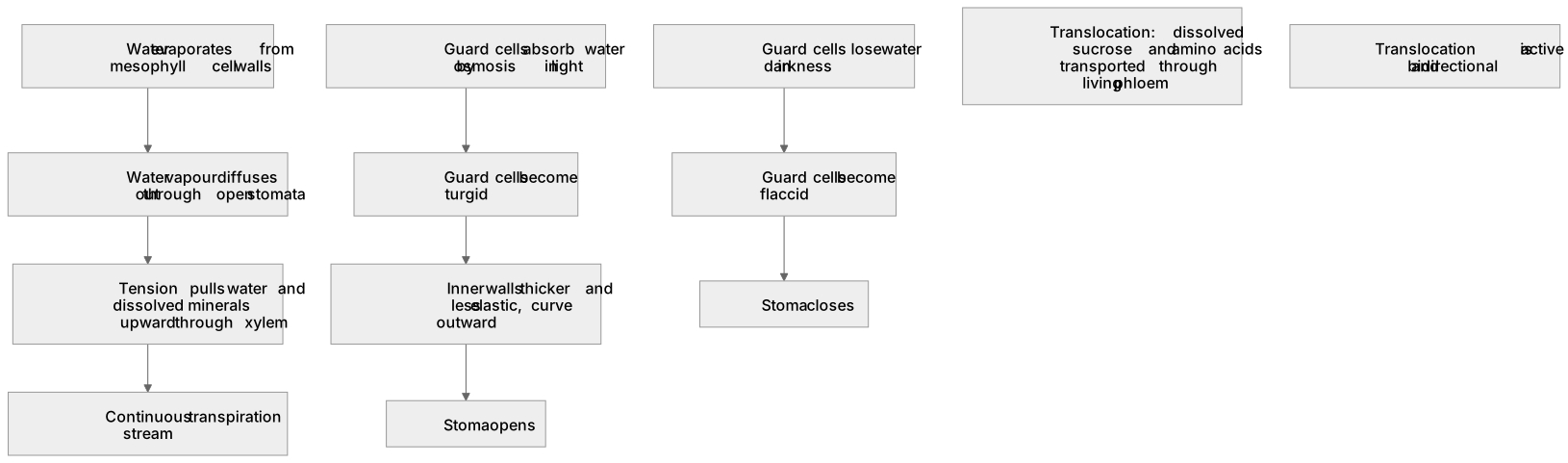
Transpiration is the passive loss of water vapor from plant leaves via evaporation from mesophyll cell walls followed by diffusion through open stomata.
- Point 11 of 14
- 4 key terms
Study notes
From the teaching notes for this specification point.
The idea
Transpiration is the passive loss of water vapor from plant leaves via evaporation from mesophyll cell walls followed by diffusion through open stomata. This creates tension pulling water and dissolved minerals upward through xylem in a continuous transpiration stream. Stomata are microscopic pores bounded by pairs of guard cells. In light, guard cells absorb water by osmosis, becoming turgid; because inner cell walls are thicker and less elastic, they curve outward, opening the pore. In darkness, guard cells lose water, turning flaccid and closing the stoma. Translocation is the active, bidirectional transport of dissolved assimilates (sucrose, amino acids) through living phloem.
What earns the marks
- Describing transpiration as evaporation of water from mesophyll cells and diffusion out through stomata.
- Explaining how guard cells control stomatal opening: swelling turgidly in light to open, becoming flaccid in darkness to close.
- Describing translocation as the transport of dissolved sucrose and amino acids through phloem.
- Contrasting energy and direction: transpiration is passive and upward-only; translocation requires energy and is bidirectional.
Common mistakes and how to put them right
Confusing transpiration (water and minerals in xylem, passive) with translocation (sugars in phloem, active).
Claiming stomata open when guard cells lose water, reversing the turgid and flaccid states.
Exam tips
- Clearly state the mechanism of stomatal opening: guard cells take in water by osmosis, become turgid, and bend to open the pore.
- Remember that translocation moves sucrose and amino acids from sources (e.g. leaves) to sinks (e.g. roots or fruits).
Try the lesson
The start of the The challenges of size: describe the processes of transpiration and translocation (to include: the structure and function of the stomata) lesson, made from teaching notes for this specification point.
Have a go first
Which process describes the loss of water vapour from the leaves of a plant?
Listen
Transpiration is the passive loss of water vapor from plant leaves via evaporation from mesophyll cell walls followed by diffusion through open stomata. This creates tension pulling water and dissolved minerals upward through xylem in a continuous transpiration stream. Stomata are microscopic pores bounded by pairs of guard cells. In light, guard cells absorb water by osmosis, becoming turgid; because inner cell walls are thicker and less elastic, they curve outward, opening the pore. In darkness, guard cells lose water, turning flaccid and closing the stoma. Translocation is the active, bidirectional transport of dissolved assimilates (sucrose, amino acids) through living phloem. A strong answer earns marks for these points. describing transpiration as evaporation of water from mesophyll cells and diffusion out through stomata. explaining how guard cells control stomatal opening: swelling turgidly in light to open, becoming flaccid in darkness to close. describing translocation as the transport of dissolved sucrose and amino acids through phloem. contrasting energy and direction: transpiration is passive and upward-only; translocation requires energy and is bidirectional. Exam tip: Clearly state the mechanism of stomatal opening: guard cells take in water by osmosis, become turgid, and bend to open the pore.
See it
Key words
Say what each word means before you turn the card.
transpiration
Try answering aloud or in your head before turning the card.
translocation
Try answering aloud or in your head before turning the card.
stomata and guard cells
Try answering aloud or in your head before turning the card.
transpiration stream
Try answering aloud or in your head before turning the card.
See every definition
- transpiration
- The passive loss of water vapour from plant leaves via evaporation from mesophyll cell walls followed by diffusion through open stomata.
- translocation
- The active, bidirectional transport of dissolved assimilates such as sucrose and amino acids through living phloem.
- stomata and guard cells
- Microscopic pores bounded by pairs of guard cells, which become turgid in light to open the pore and flaccid in darkness to close it.
- transpiration stream
- A continuous stream in which tension pulls water and dissolved minerals upward through xylem.
Label the diagram
Some boxes have lost their names. Pick the right name for each number.
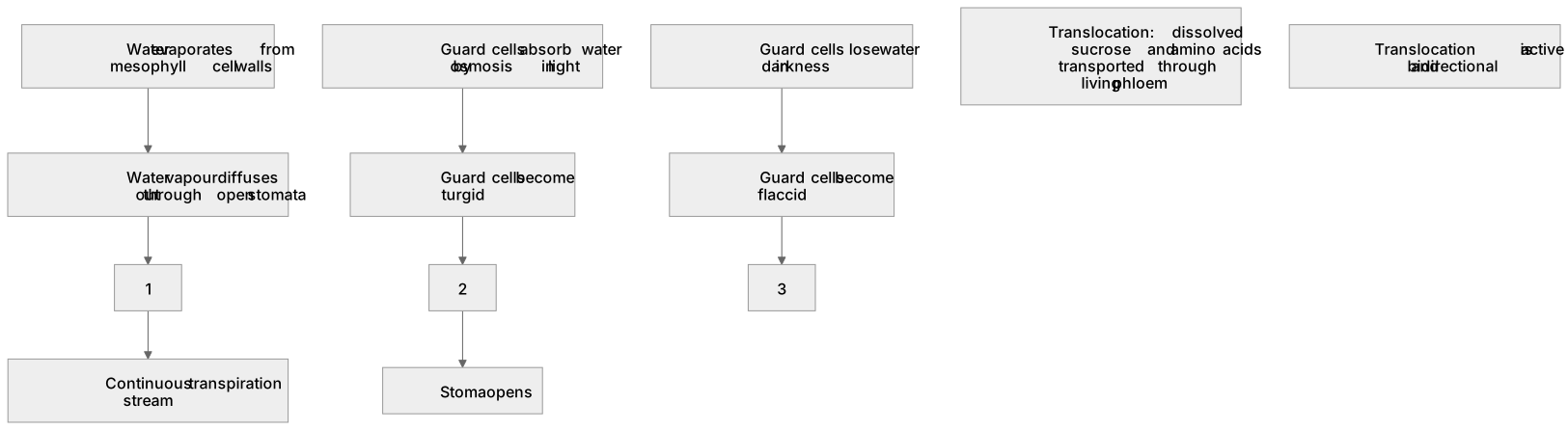
1Box 1
2Box 2
3Box 3
There is more to this lesson
The full lesson goes on to check your understanding and help you earn the marks. Create a free account to carry on, with your progress saved.
A week of Premium from your first lesson · Then the free plan continues · No card, no charge
Test your understanding of The challenges of size: describe the processes of transpiration and translocation (to include: the structure and function of the stomata)
Active recall beats re-reading. Take an instant quiz now to test what you’ve learned and lock it into long-term memory.
A week of Premium from your first lesson · Then the free plan continues · No card, no charge