OCR · GCSE · Biology
Course version: J247 · Version from Sept 2018
Explain how water and mineral ions are taken up by plants, relating the…
Full specification wording
The challenges of size: explain how water and mineral ions are taken up by plants, relating the structure of the root hair cells to their function
Root hair cells are specialized epidermal cells adapted for rapid absorption of soil water and mineral ions.
- Point 10 of 14
- 4 key terms
Study notes
From the teaching notes for this specification point.
The idea
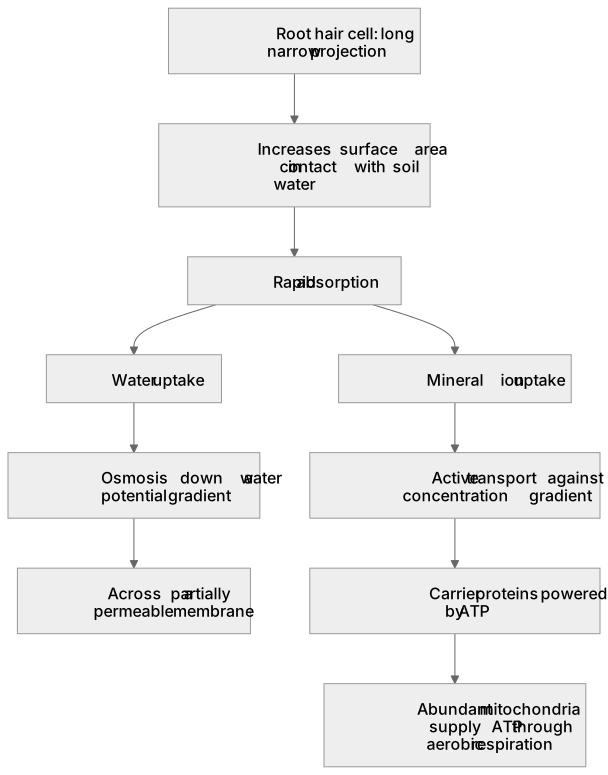
Root hair cells are specialized epidermal cells adapted for rapid absorption of soil water and mineral ions. Each cell features a long, narrow cytoplasmic extension that significantly amplifies the surface area in contact with soil water, facilitating rapid uptake. Water enters root hair cells down a water potential gradient by osmosis across a partially permeable membrane, as cell sap maintains a lower water potential than soil moisture. Mineral ions, such as nitrates and magnesium, exist in lower concentrations in soil than inside root cells, requiring active transport against their concentration gradient using carrier proteins powered by ATP.
What earns the marks
- Explaining the elongated root hair projection increases surface area for rapid absorption.
- Explaining water enters by osmosis down a water potential gradient across a partially permeable membrane.
- Explaining mineral ions are absorbed by active transport against their concentration gradient using ATP.
- Identifying abundant mitochondria supplying ATP through aerobic respiration for active transport.
Common mistakes and how to put them right
Stating mineral ions enter by osmosis, confusing water transport (osmosis) with ion transport (active transport or diffusion).
Claiming root hair cells have chloroplasts, forgetting underground roots receive no light.
Exam tips
- Distinguish water uptake (osmosis down a water potential gradient) from mineral uptake (active transport against a concentration gradient).
- Mention abundant mitochondria in root hair cells to justify the ATP requirement for active transport.
Try the lesson
The start of the The challenges of size: explain how water and mineral ions are taken up by plants, relating the structure of the root hair cells to their function lesson, made from teaching notes for this specification point.
Have a go first
How does the structure of a root hair cell help it to absorb water and mineral ions from the soil?
Listen
Root hair cells are specialized epidermal cells adapted for rapid absorption of soil water and mineral ions. Each cell features a long, narrow cytoplasmic extension that significantly amplifies the surface area in contact with soil water, facilitating rapid uptake. Water enters root hair cells down a water potential gradient by osmosis across a partially permeable membrane, as cell sap maintains a lower water potential than soil moisture. Mineral ions, such as nitrates and magnesium, exist in lower concentrations in soil than inside root cells, requiring active transport against their concentration gradient using carrier proteins powered by ATP. A strong answer earns marks for these points. explaining the elongated root hair projection increases surface area for rapid absorption. explaining water enters by osmosis down a water potential gradient across a partially permeable membrane. explaining mineral ions are absorbed by active transport against their concentration gradient using ATP. identifying abundant mitochondria supplying ATP through aerobic respiration for active transport. Exam tip: Distinguish water uptake (osmosis down a water potential gradient) from mineral uptake (active transport against a concentration gradient).
See it
Key words
Say what each word means before you turn the card.
root hair cell adaptations
Try answering aloud or in your head before turning the card.
osmosis and water uptake
Try answering aloud or in your head before turning the card.
active transport of minerals
Try answering aloud or in your head before turning the card.
mitochondria and ATP
Try answering aloud or in your head before turning the card.
See every definition
- root hair cell adaptations
- A long, narrow cytoplasmic extension that significantly amplifies the surface area in contact with soil water, facilitating rapid uptake.
- osmosis and water uptake
- Water enters down a water potential gradient across a partially permeable membrane, as cell sap maintains a lower water potential than soil moisture.
- active transport of minerals
- Mineral ions in lower concentrations in soil than inside root cells are absorbed against their concentration gradient using carrier proteins powered by ATP.
- mitochondria and ATP
- Abundant mitochondria supply ATP through aerobic respiration for active transport.
Label the diagram
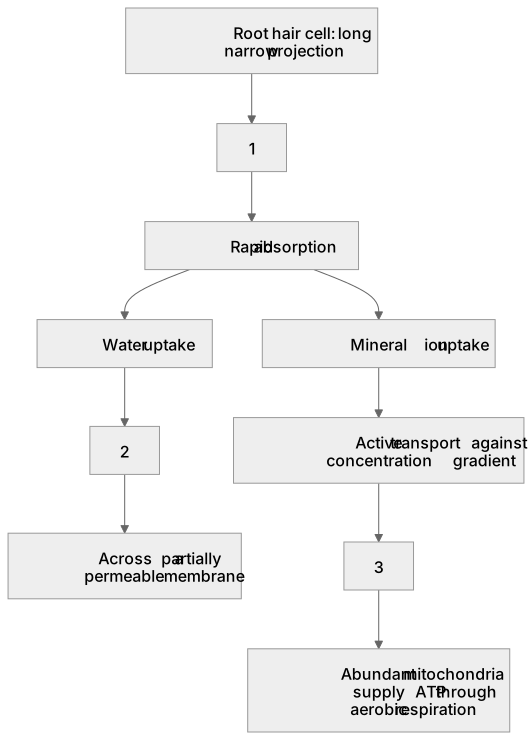
Some boxes have lost their names. Pick the right name for each number.
1Box 1
2Box 2
3Box 3
There is more to this lesson
The full lesson goes on to check your understanding and help you earn the marks. Create a free account to carry on, with your progress saved.
A week of Premium from your first lesson · Then the free plan continues · No card, no charge
Test your understanding of The challenges of size: explain how water and mineral ions are taken up by plants, relating the structure of the root hair cells to their function
Active recall beats re-reading. Take an instant quiz now to test what you’ve learned and lock it into long-term memory.
A week of Premium from your first lesson · Then the free plan continues · No card, no charge