OCR · GCSE · Biology
Course version: J247 · Version from Sept 2018
Explain how red blood cells and plasma are adapted to their transport…
Full specification wording
The challenges of size: explain how red blood cells and plasma are adapted to their transport functions in the blood
Red blood cells (erythrocytes) are highly specialized to transport oxygen.
- Point 9 of 14
- 4 key terms
Study notes
From the teaching notes for this specification point.
The idea
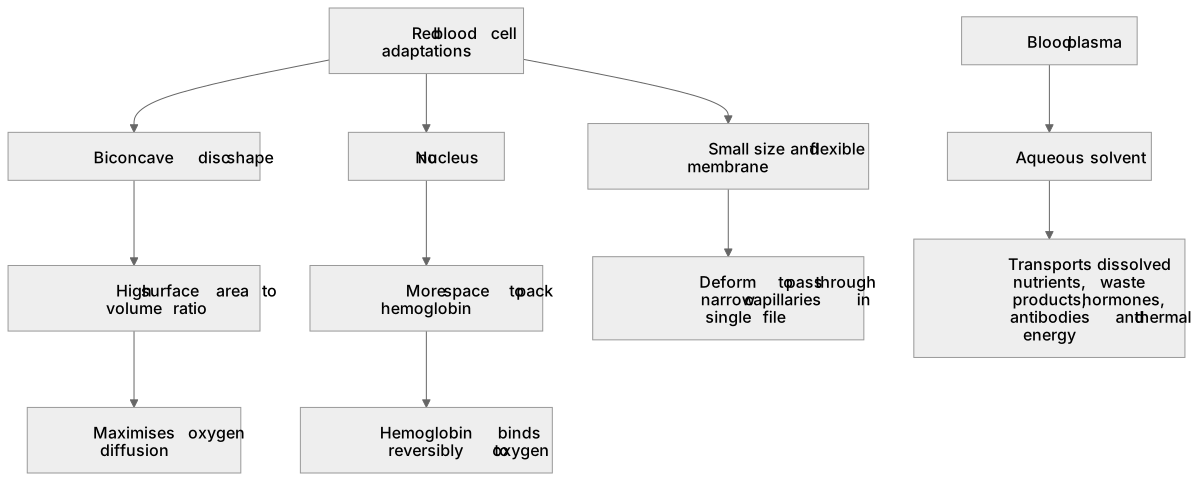
Red blood cells (erythrocytes) are highly specialized to transport oxygen. Their biconcave disc shape provides a high surface area to volume ratio, maximizing oxygen diffusion rates. Lacking a nucleus, erythrocytes maximize internal space to pack hemoglobin molecules, which bind reversibly to oxygen: Hb + 4O₂ ⇌ Hb(O₂)₄. Their small size and flexible membrane enable them to deform and pass through narrow capillaries in single file. Blood plasma is a pale straw-colored aqueous solvent that transports dissolved nutrients (glucose, amino acids), waste products (urea, carbon dioxide), hormones, antibodies, and thermal energy.
What earns the marks
- Explaining biconcave disc shape increases surface area to volume ratio for rapid oxygen diffusion.
- Explaining lack of nucleus allows more space for hemoglobin to carry oxygen reversibly.
- Describing red blood cell flexibility allowing single-file transit through narrow capillaries.
- Identifying plasma as an aqueous solvent transporting dissolved glucose, amino acids, urea, CO₂, and hormones.
Common mistakes and how to put them right
Stating red blood cells carry carbon dioxide primarily, forgetting CO₂ is mainly transported dissolved in plasma as hydrogencarbonate.
Claiming red blood cells absorb oxygen rather than oxygen binding reversibly to hemoglobin.
Exam tips
- List two distinct adaptations of red blood cells: biconcave disc for high SA:V, and absence of nucleus for maximum hemoglobin.
- Identify at least three distinct solutes transported by plasma: glucose, urea, and carbon dioxide.
Try the lesson
The start of the The challenges of size: explain how red blood cells and plasma are adapted to their transport functions in the blood lesson, made from teaching notes for this specification point.
Have a go first
Which feature of a red blood cell is an adaptation that helps it to transport oxygen efficiently?
Listen
Red blood cells (erythrocytes) are highly specialized to transport oxygen. Their biconcave disc shape provides a high surface area to volume ratio, maximizing oxygen diffusion rates. Lacking a nucleus, erythrocytes maximize internal space to pack hemoglobin molecules, which bind reversibly to oxygen: Hb + 4O₂ ⇌ Hb(O₂)₄. Their small size and flexible membrane enable them to deform and pass through narrow capillaries in single file. Blood plasma is a pale straw-colored aqueous solvent that transports dissolved nutrients (glucose, amino acids), waste products (urea, carbon dioxide), hormones, antibodies, and thermal energy. A strong answer earns marks for these points. explaining biconcave disc shape increases surface area to volume ratio for rapid oxygen diffusion. explaining lack of nucleus allows more space for hemoglobin to carry oxygen reversibly. describing red blood cell flexibility allowing single-file transit through narrow capillaries. identifying plasma as an aqueous solvent transporting dissolved glucose, amino acids, urea, CO₂, and hormones. Exam tip: List two distinct adaptations of red blood cells: biconcave disc for high SA:V, and absence of nucleus for maximum hemoglobin.
See it
Key words
Say what each word means before you turn the card.
biconcave disc
Try answering aloud or in your head before turning the card.
hemoglobin
Try answering aloud or in your head before turning the card.
blood plasma
Try answering aloud or in your head before turning the card.
erythrocyte adaptations
Try answering aloud or in your head before turning the card.
See every definition
- biconcave disc
- A shape that provides a high surface area to volume ratio, maximizing oxygen diffusion rates.
- hemoglobin
- Molecules packed inside erythrocytes that bind reversibly to oxygen.
- blood plasma
- A pale straw-coloured aqueous solvent that transports dissolved nutrients, waste products, hormones, antibodies and thermal energy.
- erythrocyte adaptations
- A biconcave disc shape, lack of a nucleus, and a small size with flexible membrane enabling single-file transit through narrow capillaries.
Label the diagram
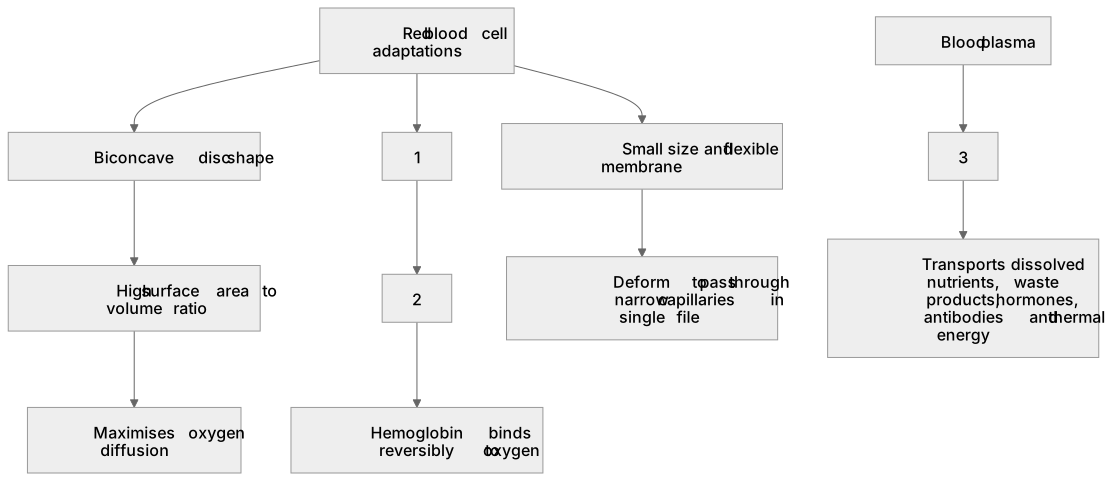
Some boxes have lost their names. Pick the right name for each number.
1Box 1
2Box 2
3Box 3
There is more to this lesson
The full lesson goes on to check your understanding and help you earn the marks. Create a free account to carry on, with your progress saved.
A week of Premium from your first lesson · Then the free plan continues · No card, no charge
Test your understanding of The challenges of size: explain how red blood cells and plasma are adapted to their transport functions in the blood
Active recall beats re-reading. Take an instant quiz now to test what you’ve learned and lock it into long-term memory.
A week of Premium from your first lesson · Then the free plan continues · No card, no charge