OCR · GCSE · Biology
Course version: J247 · Version from Sept 2018
Explain the need for exchange surfaces and a transport system in…
Full specification wording
The challenges of size: explain the need for exchange surfaces and a transport system in multicellular organisms in terms of surface area : volume ratio (to include: calculation of surface area, volume and surface area : volume ratio, and reference to diffusion distances)
Unicellular organisms possess a large surface area to volume (SA:V) ratio and short diffusion distances, allowing simple diffusion across the cell surface to satisfy all metabolic gas exchange and…
- Point 5 of 14
- 4 key terms
Study notes
From the teaching notes for this specification point.
The idea
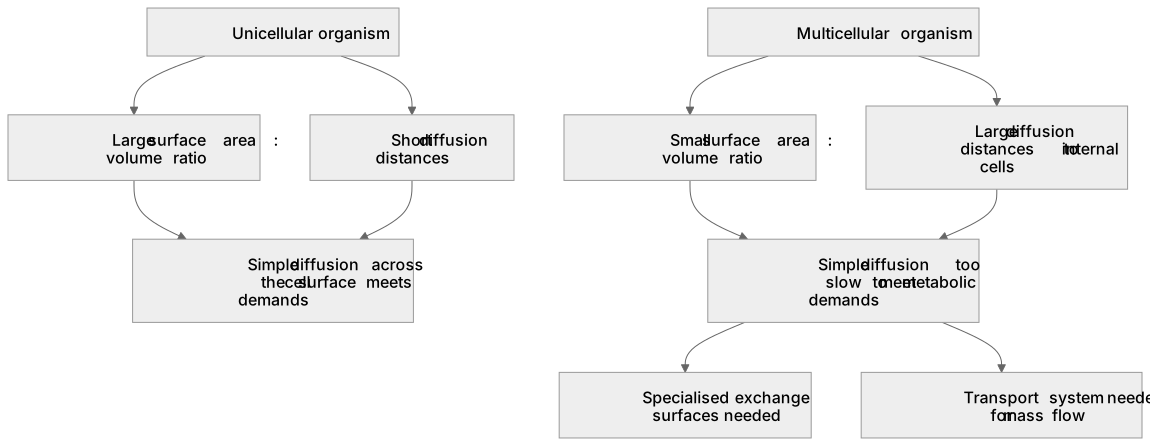
Unicellular organisms possess a large surface area to volume (SA:V) ratio and short diffusion distances, allowing simple diffusion across the cell surface to satisfy all metabolic gas exchange and nutrient demands. As multicellular organisms increase in size, volume grows far faster than surface area, causing SA:V ratio to decrease drastically. Furthermore, diffusion distance from the exterior to interior tissues becomes far too great for diffusion alone to supply oxygen or remove toxic urea. Multicellular organisms therefore require specialized exchange surfaces with folded membranes, paired with mass-flow transport systems.
What earns the marks
- Explaining that single-celled organisms have large SA:V ratios and short diffusion distances for simple diffusion.
- Explaining that multicellular organisms have small SA:V ratios and large diffusion distances to internal cells.
- Stating that simple diffusion across the body surface is too slow to meet multicellular metabolic demands.
- Explaining the need for specialized exchange surfaces and circulatory transport systems for mass flow.
Common mistakes and how to put them right
Stating large organisms have a large surface area to volume ratio, confusing absolute surface area with the ratio.
Forgetting to mention that increased diffusion distance prevents substances reaching internal cells fast enough.
Exam tips
- Contrast small vs large organisms clearly: small organisms have high SA:V and short diffusion distance; large have low SA:V and long distance.
- Always link exchange surfaces (e.g. alveoli) and transport systems (e.g. blood) to overcoming diffusion limitations.
Try the lesson
The start of the The challenges of size: explain the need for exchange surfaces and a transport system in multicellular organisms in terms of surface area : volume ratio (to include: calculation of surface area, volume and surface area : volume ratio, and reference to diffusion distances) lesson, made from teaching notes for this specification point.
Have a go first
A cube-shaped organism has sides of length 2 cm. What is its surface area : volume ratio?
Listen
Unicellular organisms possess a large surface area to volume (SA:V) ratio and short diffusion distances, allowing simple diffusion across the cell surface to satisfy all metabolic gas exchange and nutrient demands. As multicellular organisms increase in size, volume grows far faster than surface area, causing SA:V ratio to decrease drastically. Furthermore, diffusion distance from the exterior to interior tissues becomes far too great for diffusion alone to supply oxygen or remove toxic urea. Multicellular organisms therefore require specialized exchange surfaces with folded membranes, paired with mass-flow transport systems. A strong answer earns marks for these points. explaining that single-celled organisms have large SA:V ratios and short diffusion distances for simple diffusion. explaining that multicellular organisms have small SA:V ratios and large diffusion distances to internal cells. stating that simple diffusion across the body surface is too slow to meet multicellular metabolic demands. explaining the need for specialized exchange surfaces and circulatory transport systems for mass flow. Exam tip: Contrast small vs large organisms clearly: small organisms have high SA:V and short diffusion distance; large have low SA:V and long distance.
See it
Key words
Say what each word means before you turn the card.
surface area to volume ratio
Try answering aloud or in your head before turning the card.
diffusion distances
Try answering aloud or in your head before turning the card.
exchange surfaces
Try answering aloud or in your head before turning the card.
mass-flow transport
Try answering aloud or in your head before turning the card.
See every definition
- surface area to volume ratio
- As multicellular organisms increase in size, volume grows far faster than surface area, causing this ratio to decrease drastically.
- diffusion distances
- The distance from the exterior to interior tissues becomes far too great for diffusion alone to supply oxygen or remove toxic urea.
- exchange surfaces
- Specialized surfaces with folded membranes that multicellular organisms require, paired with mass-flow transport systems.
- mass-flow transport
- A transport system that multicellular organisms require alongside specialized exchange surfaces to meet metabolic demands.
Label the diagram
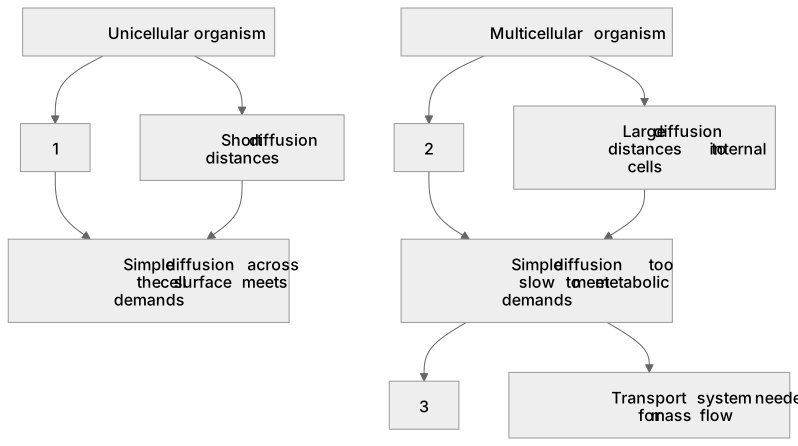
Some boxes have lost their names. Pick the right name for each number.
1Box 1
2Box 2
3Box 3
There is more to this lesson
The full lesson goes on to check your understanding and help you earn the marks. Create a free account to carry on, with your progress saved.
A week of Premium from your first lesson · Then the free plan continues · No card, no charge
Test your understanding of The challenges of size: explain the need for exchange surfaces and a transport system in multicellular organisms in terms of surface area : volume ratio (to include: calculation of surface area, volume and surface area : volume ratio, and reference to diffusion distances)
Active recall beats re-reading. Take an instant quiz now to test what you’ve learned and lock it into long-term memory.
A week of Premium from your first lesson · Then the free plan continues · No card, no charge