OCR · GCSE · Biology
Course version: J247 · Version from Sept 2018
Carry out rate calculations for chemical reactions
Full specification wording
What happens in cells (and what do cells need)?: carry out rate calculations for chemical reactions
Calculating the rate of an enzymatic reaction quantifies how rapidly reactants disappear or products accumulate over time.
- Point 1 of 9
- 3 key terms
Study notes
From the teaching notes for this specification point.
The idea
Calculating the rate of an enzymatic reaction quantifies how rapidly reactants disappear or products accumulate over time. In quantitative biology experiments, rate is determined from the equation rate = volume of product formed / time taken, or rate = mass of substrate broken down / time taken. Alternatively, when measuring the time taken to reach a distinct endpoint, such as the achromatic point where starch is fully digested, rate is proportional to 1 / time (expressed in s⁻¹). On continuous product-time graphs, initial rate of reaction is found by drawing a tangent to the curve at time = 0 and calculating gradient as change in y divided by change in x.
What earns the marks
- Using rate equals volume or mass divided by time taken with appropriate units such as cm³ s⁻¹.
- Calculating rate as 1 / time when measuring the time taken to reach an experimental endpoint.
- Drawing a tangent to a reaction curve at a specified time and calculating gradient as Δy / Δx.
Common mistakes and how to put them right
Omitting units or stating incorrect compound units such as cm³ rather than cm³ s⁻¹.
Drawing a straight chord between two distant points rather than a tangent when finding initial reaction rate.
Exam tips
- Check the x-axis units: if time is recorded in minutes, convert to seconds if the question asks for rate in cm³ s⁻¹.
- To find the initial rate, place a ruler tangent to the steepest initial part of the curve starting from the origin.
Try the lesson
The start of the What happens in cells (and what do cells need)?: carry out rate calculations for chemical reactions lesson, made from teaching notes for this specification point.
Have a go first
A reaction produces 30 cm³ of gas in 10 seconds. What is the mean rate of reaction in cm³/s?
Listen
Calculating the rate of an enzymatic reaction quantifies how rapidly reactants disappear or products accumulate over time. In quantitative biology experiments, rate is determined from the equation rate = volume of product formed / time taken, or rate = mass of substrate broken down / time taken. Alternatively, when measuring the time taken to reach a distinct endpoint, such as the achromatic point where starch is fully digested, rate is proportional to 1 / time (expressed in s⁻¹). On continuous product-time graphs, initial rate of reaction is found by drawing a tangent to the curve at time = 0 and calculating gradient as change in y divided by change in x. A strong answer earns marks for these points. using rate equals volume or mass divided by time taken with appropriate units such as cm³ s⁻¹. calculating rate as 1 / time when measuring the time taken to reach an experimental endpoint. drawing a tangent to a reaction curve at a specified time and calculating gradient as Δy / Δx. Exam tip: Check the x-axis units: if time is recorded in minutes, convert to seconds if the question asks for rate in cm³ s⁻¹.
See it
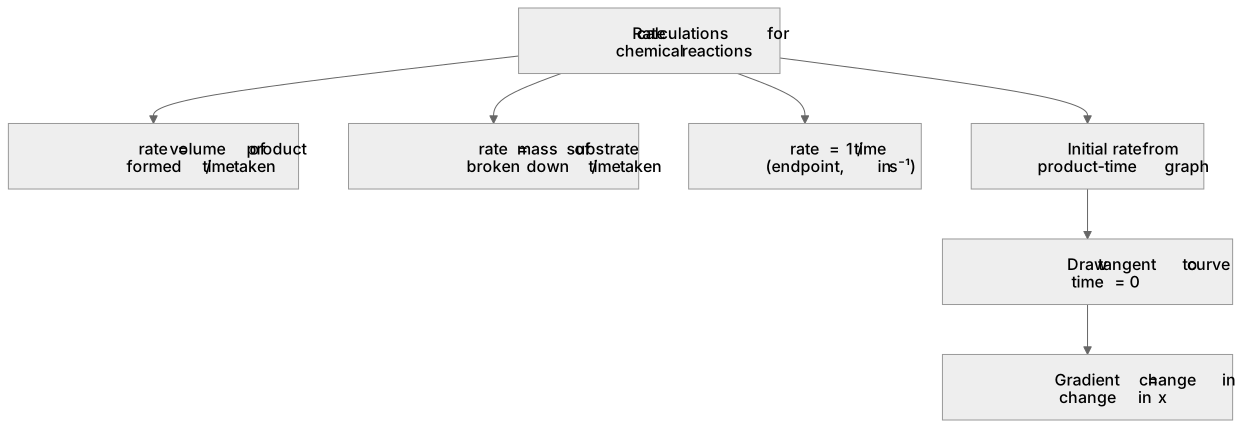
Key words
Say what each word means before you turn the card.
reaction rates
Try answering aloud or in your head before turning the card.
gradient calculations
Try answering aloud or in your head before turning the card.
tangents
Try answering aloud or in your head before turning the card.
See every definition
- reaction rates
- How rapidly reactants disappear or products accumulate over time, calculated as volume of product formed or mass of substrate broken down divided by time taken.
- gradient calculations
- On continuous product-time graphs, the initial rate of reaction is found by calculating gradient as change in y divided by change in x.
- tangents
- A line drawn to the curve at time = 0, used to find the initial rate of reaction on continuous product-time graphs.
Label the diagram
Some boxes have lost their names. Pick the right name for each number.
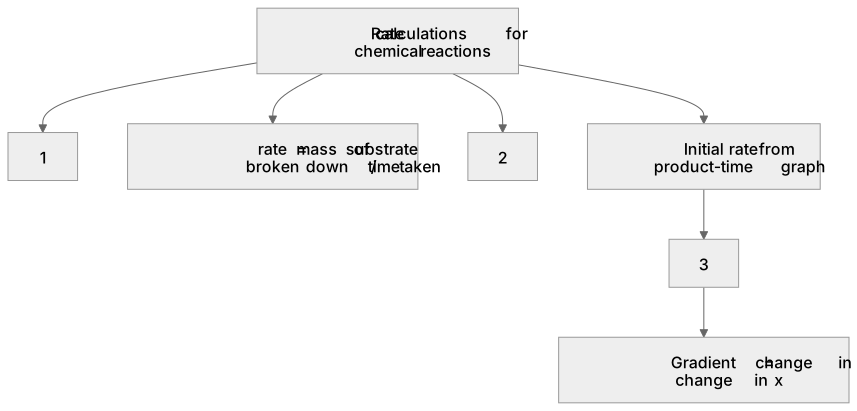
1Box 1
2Box 2
3Box 3
There is more to this lesson
The full lesson goes on to check your understanding and help you earn the marks. Create a free account to carry on, with your progress saved.
A week of Premium from your first lesson · Then the free plan continues · No card, no charge
Test your understanding of What happens in cells (and what do cells need)?: carry out rate calculations for chemical reactions
Active recall beats re-reading. Take an instant quiz now to test what you’ve learned and lock it into long-term memory.
A week of Premium from your first lesson · Then the free plan continues · No card, no charge