OCR · GCSE · Biology
Course version: J247 · Version from Sept 2018
Understand and use simple compound measures such as the rate of a reaction
Full specification wording
What happens in cells (and what do cells need)?: understand and use simple compound measures such as the rate of a reaction
A compound measure combines two or more different base dimensions to quantify a biological relationship per unit of time or space.
- Point 2 of 9
- 3 key terms
Study notes
From the teaching notes for this specification point.
The idea
A compound measure combines two or more different base dimensions to quantify a biological relationship per unit of time or space. Reaction rate represents a compound measure expressing the velocity of biochemical transformations, expressed in units like cm³ s⁻¹, g min⁻¹, or s⁻¹. Understanding compound measures allows pupils to interpret how physiological variables interact: if 15 cm³ of oxygen is evolved during a catalase assay in 30 seconds, the compound rate is 0.5 cm³ s⁻¹. Comparing these rates across varying temperatures or substrate concentrations reveals the quantitative kinetic efficiency of the enzyme.
What earns the marks
- Recognizing compound units as combinations of measured quantities per unit time.
- Calculating compound reaction rates correctly from given biological measurements.
- Comparing calculated compound measures to evaluate enzyme efficiency across conditions.
Common mistakes and how to put them right
Forgetting that compound units require a slash or negative index, writing cm³ s instead of cm³ s⁻¹.
Failing to keep units consistent when comparing two reaction conditions measured over different time intervals.
Exam tips
- Always write compound units clearly using standard indices such as cm³ s⁻¹ or words like cm³ per second.
- Ensure time units match before calculating or comparing compound rates.
Try the lesson
The start of the What happens in cells (and what do cells need)?: understand and use simple compound measures such as the rate of a reaction lesson, made from teaching notes for this specification point.
Have a go first
A reaction produces 30 cm³ of gas in 10 seconds. What is the rate of the reaction in cm³ per second?
Listen
A compound measure combines two or more different base dimensions to quantify a biological relationship per unit of time or space. Reaction rate represents a compound measure expressing the velocity of biochemical transformations, expressed in units like cm³ s⁻¹, g min⁻¹, or s⁻¹. Understanding compound measures allows pupils to interpret how physiological variables interact: if 15 cm³ of oxygen is evolved during a catalase assay in 30 seconds, the compound rate is 0.5 cm³ s⁻¹. Comparing these rates across varying temperatures or substrate concentrations reveals the quantitative kinetic efficiency of the enzyme. A strong answer earns marks for these points. recognizing compound units as combinations of measured quantities per unit time. calculating compound reaction rates correctly from given biological measurements. comparing calculated compound measures to evaluate enzyme efficiency across conditions. Exam tip: Always write compound units clearly using standard indices such as cm³ s⁻¹ or words like cm³ per second.
See it
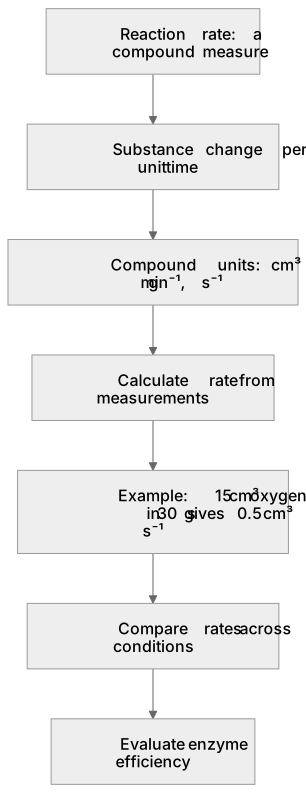
Put it in order
Put these steps in the order they happen.
- 1. Evaluate enzyme efficiency
- 2. Compare rates across conditions
- 3. Compound units: cm³ s⁻¹, g min⁻¹, s⁻¹
- 4. Example: 15 cm³ oxygen in 30 s gives 0.5 cm³ s⁻¹
- 5. Reaction rate: a compound measure
- 6. Substance change per unit time
- 7. Calculate rate from measurements
Key words
Say what each word means before you turn the card.
compound measures
Try answering aloud or in your head before turning the card.
reaction rate
Try answering aloud or in your head before turning the card.
units of rate
Try answering aloud or in your head before turning the card.
See every definition
- compound measures
- Measures that combine two or more different base dimensions to quantify a biological relationship per unit of time or space.
- reaction rate
- A compound measure expressing the velocity of biochemical transformations, expressed in units like cm³ s⁻¹, g min⁻¹, or s⁻¹.
- units of rate
- Compound units written using standard indices such as cm³ s⁻¹ or words like cm³ per second.
Label the diagram
Some boxes have lost their names. Pick the right name for each number.
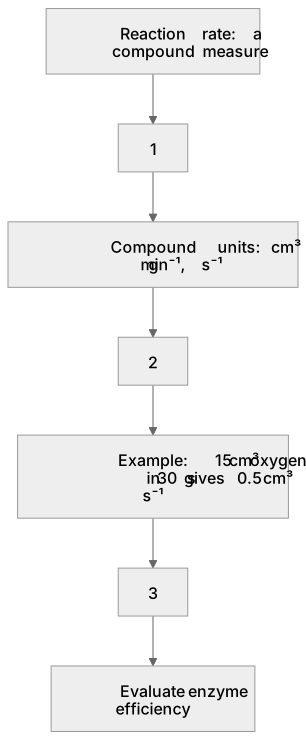
1Box 1
2Box 2
3Box 3
There is more to this lesson
The full lesson goes on to check your understanding and help you earn the marks. Create a free account to carry on, with your progress saved.
A week of Premium from your first lesson · Then the free plan continues · No card, no charge
Test your understanding of What happens in cells (and what do cells need)?: understand and use simple compound measures such as the rate of a reaction
Active recall beats re-reading. Take an instant quiz now to test what you’ve learned and lock it into long-term memory.
A week of Premium from your first lesson · Then the free plan continues · No card, no charge