OCR · GCSE · Biology
Course version: J247 · Version from Sept 2018
What happens in cells (and what do cells need)?: describe DNA as a polymer
Deoxyribonucleic acid (DNA) is a macromolecule categorized as a polymer, which means it consists of a long chain formed by linking numerous smaller repeating molecular units termed monomers.
- Point 3 of 9
- 4 key terms
Study notes
From the teaching notes for this specification point.
The idea
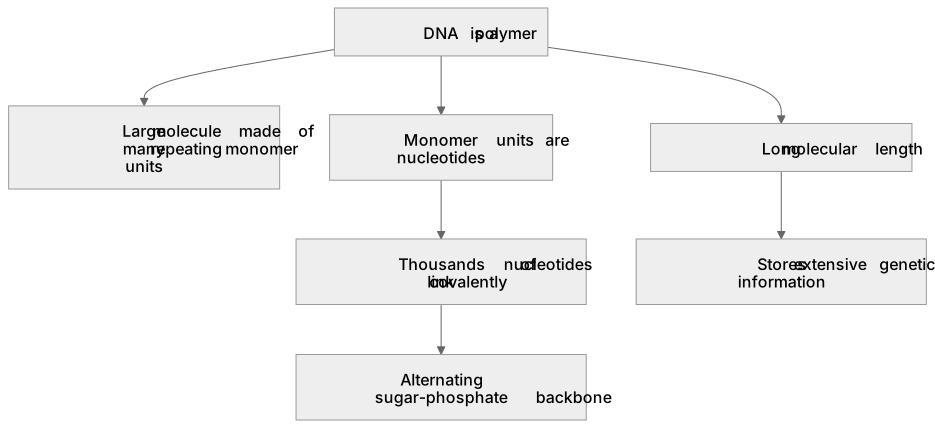
Deoxyribonucleic acid (DNA) is a macromolecule categorized as a polymer, which means it consists of a long chain formed by linking numerous smaller repeating molecular units termed monomers. In nucleic acids, these individual monomers are nucleotides. Thousands of nucleotides link covalently along their sugar and phosphate groups to produce a continuous, alternating sugar-phosphate backbone. Because polymers can extend over millions of monomer units, DNA possesses the immense molecular length required to store extensive genetic information encoding all cellular proteins within an organism.
What earns the marks
- Defining a polymer as a large molecule made of many repeating monomer units.
- Identifying nucleotides as the monomer subunits that join to build DNA.
- Describing the repeating sugar-phosphate backbone formed by linked nucleotides.
Common mistakes and how to put them right
Confusing the monomers of DNA (nucleotides) with the monomers of proteins (amino acids).
Calling DNA a monomer and nucleotides polymers, reversing the relationship.
Exam tips
- Explicitly define polymer when asked to describe DNA as one: mention repeated nucleotide monomers linked together.
- Link the polymer nature of DNA to its capacity to store vast amounts of hereditary code.
Try the lesson
The start of the What happens in cells (and what do cells need)?: describe DNA as a polymer lesson, made from teaching notes for this specification point.
Have a go first
Which term best describes DNA?
Listen
Deoxyribonucleic acid (DNA) is a macromolecule categorized as a polymer, which means it consists of a long chain formed by linking numerous smaller repeating molecular units termed monomers. In nucleic acids, these individual monomers are nucleotides. Thousands of nucleotides link covalently along their sugar and phosphate groups to produce a continuous, alternating sugar-phosphate backbone. Because polymers can extend over millions of monomer units, DNA possesses the immense molecular length required to store extensive genetic information encoding all cellular proteins within an organism. A strong answer earns marks for these points. defining a polymer as a large molecule made of many repeating monomer units. identifying nucleotides as the monomer subunits that join to build DNA. describing the repeating sugar-phosphate backbone formed by linked nucleotides. Exam tip: Explicitly define polymer when asked to describe DNA as one: mention repeated nucleotide monomers linked together.
See it
Key words
Say what each word means before you turn the card.
polymer
Try answering aloud or in your head before turning the card.
monomers
Try answering aloud or in your head before turning the card.
nucleotides
Try answering aloud or in your head before turning the card.
sugar-phosphate backbone
Try answering aloud or in your head before turning the card.
See every definition
- polymer
- A large molecule made of many repeating monomer units, and DNA is categorised as one.
- monomers
- Smaller repeating molecular units that link together in a long chain to form a polymer.
- nucleotides
- The individual monomers of nucleic acids, which link along their sugar and phosphate groups to build DNA.
- sugar-phosphate backbone
- A continuous, alternating structure produced when thousands of nucleotides link covalently along their sugar and phosphate groups.
Label the diagram
Some boxes have lost their names. Pick the right name for each number.
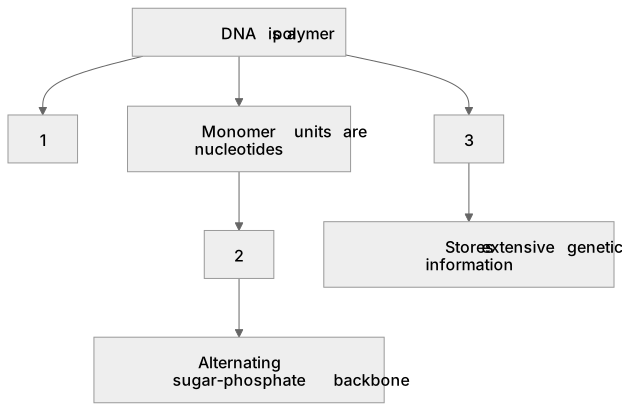
1Box 1
2Box 2
3Box 3
There is more to this lesson
The full lesson goes on to check your understanding and help you earn the marks. Create a free account to carry on, with your progress saved.
A week of Premium from your first lesson · Then the free plan continues · No card, no charge
Test your understanding of What happens in cells (and what do cells need)?: describe DNA as a polymer
Active recall beats re-reading. Take an instant quiz now to test what you’ve learned and lock it into long-term memory.
A week of Premium from your first lesson · Then the free plan continues · No card, no charge