OCR · GCSE · Biology
Course version: J247 · Version from Sept 2018
Describe experiments that can be used to investigate enzymatic reactions
Full specification wording
What happens in cells (and what do cells need)?: describe experiments that can be used to investigate enzymatic reactions
Investigating enzyme-catalysed reactions involves tracking the rate of substrate use or product formation under controlled conditions.
- Point 8 of 9
- 3 key terms
Study notes
From the teaching notes for this specification point.
The idea
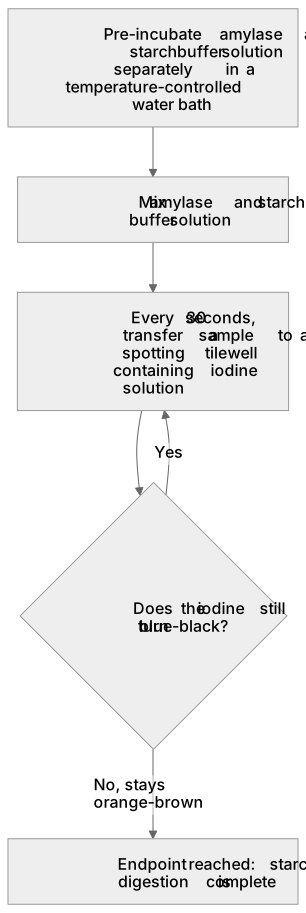
Investigating enzyme-catalysed reactions involves tracking the rate of substrate use or product formation under controlled conditions. In the amylase assay, amylase and starch buffer solution are pre-incubated separately in a temperature-controlled water bath, then mixed. Every 30 seconds a sample is transferred to a spotting tile well containing iodine solution; the endpoint is reached when the iodine no longer turns blue-black and stays orange-brown, showing starch digestion is complete. In catalase investigations, hydrogen peroxide is decomposed to release oxygen, collected in a gas syringe to measure volume over time. Key control variables include enzyme volume and concentration, substrate volume, temperature and pH.
What earns the marks
- Equilibrating enzyme and substrate separately in a water bath at constant temperature before mixing.
- Sampling reaction mixtures at regular timed intervals into spotting tiles containing iodine solution.
- Determining the endpoint when iodine no longer turns blue-black and remains orange-brown.
- Controlling variables such as enzyme concentration, substrate volume, temperature and buffer pH.
- Measuring reaction rate by gas collection, e.g. volume of oxygen produced from hydrogen peroxide over time.
Common mistakes and how to put them right
Mixing enzyme and substrate before reaching the target water bath temperature, distorting initial reaction rates.
Put it right: Pre-incubate both tubes separately first.
Failing to use a buffer solution when investigating temperature, allowing pH to change and confound results.
Put it right: Keep pH constant with a buffer.
Recording only the final colour rather than timing samples at fixed intervals.
Put it right: Take samples every 30 seconds to track the rate.
Exam tips
- Always specify pre-incubating enzyme and substrate tubes in the water bath separately before mixing.
- Mention testing samples at fixed intervals (e.g. every 30 seconds) until the colour change ceases, and state the endpoint clearly.
Try the lesson
The start of the What happens in cells (and what do cells need)?: describe experiments that can be used to investigate enzymatic reactions lesson, made from teaching notes for this specification point.
Have a go first
A student investigates how pH affects the rate at which amylase breaks down starch. Every 20 seconds they add a sample of the reaction mixture to iodine solution. Which procedure best allows a valid comparison between pH values?
Listen
Investigating enzyme-catalysed reactions involves tracking the rate of substrate use or product formation under controlled conditions. In the amylase assay, amylase and starch buffer solution are pre-incubated separately in a temperature-controlled water bath, then mixed. Every 30 seconds a sample is transferred to a spotting tile well containing iodine solution; the endpoint is reached when the iodine no longer turns blue-black and stays orange-brown, showing starch digestion is complete. In catalase investigations, hydrogen peroxide is decomposed to release oxygen, collected in a gas syringe to measure volume over time. Key control variables include enzyme volume and concentration, substrate volume, temperature and pH. A strong answer earns marks for these points. equilibrating enzyme and substrate separately in a water bath at constant temperature before mixing. sampling reaction mixtures at regular timed intervals into spotting tiles containing iodine solution. determining the endpoint when iodine no longer turns blue-black and remains orange-brown. controlling variables such as enzyme concentration, substrate volume, temperature and buffer pH. Exam tip: Always specify pre-incubating enzyme and substrate tubes in the water bath separately before mixing.
See it
Key words
Say what each word means before you turn the card.
iodine test
Try answering aloud or in your head before turning the card.
controlled variables
Try answering aloud or in your head before turning the card.
enzyme investigations
Try answering aloud or in your head before turning the card.
See every definition
- iodine test
- A sample is transferred to a spotting tile well containing iodine solution, and the endpoint is reached when the iodine no longer turns blue-black and stays orange-brown.
- controlled variables
- These include enzyme volume and concentration, substrate volume, temperature and pH, which are kept constant during the investigation.
- enzyme investigations
- These track the rate of substrate use or product formation under controlled conditions, using gas collection or timed sampling.
There is more to this lesson
The full lesson goes on to check your understanding and help you earn the marks. Create a free account to carry on, with your progress saved.
A week of Premium from your first lesson · Then the free plan continues · No card, no charge
Test your understanding of What happens in cells (and what do cells need)?: describe experiments that can be used to investigate enzymatic reactions
Active recall beats re-reading. Take an instant quiz now to test what you’ve learned and lock it into long-term memory.
A week of Premium from your first lesson · Then the free plan continues · No card, no charge