OCR · GCSE · Biology
Course version: J247 · Version from Sept 2018
Explain the mechanism of enzyme action (to include: the role of enzymes in…
Full specification wording
What happens in cells (and what do cells need)?: explain the mechanism of enzyme action (to include: the role of enzymes in metabolism, the role of the active site, enzyme specificity (lock and key hypothesis) and factors affecting the rate of enzyme controlled reactions (pH, temperature, substrate and enzyme concentration))
Enzymes are biological catalysts that accelerate cellular metabolic reactions without being consumed, by lowering activation energy.
- Point 9 of 9
- 3 key terms
Study notes
From the teaching notes for this specification point.
The idea
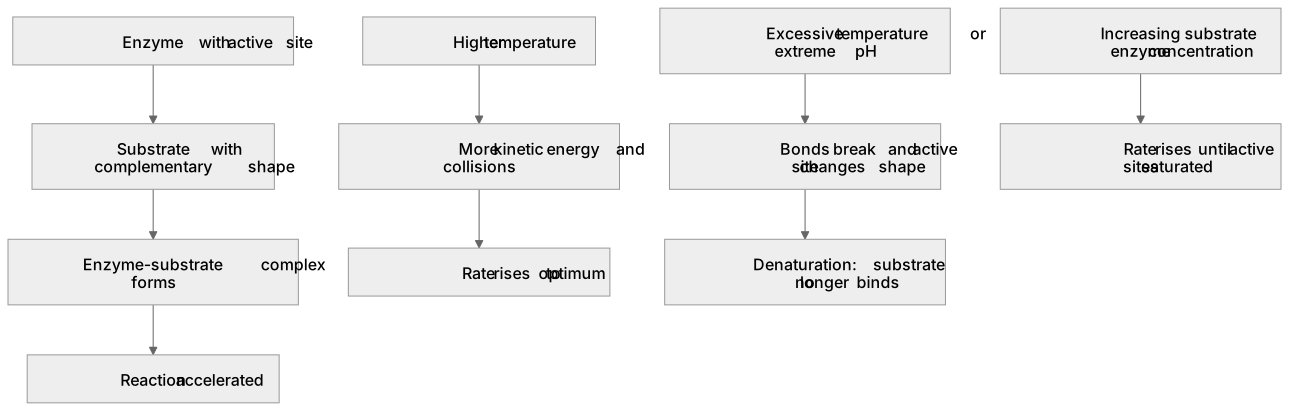
Enzymes are biological catalysts that accelerate cellular metabolic reactions without being consumed, by lowering activation energy. According to the lock and key hypothesis, each enzyme possesses an active site with a rigid, complementary three-dimensional shape that binds only one specific substrate to form an enzyme-substrate complex. Increasing temperature accelerates kinetic collisions, raising rate up to an optimum; beyond this, bonds holding protein tertiary structure break, permanently denaturing the active site. Extreme pH similarly denatures enzymes. Increasing substrate or enzyme concentration raises rate until active sites become saturated.
What earns the marks
- Explaining enzyme specificity via the lock and key model where substrate fits a complementary active site.
- Describing how higher temperature increases kinetic energy and collision frequency up to the optimum.
- Explaining that extreme pH or excessive temperature causes denaturation by altering active site shape.
- Explaining that increasing substrate concentration increases rate until active sites are saturated.
Common mistakes and how to put them right
Saying enzymes are killed by high temperature rather than denatured.
Stating active site and substrate have the same shape instead of complementary shapes.
Confusing enzyme concentration becoming limiting with substrate concentration becoming limiting.
Exam tips
- Use precise biological terminology: substrates have a shape complementary to the active site, never identical.
- When explaining denaturation, mention that bonds break, altering active site conformation so substrate no longer binds.
Try the lesson
The start of the What happens in cells (and what do cells need)?: explain the mechanism of enzyme action (to include: the role of enzymes in metabolism, the role of the active site, enzyme specificity (lock and key hypothesis) and factors affecting the rate of enzyme controlled reactions (pH, temperature, substrate and enzyme concentration)) lesson, made from teaching notes for this specification point.
Have a go first
Which part of an enzyme molecule binds to the substrate?
Listen
Enzymes are biological catalysts that accelerate cellular metabolic reactions without being consumed, by lowering activation energy. According to the lock and key hypothesis, each enzyme possesses an active site with a rigid, complementary three-dimensional shape that binds only one specific substrate to form an enzyme-substrate complex. Increasing temperature accelerates kinetic collisions, raising rate up to an optimum; beyond this, bonds holding protein tertiary structure break, permanently denaturing the active site. Extreme pH similarly denatures enzymes. Increasing substrate or enzyme concentration raises rate until active sites become saturated. A strong answer earns marks for these points. explaining enzyme specificity via the lock and key model where substrate fits a complementary active site. describing how higher temperature increases kinetic energy and collision frequency up to the optimum. explaining that extreme pH or excessive temperature causes denaturation by altering active site shape. explaining that increasing substrate concentration increases rate until active sites are saturated. Exam tip: Use precise biological terminology: substrates have a shape complementary to the active site, never identical.
See it
Key words
Say what each word means before you turn the card.
lock and key hypothesis
Try answering aloud or in your head before turning the card.
active site
Try answering aloud or in your head before turning the card.
denaturation
Try answering aloud or in your head before turning the card.
See every definition
- lock and key hypothesis
- Each enzyme possesses an active site with a rigid, complementary three-dimensional shape that binds only one specific substrate to form an enzyme-substrate complex.
- active site
- A rigid, complementary three-dimensional shape that binds only one specific substrate to form an enzyme-substrate complex.
- denaturation
- Bonds holding protein tertiary structure break, permanently altering the active site so substrate no longer binds.
Label the diagram
Some boxes have lost their names. Pick the right name for each number.
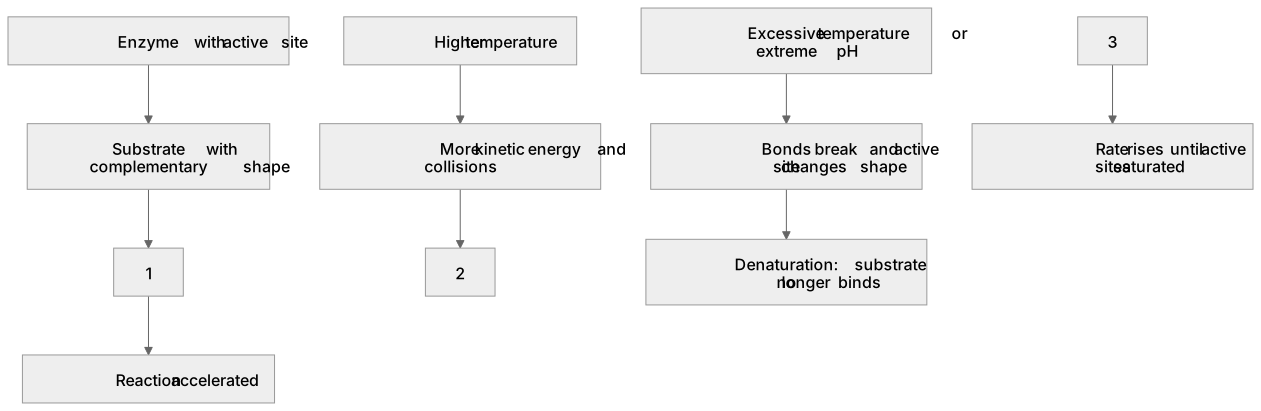
1Box 1
2Box 2
3Box 3
There is more to this lesson
The full lesson goes on to check your understanding and help you earn the marks. Create a free account to carry on, with your progress saved.
A week of Premium from your first lesson · Then the free plan continues · No card, no charge
Test your understanding of What happens in cells (and what do cells need)?: explain the mechanism of enzyme action (to include: the role of enzymes in metabolism, the role of the active site, enzyme specificity (lock and key hypothesis) and factors affecting the rate of enzyme controlled reactions (pH, temperature, substrate and enzyme concentration))
Active recall beats re-reading. Take an instant quiz now to test what you’ve learned and lock it into long-term memory.
A week of Premium from your first lesson · Then the free plan continues · No card, no charge