AQA · A-Level · Business
Course version: 7132 · Version from Sept 2023
How to analyse profitability (to include: Analysing profitability margins…
Full specification wording
Analysing financial performance: How to analyse profitability (to include: Analysing profitability margins should include the following ratio analysis: gross profit, profit from operations, profit for the year.)
Profitability is analysed using three key margins, each calculated as (Profit ÷ Revenue) × 100.
- Point 6 of 8
- 4 key terms
Study notes
From the teaching notes for this specification point.
The idea
Profitability is analysed using three key margins, each calculated as (Profit ÷ Revenue) × 100. The gross profit margin, using profit after cost of sales, reflects pricing strategy and direct production costs. A fall could indicate rising material costs or price discounting. The margin on profit from operations is next, after deducting overheads like rent and salaries. A large gap between the gross and operating margins points to high indirect costs. The profit for the year margin is last, after deducting interest and tax. The gap between the operating margin and this final margin reveals the impact of financing costs and taxation; a highly geared firm will see a significant reduction here from interest payments. Ratios are only useful when compared over time or against competitors.
What earns the marks
- Applying the correct formula, dividing by revenue in every case and presenting the answer as a percentage.
- Comparing the figure with the previous year or with a competitor given in the extract, because a single margin on its own supports no judgement.
- Explaining what the gap between two of the margins reveals about where the money is going, such as overheads eating a strong gross margin.
- Attributing the movement to a cause in the case study, for instance a new lease, a pay settlement or a switch to a cheaper supplier.
- Recognising sector norms, since a supermarket lives on a thin margin and high turnover while a jeweller does the opposite.
Common mistakes and how to put them right
Dividing by cost of sales or by capital employed instead of revenue, which produces a number that is not a margin at all.
Put it right: Divide the relevant profit figure by revenue.
Stating that profit rose so performance improved, when revenue rose faster and every margin actually fell.
Put it right: Focus on the margin percentage, not the absolute profit figure, when judging profitability.
Writing about 'profit' without saying which profit, so the examiner cannot tell whether overheads and interest are in or out.
Put it right: Use the precise term: gross profit, profit from operations, or profit for the year.
Leaving the answer as a decimal because the final step of multiplying by one hundred was forgotten.
Put it right: Present margins as percentages unless instructed otherwise.
Exam tips
- Calculation questions on one margin are common, often followed by a longer question requiring analysis of trends over time or comparison with competitors.
- Set the calculation out in full lines so a slip in arithmetic still collects the method marks.
- Evaluation marks often come from discussing what the ratios cannot tell you: nothing about cash flow, market conditions, or non-financial performance.
Try the lesson
The start of the Analysing financial performance: How to analyse profitability (to include: Analysing profitability margins should include the following ratio analysis: gross profit, profit from operations, profit for the year.) lesson, made from teaching notes for this specification point.
Have a go first
A business has gross profit of £60,000 and revenue of £200,000. What is its gross profit margin?
Listen
Profitability is analysed using three key margins, each calculated as (Profit ÷ Revenue) × 100. The gross profit margin, using profit after cost of sales, reflects pricing strategy and direct production costs. A fall could indicate rising material costs or price discounting. The margin on profit from operations is next, after deducting overheads like rent and salaries. A large gap between the gross and operating margins points to high indirect costs. The profit for the year margin is last, after deducting interest and tax. The gap between the operating margin and this final margin reveals the impact of financing costs and taxation; a highly geared firm will see a significant reduction here from interest payments. Ratios are only useful when compared over time or against competitors. A strong answer earns marks for these points. Applying the correct formula, dividing by revenue in every case and presenting the answer as a percentage. Comparing the figure with the previous year or with a competitor given in the extract, because a single margin on its own supports no judgement. Explaining what the gap between two of the margins reveals about where the money is going, such as overheads eating a strong gross margin. Attributing the movement to a cause in the case study, for instance a new lease, a pay settlement or a switch to a cheaper supplier. A common slip: Dividing by cost of sales or by capital employed instead of revenue, which produces a number that is not a margin at all. Instead, divide the relevant profit figure by revenue. Exam tip: Calculation questions on one margin are common, often followed by a longer question requiring analysis of trends over time or comparison with competitors.
See it
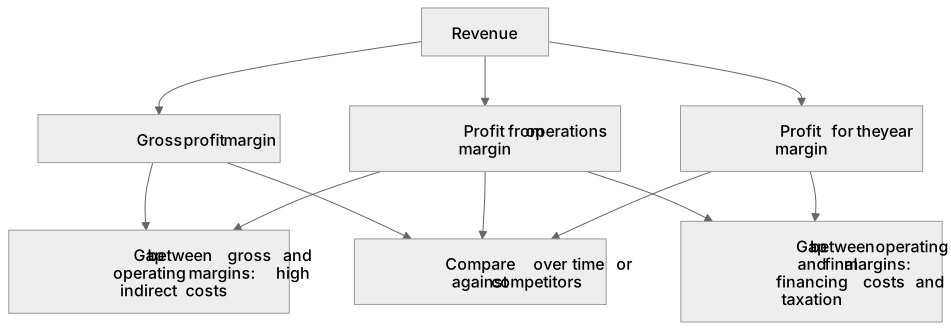
Key words
Say what each word means before you turn the card.
gross profit margin
Try answering aloud or in your head before turning the card.
profit from operations margin
Try answering aloud or in your head before turning the card.
profit for the year margin
Try answering aloud or in your head before turning the card.
trend and benchmark comparison
Try answering aloud or in your head before turning the card.
See every definition
- gross profit margin
- A profitability margin using profit after cost of sales, reflecting pricing strategy and direct production costs.
- profit from operations margin
- The margin calculated after deducting overheads like rent and salaries.
- profit for the year margin
- The final margin, calculated after deducting interest and tax.
- trend and benchmark comparison
- Ratios are only useful when compared over time or against competitors.
Label the diagram
Some boxes have lost their names. Pick the right name for each number.
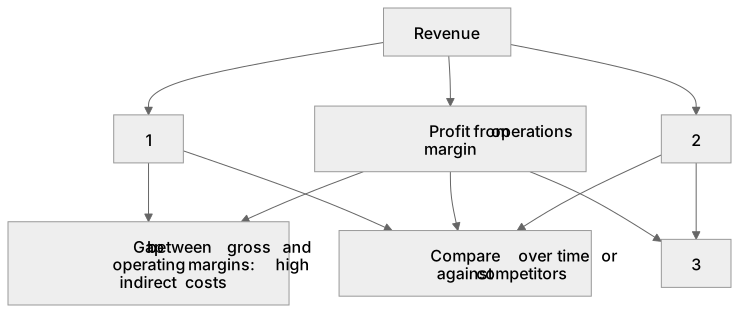
1Box 1
2Box 2
3Box 3
There is more to this lesson
The full lesson goes on to check your understanding and help you earn the marks. Create a free account to carry on, with your progress saved.
A week of Premium from your first lesson · Then the free plan continues · No card, no charge
Test your understanding of Analysing financial performance: How to analyse profitability (to include: Analysing profitability margins should include the following ratio analysis: gross profit, profit from operations, profit for the year.)
Active recall beats re-reading. Take an instant quiz now to test what you’ve learned and lock it into long-term memory.
A week of Premium from your first lesson · Then the free plan continues · No card, no charge