AQA · A-Level · Business
Course version: 7132 · Version from Sept 2023
How to construct and analyse budgets and cash flow forecasts (to include:…
Full specification wording
Analysing financial performance: How to construct and analyse budgets and cash flow forecasts (to include: Analysing budgets should include variance analysis and adverse and favourable variances.)
A budget is a financial plan for a set period and a cash flow forecast is a month by month timetable of receipts and payments, so the two answer different questions: whether the business expects…
- Point 1 of 8
- 4 key terms
Study notes
From the teaching notes for this specification point.
The idea
A budget is a financial plan for a set period and a cash flow forecast is a month by month timetable of receipts and payments, so the two answer different questions: whether the business expects to make a profit, and whether it will have the cash to pay its bills in March. Build the forecast by adding net cash flow to the opening balance to get a closing balance, which then becomes the next month opening balance, and a negative closing balance identifies the month the overdraft is needed. A variance is the gap between the budgeted figure and the actual one; it is adverse when the outcome worsens profit, such as revenue below budget or costs above it, and favourable when it improves profit. The purpose is control, because a variance is a question to put to a manager rather than a verdict on one.
What earns the marks
- Completing a forecast correctly, adding net cash flow to the opening balance to reach a closing balance and carrying that closing balance forward as the next opening balance.
- Placing a credit sale in the month the customer actually pays rather than the month the order was taken, which is the timing marker that separates a cash forecast from a profit statement.
- Calculating the variance from the case figures and labelling it adverse or favourable by its effect on profit, not by whether the number rose or fell.
- Offering a cause for the variance drawn from the extract, such as a supplier raising material prices or a competitor discounting, rather than a generic statement that sales were disappointing.
- Saying what the manager should do next with the information, since a budget only controls anything through the decision it triggers.
Common mistakes and how to put them right
Calling a cost variance favourable because spending fell, when the underspend came from understaffing that also cost the firm sales.
Recording revenue in the cash flow forecast at the point of sale when the customer has sixty days credit, which flatters the cash position by two months.
Putting depreciation into a cash flow forecast, when no money leaves the bank.
Treating the forecast as a statement of fact, so the answer never questions the sales figure every other line depends on.
Exam tips
- A short calculate question often asks for one missing cell of a forecast or one variance, then the longer question asks you to analyse what it shows, so read both parts before you start the arithmetic.
- Show the working even when the final figure is wrong, because method marks are available for the right structure.
- In an assess question the judgement usually turns on how reliable the sales forecast is and how volatile the market in the case study looks.
Try the lesson
The start of the Analysing financial performance: How to construct and analyse budgets and cash flow forecasts (to include: Analysing budgets should include variance analysis and adverse and favourable variances.) lesson, made from teaching notes for this specification point.
Have a go first
A firm budgeted to sell 500 units at £20 each. It actually sold 500 units at £18 each. What is the sales revenue variance?
Listen
A budget is a financial plan for a set period and a cash flow forecast is a month by month timetable of receipts and payments, so the two answer different questions: whether the business expects to make a profit, and whether it will have the cash to pay its bills in March. Build the forecast by adding net cash flow to the opening balance to get a closing balance, which then becomes the next month opening balance, and a negative closing balance identifies the month the overdraft is needed. A variance is the gap between the budgeted figure and the actual one; it is adverse when the outcome worsens profit, such as revenue below budget or costs above it, and favourable when it improves profit. The purpose is control, because a variance is a question to put to a manager rather than a verdict on one. A strong answer earns marks for these points. Completing a forecast correctly, adding net cash flow to the opening balance to reach a closing balance and carrying that closing balance forward as the next opening balance. Placing a credit sale in the month the customer actually pays rather than the month the order was taken, which is the timing marker that separates a cash forecast from a profit statement. Calculating the variance from the case figures and labelling it adverse or favourable by its effect on profit, not by whether the number rose or fell. Offering a cause for the variance drawn from the extract, such as a supplier raising material prices or a competitor discounting, rather than a generic statement that sales were disappointing. Exam tip: A short calculate question often asks for one missing cell of a forecast or one variance, then the longer question asks you to analyse what it shows, so read both parts before you start the arithmetic.
See it
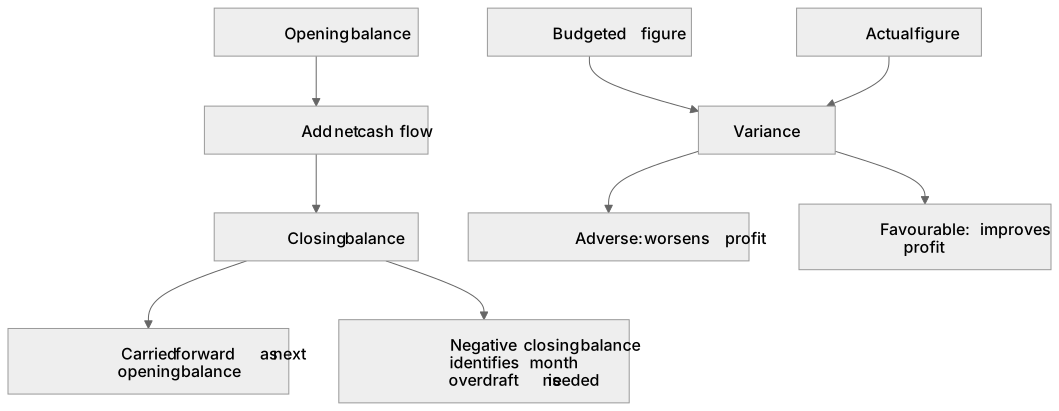
Key words
Say what each word means before you turn the card.
variance analysis
Try answering aloud or in your head before turning the card.
cash flow forecast
Try answering aloud or in your head before turning the card.
adverse variance
Try answering aloud or in your head before turning the card.
favourable variance
Try answering aloud or in your head before turning the card.
See every definition
- variance analysis
- Analysing budgets should include this, where a variance is the gap between the budgeted figure and the actual one.
- cash flow forecast
- A month by month timetable of receipts and payments, built by adding net cash flow to the opening balance to get a closing balance.
- adverse variance
- A variance that is adverse when the outcome worsens profit, such as revenue below budget or costs above it.
- favourable variance
- A variance that is favourable when it improves profit.
Label the diagram
Some boxes have lost their names. Pick the right name for each number.
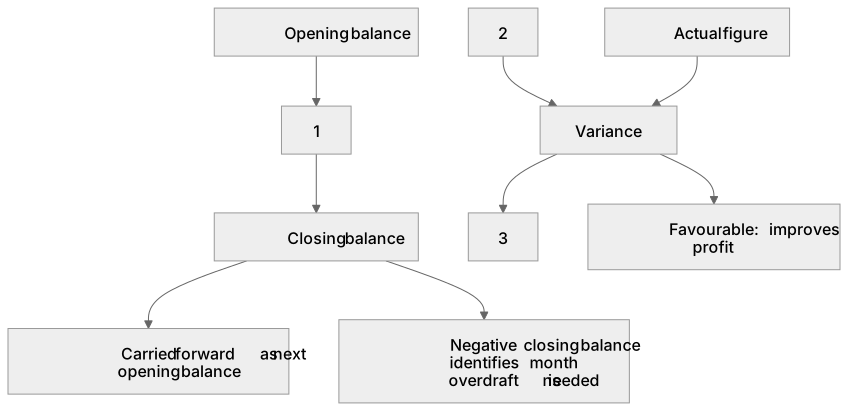
1Box 1
2Box 2
3Box 3
There is more to this lesson
The full lesson goes on to check your understanding and help you earn the marks. Create a free account to carry on, with your progress saved.
A week of Premium from your first lesson · Then the free plan continues · No card, no charge
Test your understanding of Analysing financial performance: How to construct and analyse budgets and cash flow forecasts (to include: Analysing budgets should include variance analysis and adverse and favourable variances.)
Active recall beats re-reading. Take an instant quiz now to test what you’ve learned and lock it into long-term memory.
A week of Premium from your first lesson · Then the free plan continues · No card, no charge