AQA · A-Level · Business
Course version: 7132 · Version from Sept 2023
Analysing financial performance: The value of budgeting
A budget is a financial plan for a future period, and its value lies in whether the numbers change a decision.
- Point 2 of 8
- 2 key terms
Study notes
From the teaching notes for this specification point.
The idea
A budget is a financial plan for a future period, and its value lies in whether the numbers change a decision. It buys control, because a manager who owns a figure can be asked why the spend moved; coordination, because marketing cannot promise a campaign that finance has not funded; and motivation, since a delegated budget hands over real responsibility, which Herzberg's theory would classify as a motivator rather than a hygiene factor. The costs are just as real. It consumes management time, it invites gaming such as spending whatever is left in the final month so that next year's allocation is not cut, and it tempts a manager to defer maintenance to protect the current figure. A historical budget carries last year's mistakes forward with an inflation uplift; a zero based budget forces every line to be justified from scratch but takes far longer to prepare.
What earns the marks
- Naming one benefit of budgeting and tying it to this firm, for example that a start-up with tight cash needs the discipline more than a cash rich established business does.
- Distinguishing historical budgeting from zero based budgeting and saying which suits the circumstances in the extract.
- Recognising that the value depends on the accuracy of the forecast underneath it, so a volatile market weakens the whole exercise.
- Reaching a judgement that weighs the management time consumed against the control gained.
Common mistakes and how to put them right
Writing that a budget controls costs, as though the document does something.
Put it right: Say the budget allows variances to be identified and that managers then act on them.
Claiming budgets always motivate, when an imposed and unreachable target is the fastest way to make a manager stop trying.
Put it right: State the condition, such as a target the manager helped set and believes is achievable.
Describing zero based budgeting as simply better without noting how much manager time it takes each year.
Put it right: Weigh the sharper cost control against the preparation burden.
Treating budgeting as free, so the answer lists benefits only and never reaches an evaluative judgement.
Put it right: Include at least one cost of the process before concluding.
Exam tips
- This wording is well suited to an assess or evaluate question on the higher tariff, so plan two developed arguments and a supported conclusion rather than four thin ones.
- Use the firm's circumstances as the deciding factor: a predictable market makes budgeting powerful, a fast changing one makes it stale within a quarter.
- A strong conclusion says what would have to be true for your verdict to flip, for instance that budgets would be worth more here if demand were more stable.
Try the lesson
The start of the Analysing financial performance: The value of budgeting lesson, made from teaching notes for this specification point.
Have a go first
What is a budget? Select the correct answer.
Listen
A budget is a financial plan for a future period, and its value lies in whether the numbers change a decision. It buys control, because a manager who owns a figure can be asked why the spend moved; coordination, because marketing cannot promise a campaign that finance has not funded; and motivation, since a delegated budget hands over real responsibility, which Herzberg's theory would classify as a motivator rather than a hygiene factor. The costs are just as real. It consumes management time, it invites gaming such as spending whatever is left in the final month so that next year's allocation is not cut, and it tempts a manager to defer maintenance to protect the current figure. A historical budget carries last year's mistakes forward with an inflation uplift; a zero based budget forces every line to be justified from scratch but takes far longer to prepare. A strong answer earns marks for these points. Naming one benefit of budgeting and tying it to this firm, for example that a start-up with tight cash needs the discipline more than a cash rich established business does. Distinguishing historical budgeting from zero based budgeting and saying which suits the circumstances in the extract. Explaining how a delegated budget can motivate staff, for example by giving a manager control over a cost centre, and noting that an imposed, unreachable target can demotivate instead. Herzberg's motivator/hygiene distinction is useful enrichment but is not required by the specification. Recognising that the value depends on the accuracy of the forecast underneath it, so a volatile market weakens the whole exercise. A common slip: Writing that a budget controls costs, as though the document does something; it is the response to the variance that changes spending. Instead, say the budget allows variances to be identified and that managers then act on them. Exam tip: This wording is well suited to an assess or evaluate question on the higher tariff, so plan two developed arguments and a supported conclusion rather than four thin ones.
See it

Key words
Say what each word means before you turn the card.
zero based budgeting
Try answering aloud or in your head before turning the card.
motivation
Try answering aloud or in your head before turning the card.
See every definition
- zero based budgeting
- A budget that forces every line to be justified from scratch but takes far longer to prepare.
- motivation
- A benefit of budgeting, since a delegated budget hands over real responsibility, which Herzberg's theory would classify as a motivator rather than a hygiene factor.
Label the diagram
Some boxes have lost their names. Pick the right name for each number.
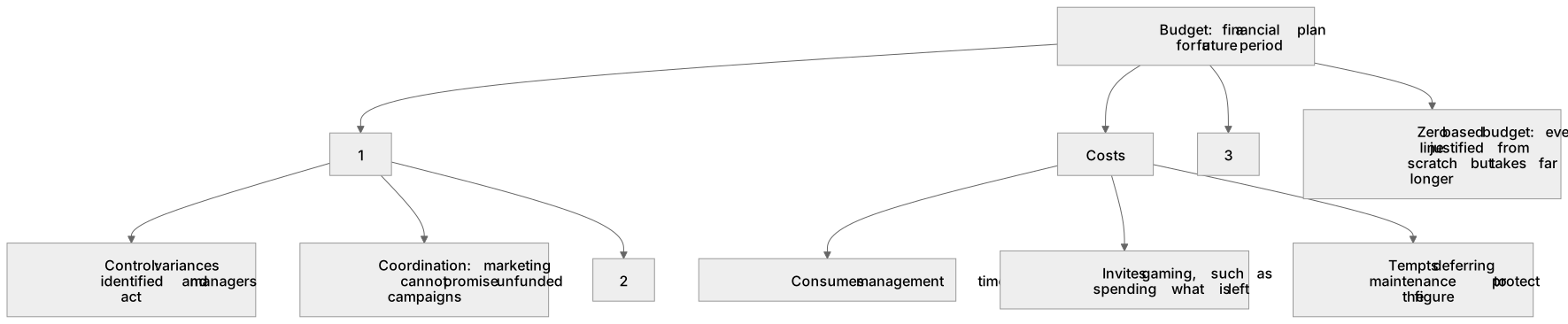
1Box 1
2Box 2
3Box 3
There is more to this lesson
The full lesson goes on to check your understanding and help you earn the marks. Create a free account to carry on, with your progress saved.
A week of Premium from your first lesson · Then the free plan continues · No card, no charge
Test your understanding of Analysing financial performance: The value of budgeting
Active recall beats re-reading. Take an instant quiz now to test what you’ve learned and lock it into long-term memory.
A week of Premium from your first lesson · Then the free plan continues · No card, no charge