AQA · A-Level · Business
Course version: 7132 · Version from Sept 2023
Investment appraisal: Financial methods of assessing an investment (to…
Full specification wording
Analysing strategic options: investment appraisal: Financial methods of assessing an investment (to include: Investment appraisal should include the calculation and interpretation of payback, average rate of return and net present value.)
Three ways of putting a number on a capital project, each answering a different question.
- Point 1 of 2
- 3 key terms
Study notes
From the teaching notes for this specification point.
The idea
Three ways of putting a number on a capital project, each answering a different question. Payback counts how long the cumulative net cash inflow takes to repay the initial outlay, with the part year found by dividing the amount still outstanding at the start of that year by that year's inflow and multiplying by twelve, so it is a liquidity test rather than a profit test. Average rate of return divides the average annual profit by the initial cost and gives a percentage that can be set beside the cost of borrowing. Net present value multiplies each future flow by the discount factor supplied, adds them and takes off the outlay, so a positive figure in pounds means the project beats that discount rate. The first two ignore the time value of money; the third depends entirely on a rate somebody chose.
What earns the marks
- Setting out the cumulative cash position year by year, identifying the year the balance turns positive, then converting the remainder into months rather than leaving the answer in whole years.
- Using average annual profit in the numerator of average rate of return, that is total net return over the life of the project divided by the number of years, and expressing the result as a percentage of the initial cost.
- Multiplying each year's net cash flow by the discount factor given in the table, summing the discounted inflows and subtracting the outlay, then stating net present value in pounds with a decision attached.
- Interpreting as well as calculating, by saying whether the figure clears the firm's own criterion, such as payback inside two years or a return above the cost of finance.
Common mistakes and how to put them right
Discounting the initial outlay as though it were a future flow, when it is spent now and its discount factor is one.
Putting cash flow rather than profit into average rate of return, or averaging the returns without first taking off the cost of the asset.
Stopping payback at a whole year because the table shows year ends, when the part-year figure is what the method is designed to produce.
Exam tips
- These calculations arrive with a table of net cash flows and a column of discount factors, so show each line of working: a clear method lets the examiner follow your reasoning even if an arithmetic slip creeps in.
- A question asking you to recommend an investment wants the numbers from the appendix and a view on which method matters most for this firm, not three results left side by side.
- Always write the unit: pounds for net present value, years and months for payback, per cent for average rate of return.
Try the lesson
The start of the Analysing strategic options: investment appraisal: Financial methods of assessing an investment (to include: Investment appraisal should include the calculation and interpretation of payback, average rate of return and net present value.) lesson, made from teaching notes for this specification point.
Have a go first
A project costs £80,000 and is expected to generate net cash inflows of £20,000 in each of the next five years. What is the payback period?
Listen
Three ways of putting a number on a capital project, each answering a different question. Payback counts how long the cumulative net cash inflow takes to repay the initial outlay, with the part year found by dividing the amount still outstanding at the start of that year by that year's inflow and multiplying by twelve, so it is a liquidity test rather than a profit test. Average rate of return divides the average annual profit by the initial cost and gives a percentage that can be set beside the cost of borrowing. Net present value multiplies each future flow by the discount factor supplied, adds them and takes off the outlay, so a positive figure in pounds means the project beats that discount rate. The first two ignore the time value of money; the third depends entirely on a rate somebody chose. A strong answer earns marks for these points. Setting out the cumulative cash position year by year, identifying the year the balance turns positive, then converting the remainder into months rather than leaving the answer in whole years. Using average annual profit in the numerator of average rate of return, that is total net return over the life of the project divided by the number of years, and expressing the result as a percentage of the initial cost. Multiplying each year's net cash flow by the discount factor given in the table, summing the discounted inflows and subtracting the outlay, then stating net present value in pounds with a decision attached. Interpreting as well as calculating, by saying whether the figure clears the firm's own criterion, such as payback inside two years or a return above the cost of finance. Exam tip: These calculations arrive with a table of net cash flows and a column of discount factors, so show each line of working: a clear method lets the examiner follow your reasoning even if an arithmetic slip creeps in.
See it
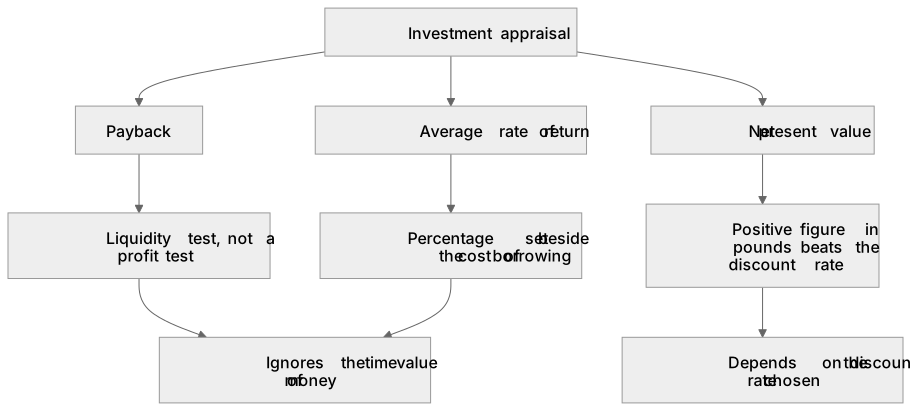
Key words
Say what each word means before you turn the card.
investment appraisal
Try answering aloud or in your head before turning the card.
average rate of return
Try answering aloud or in your head before turning the card.
net present value
Try answering aloud or in your head before turning the card.
See every definition
- investment appraisal
- Financial methods of assessing an investment, including the calculation and interpretation of payback, average rate of return and net present value.
- average rate of return
- Divides the average annual profit by the initial cost and gives a percentage that can be set beside the cost of borrowing.
- net present value
- Multiplies each future flow by the discount factor supplied, adds them and takes off the outlay, so a positive figure in pounds means the project beats that discount rate.
Label the diagram
Some boxes have lost their names. Pick the right name for each number.
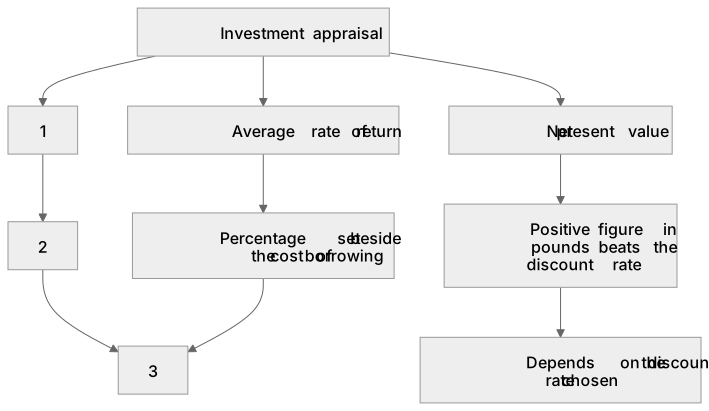
1Box 1
2Box 2
3Box 3
There is more to this lesson
The full lesson goes on to check your understanding and help you earn the marks. Create a free account to carry on, with your progress saved.
A week of Premium from your first lesson · Then the free plan continues · No card, no charge
Test your understanding of Analysing strategic options: investment appraisal: Financial methods of assessing an investment (to include: Investment appraisal should include the calculation and interpretation of payback, average rate of return and net present value.)
Active recall beats re-reading. Take an instant quiz now to test what you’ve learned and lock it into long-term memory.
A week of Premium from your first lesson · Then the free plan continues · No card, no charge