AQA · A-Level · Business
Course version: 7132 · Version from Sept 2023
Overall performance: The value of different measures of assessing business…
Full specification wording
Analysing the existing internal position of a business to assess strengths and weaknesses: overall performance: The value of different measures of assessing business performance (to include: Methods of assessing overall business performance to include Elkington’s Triple Bottom Line (Profit, People, Planet).)
Elkington's framework asks a firm to report against money, people and the planet together, and to accept that a gain on one line can be a loss on another.
- Point 4 of 4
- 4 key terms
Study notes
From the teaching notes for this specification point.
The idea
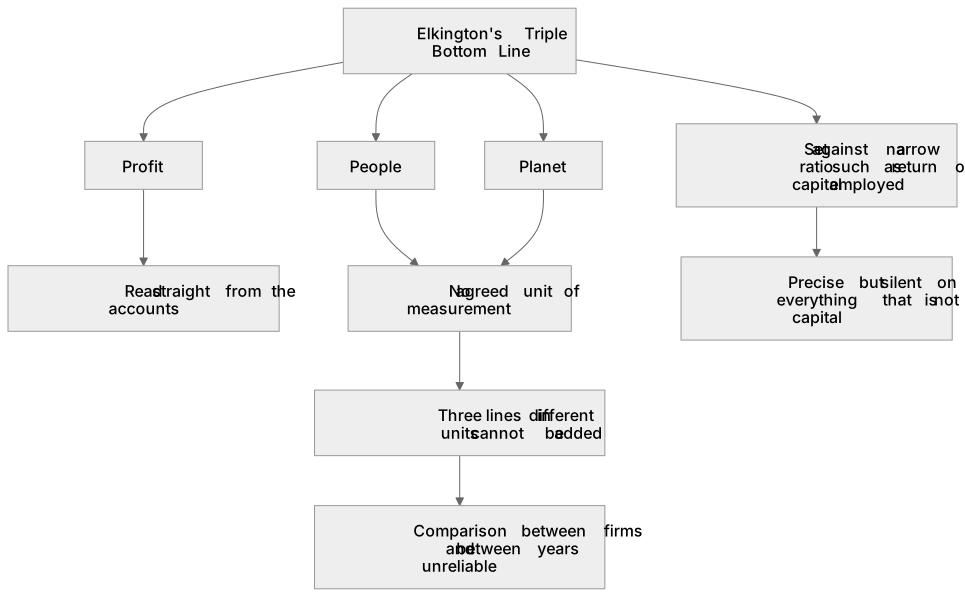
Elkington's framework asks a firm to report against money, people and the planet together, and to accept that a gain on one line can be a loss on another. Profit is read straight from the accounts; social and environmental outcomes usually have no agreed unit, which is the framework's weakness, because three lines measured in different units cannot be added and a poor record on emissions cannot be netted off a strong margin. It is still worth using because it forces the question of what a healthy operating profit cost in wages, in carbon or in supplier payment terms. Set it against a narrow ratio such as return on capital employed, which is operating profit divided by capital employed times one hundred, precise but silent on everything that is not capital, and the judgement writes itself: the right measure depends on who is asking and what decision follows.
What earns the marks
- Applying all three strands to the named business rather than defining them, so the social line names actual employees, suppliers or communities in the case.
- Stating that the social and environmental strands have no common unit of measurement, which makes comparison between firms and between years unreliable.
- Setting a broad measure against a precise financial one such as return on capital employed or gearing, and saying what each one cannot see.
- Judging the measure against the user, since a lender wants interest cover and gearing while a campaign group or a recruit wants the environmental record.
Common mistakes and how to put them right
Arguing that the wider measure is simply better than profit, without saying how people and planet would actually be measured for this particular firm.
Confusing a reporting and measurement framework with corporate social responsibility policy, so the answer drifts into ethics and never assesses performance.
Ignoring the cost, when better environmental or social performance is usually paid for out of margin and that trade-off is where the evaluation marks sit.
Exam tips
- This is commonly set as an evaluate question on whether a business is performing well, so structure the answer by strand and finish on which strand matters most to this firm.
- Bring in one financial measure with its formula so that you are visibly weighing a quantitative measure against a qualitative one rather than only discussing values.
Try the lesson
The start of the Analysing the existing internal position of a business to assess strengths and weaknesses: overall performance: The value of different measures of assessing business performance (to include: Methods of assessing overall business performance to include Elkington’s Triple Bottom Line (Profit, People, Planet).) lesson, made from teaching notes for this specification point.
Have a go first
In Elkington’s Triple Bottom Line, which three areas are used to assess a business’s overall performance?
Listen
Elkington's framework asks a firm to report against money, people and the planet together, and to accept that a gain on one line can be a loss on another. Profit is read straight from the accounts; social and environmental outcomes usually have no agreed unit, which is the framework's weakness, because three lines measured in different units cannot be added and a poor record on emissions cannot be netted off a strong margin. It is still worth using because it forces the question of what a healthy operating profit cost in wages, in carbon or in supplier payment terms. Set it against a narrow ratio such as return on capital employed, which is operating profit divided by capital employed times one hundred, precise but silent on everything that is not capital, and the judgement writes itself: the right measure depends on who is asking and what decision follows. A strong answer earns marks for these points. Applying all three strands to the named business rather than defining them, so the social line names actual employees, suppliers or communities in the case. Stating that the social and environmental strands have no common unit of measurement, which makes comparison between firms and between years unreliable. Setting a broad measure against a precise financial one such as return on capital employed or gearing, and saying what each one cannot see. Judging the measure against the user, since a lender wants interest cover and gearing while a campaign group or a recruit wants the environmental record. Exam tip: This is commonly set as an evaluate question on whether a business is performing well, so structure the answer by strand and finish on which strand matters most to this firm.
See it
Key words
Say what each word means before you turn the card.
triple bottom line
Try answering aloud or in your head before turning the card.
profit, people and planet
Try answering aloud or in your head before turning the card.
measurement limitations
Try answering aloud or in your head before turning the card.
stakeholder perspective
Try answering aloud or in your head before turning the card.
See every definition
- triple bottom line
- Elkington's framework asks a firm to report against money, people and the planet together, accepting that a gain on one line can be a loss on another.
- profit, people and planet
- The three strands of Elkington's framework, where profit is read straight from the accounts while social and environmental outcomes usually have no agreed unit.
- measurement limitations
- The framework's weakness is that social and environmental strands have no common unit, so three lines measured in different units cannot be added.
- stakeholder perspective
- The judgement that the right measure depends on who is asking and what decision follows, since a lender wants interest cover and gearing while a campaign group or a recruit wants the environmental record.
Label the diagram
Some boxes have lost their names. Pick the right name for each number.
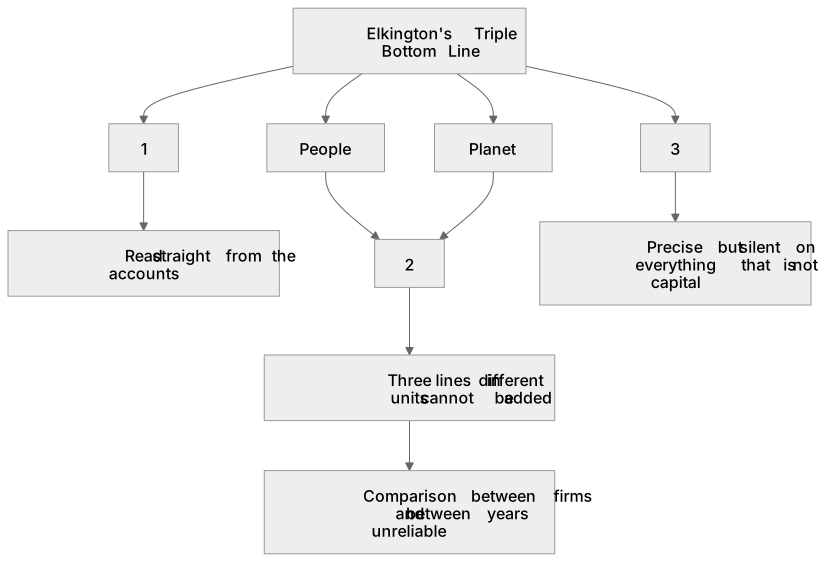
1Box 1
2Box 2
3Box 3
There is more to this lesson
The full lesson goes on to check your understanding and help you earn the marks. Create a free account to carry on, with your progress saved.
A week of Premium from your first lesson · Then the free plan continues · No card, no charge
Test your understanding of Analysing the existing internal position of a business to assess strengths and weaknesses: overall performance: The value of different measures of assessing business performance (to include: Methods of assessing overall business performance to include Elkington’s Triple Bottom Line (Profit, People, Planet).)
Active recall beats re-reading. Take an instant quiz now to test what you’ve learned and lock it into long-term memory.
A week of Premium from your first lesson · Then the free plan continues · No card, no charge