AQA · A-Level · Business
Course version: 7132 · Version from Sept 2023
Political and legal change: The impact of changes in the political and…
Full specification wording
Analysing the external environment to assess opportunities and threats: political and legal change: The impact of changes in the political and legal environment on strategic and functional decision making (to include: The political and legal environment should include a broad understanding of the scope and effects of laws related to competition, the labour market and environmental legislation. The impact of government policy related to enterprise, the role of regulators, infrastructure, the environment and international trade.)
Law and policy draw the boundary inside which a strategy has to work, and a change to that boundary is an opportunity or a cost depending on who adapts first.
- 4 key terms
Study notes
From the teaching notes for this specification point.
The idea
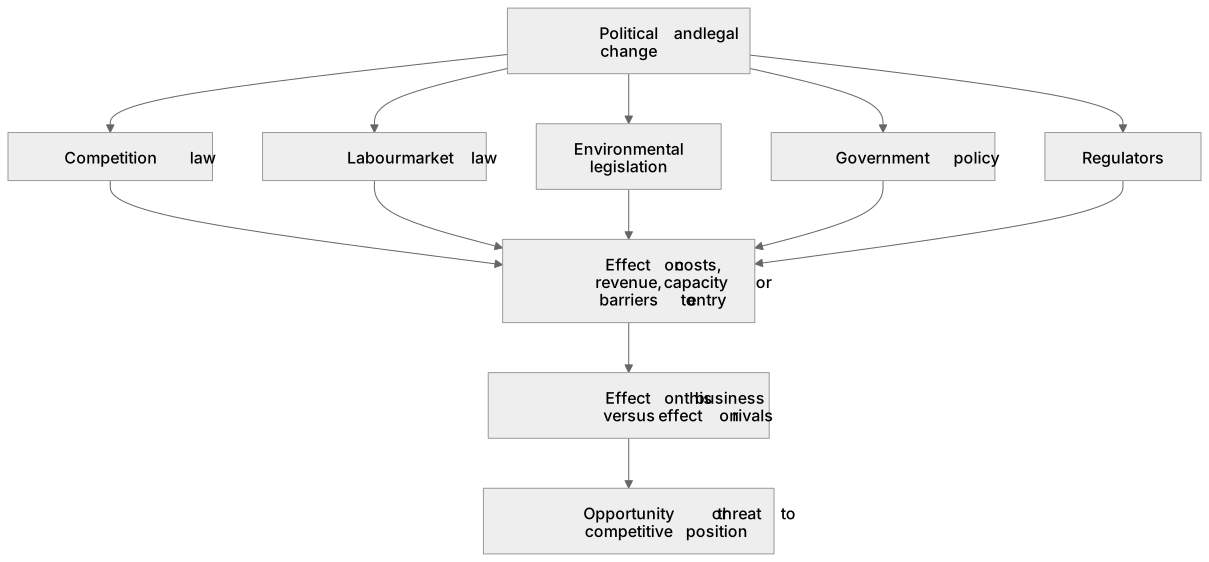
Law and policy draw the boundary inside which a strategy has to work, and a change to that boundary is an opportunity or a cost depending on who adapts first. Competition law can block a merger or force a disposal; employment law lifts labour costs through the minimum wage, holiday entitlement and pension duties; environmental law adds compliance, monitoring and disposal costs. Regulators such as Ofgem and Ofwat cap prices and therefore cap margin, while policy on enterprise, infrastructure, taxation and trade steers where investment goes. The examinable skill is never listing legislation. It is asking what the change does to costs, revenue, capacity or barriers to entry, and then noticing that a rule which raises this firm's costs may raise a smaller rival's by more, which turns a threat into a competitive advantage.
What earns the marks
- Turning the political or legal change into a direction or a number, such as a rise in unit labour costs, a fall in contribution per unit or a delayed expansion.
- Saying which function absorbs the change first, operations for environmental rules, human resources for employment law, marketing for advertising restrictions.
- Distinguishing the effect on this business from the effect on its rivals, because relative impact is what moves competitive position and market share.
- Weighing the size, the timing and the certainty of the change, including whether a proposed law has actually been passed.
Common mistakes and how to put them right
Listing laws and regulators with no application to the business, which reads as a knowledge dump and never reaches analysis.
Assuming regulation is always a threat, when compliance cost can raise barriers to entry and protect an established firm from new competitors.
Confusing taxation and spending policy with legislation, so the answer drifts into the economics question instead of the political and legal one.
Exam tips
- Political and legal change usually appears as a single sentence in the case, often a proposed law or a regulator's ruling, so quote that sentence and work forward from it.
- A judgement on likelihood and lead time, for example that the rule is only proposed and the firm has two years to prepare, is a dependable route into the top evaluation band.
Try the lesson
The start of the Analysing the external environment to assess opportunities and threats: political and legal change: The impact of changes in the political and legal environment on strategic and functional decision making (to include: The political and legal environment should include a broad understanding of the scope and effects of laws related to competition, the labour market and environmental legislation. The impact of government policy related to enterprise, the role of regulators, infrastructure, the environment and international trade.) lesson, made from teaching notes for this specification point.
Have a go first
Which one of the following is a law that affects the labour market?
Listen
Law and policy draw the boundary inside which a strategy has to work, and a change to that boundary is an opportunity or a cost depending on who adapts first. Competition law can block a merger or force a disposal; employment law lifts labour costs through the minimum wage, holiday entitlement and pension duties; environmental law adds compliance, monitoring and disposal costs. Regulators such as Ofgem and Ofwat cap prices and therefore cap margin, while policy on enterprise, infrastructure, taxation and trade steers where investment goes. The examinable skill is never listing legislation. It is asking what the change does to costs, revenue, capacity or barriers to entry, and then noticing that a rule which raises this firm's costs may raise a smaller rival's by more, which turns a threat into a competitive advantage. A strong answer earns marks for these points. Turning the political or legal change into a direction or a number, such as a rise in unit labour costs, a fall in contribution per unit or a delayed expansion. Saying which function absorbs the change first, operations for environmental rules, human resources for employment law, marketing for advertising restrictions. Distinguishing the effect on this business from the effect on its rivals, because relative impact is what moves competitive position and market share. Weighing the size, the timing and the certainty of the change, including whether a proposed law has actually been passed. Exam tip: Political and legal change usually appears as a single sentence in the case, often a proposed law or a regulator's ruling, so quote that sentence and work forward from it.
See it
Key words
Say what each word means before you turn the card.
competition law
Try answering aloud or in your head before turning the card.
employment law
Try answering aloud or in your head before turning the card.
environmental law
Try answering aloud or in your head before turning the card.
barriers to entry
Try answering aloud or in your head before turning the card.
See every definition
- competition law
- A law whose scope and effects can block a merger or force a disposal.
- employment law
- A law whose scope and effects can lift labour costs through the minimum wage, holiday entitlement and pension duties.
- environmental law
- A law whose scope and effects can add compliance, monitoring and disposal costs.
- barriers to entry
- Compliance cost can raise these and protect an established firm from new competitors.
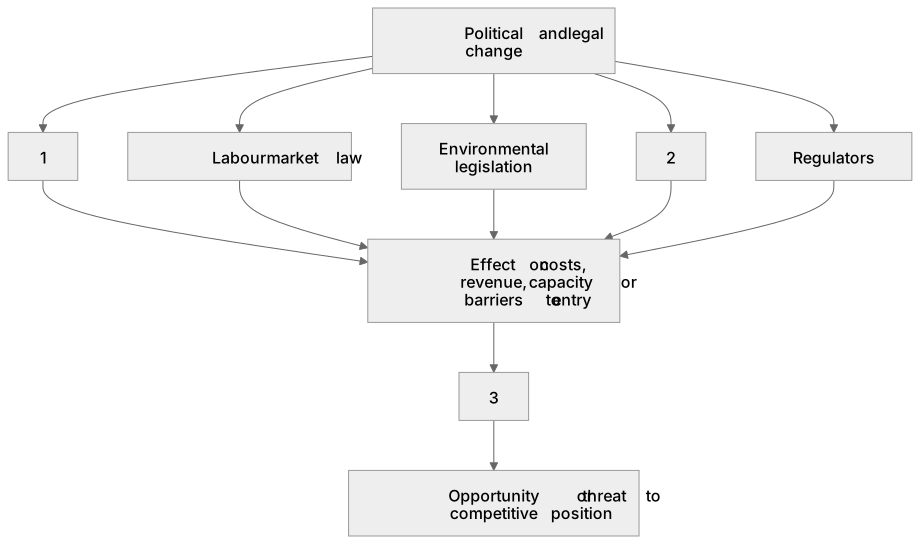
Label the diagram
Some boxes have lost their names. Pick the right name for each number.
1Box 1
2Box 2
3Box 3
There is more to this lesson
The full lesson goes on to check your understanding and help you earn the marks. Create a free account to carry on, with your progress saved.
A week of Premium from your first lesson · Then the free plan continues · No card, no charge
Test your understanding of Analysing the external environment to assess opportunities and threats: political and legal change: The impact of changes in the political and legal environment on strategic and functional decision making (to include: The political and legal environment should include a broad understanding of the scope and effects of laws related to competition, the labour market and environmental legislation. The impact of government policy related to enterprise, the role of regulators, infrastructure, the environment and international trade.)
Active recall beats re-reading. Take an instant quiz now to test what you’ve learned and lock it into long-term memory.
A week of Premium from your first lesson · Then the free plan continues · No card, no charge