AQA · A-Level · Business
Course version: 7132 · Version from Sept 2023
The competitive environment: Porter’s five forces, how and why these might…
Full specification wording
Analysing the external environment to assess opportunities and threats: the competitive environment: Porter’s five forces, how and why these might change, and the implications of these forces for strategic and functional decision making and profits (to include: An understanding of the five forces to include: entry threat (barriers to entry), buyer power, supplier power, rivalry, substitute threat. Students should consider how the five forces shape competitive strategy.)
Porter's Five Forces model analyses an industry's structure to assess its long-run profitability.
- 4 key terms
Study notes
From the teaching notes for this specification point.
The idea
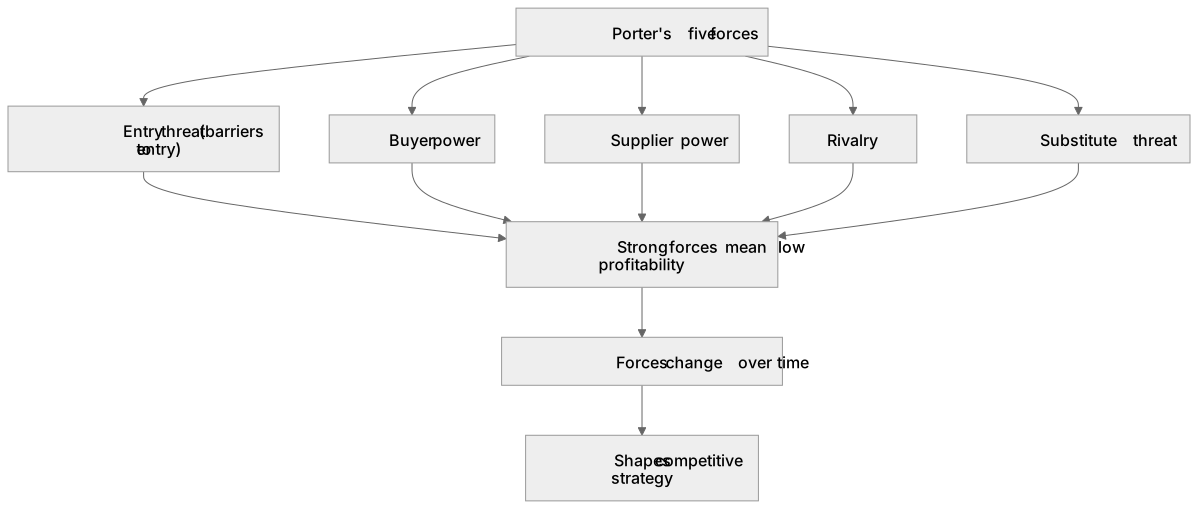
Porter's Five Forces model analyses an industry's structure to assess its long-run profitability. It examines five areas: the threat of new entrants (resisted by barriers like patents or economies of scale); the bargaining power of buyers; the bargaining power of suppliers; the threat from substitute products or services; and the intensity of rivalry among existing competitors. Where these forces are strong, profitability is low. Crucially, these forces are not static. For example, deregulation can lower barriers to entry, new technology can create powerful substitutes, and globalisation can increase supplier power. A business can use this analysis strategically to decide whether to enter a market, or to find ways to weaken a force, such as building customer loyalty to reduce buyer power.
What earns the marks
- Analysing each of the five forces with specific evidence from the case, concluding whether each is a strong or weak influence on the business.
- Explaining how the strength of the forces directly impacts the firm's potential for profit, for example, how high rivalry forces prices down.
- Suggesting a realistic strategy the business could adopt to alter the balance of forces, such as creating a strong brand to raise entry barriers.
- Considering how and why the forces might change over time, for instance how a new patent expiring could increase the threat of new entrants.
Common mistakes and how to put them right
Listing the five forces as a theory without applying them to the specific business or market in the case study.
Confusing rivals (firms offering the same product) with substitutes (different products meeting the same need, e.g., train vs. plane).
Treating the model as a static snapshot, failing to consider how competitive pressures might evolve in the future.
Exam tips
- Use the five forces as a framework to structure an answer about the attractiveness of a market, rather than making the framework itself the subject of the essay.
- For evaluation, consider the model's limitations. It overlooks the role of collaboration (e.g., joint ventures) and can underestimate the speed of technological disruption.
Try the lesson
The start of the Analysing the external environment to assess opportunities and threats: the competitive environment: Porter’s five forces, how and why these might change, and the implications of these forces for strategic and functional decision making and profits (to include: An understanding of the five forces to include: entry threat (barriers to entry), buyer power, supplier power, rivalry, substitute threat. Students should consider how the five forces shape competitive strategy.) lesson, made from teaching notes for this specification point.
Have a go first
Which of Porter’s five forces is concerned with the ease with which new businesses can begin operating in an industry?
Listen
Porter's Five Forces model analyses an industry's structure to assess its long-run profitability. It examines five areas: the threat of new entrants (resisted by barriers like patents or economies of scale); the bargaining power of buyers; the bargaining power of suppliers; the threat from substitute products or services; and the intensity of rivalry among existing competitors. Where these forces are strong, profitability is low. Crucially, these forces are not static. For example, deregulation can lower barriers to entry, new technology can create powerful substitutes, and globalisation can increase supplier power. A business can use this analysis strategically to decide whether to enter a market, or to find ways to weaken a force, such as building customer loyalty to reduce buyer power. A strong answer earns marks for these points. Analysing each of the five forces with specific evidence from the case, concluding whether each is a strong or weak influence on the business. Explaining how the strength of the forces directly impacts the firm's potential for profit, for example, how high rivalry forces prices down. Suggesting a realistic strategy the business could adopt to alter the balance of forces, such as creating a strong brand to raise entry barriers. Considering how and why the forces might change over time, for instance how a new patent expiring could increase the threat of new entrants. Exam tip: Use the five forces as a framework to structure an answer about the attractiveness of a market, rather than making the framework itself the subject of the essay.
See it
Key words
Say what each word means before you turn the card.
Barriers to entry
Try answering aloud or in your head before turning the card.
Buyer power
Try answering aloud or in your head before turning the card.
Supplier power
Try answering aloud or in your head before turning the card.
Substitute threat
Try answering aloud or in your head before turning the card.
See every definition
- Barriers to entry
- Factors that resist the threat of new entrants to an industry, such as patents or economies of scale.
- Buyer power
- The bargaining power of buyers, which is one of the five forces shaping competitive strategy.
- Supplier power
- The bargaining power of suppliers, which can increase through globalisation.
- Substitute threat
- The threat from substitute products or services, which can be created by new technology.
Label the diagram
Some boxes have lost their names. Pick the right name for each number.
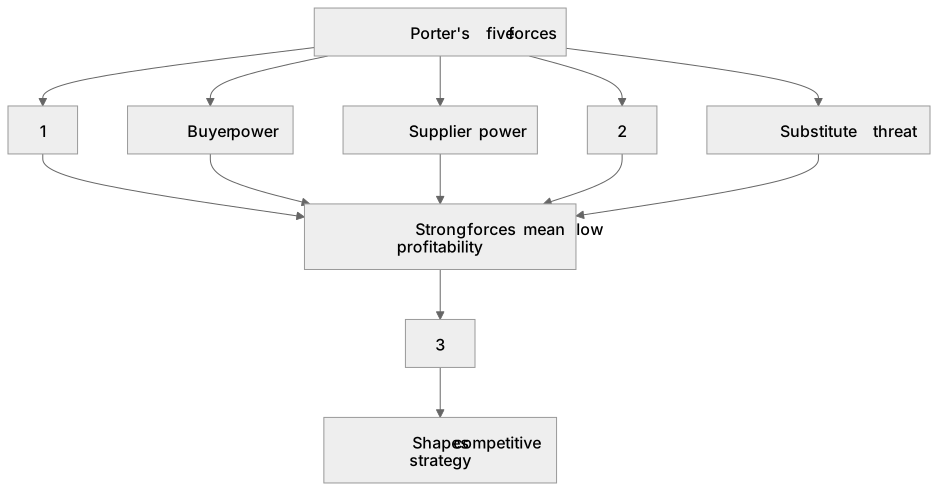
1Box 1
2Box 2
3Box 3
There is more to this lesson
The full lesson goes on to check your understanding and help you earn the marks. Create a free account to carry on, with your progress saved.
A week of Premium from your first lesson · Then the free plan continues · No card, no charge
Test your understanding of Analysing the external environment to assess opportunities and threats: the competitive environment: Porter’s five forces, how and why these might change, and the implications of these forces for strategic and functional decision making and profits (to include: An understanding of the five forces to include: entry threat (barriers to entry), buyer power, supplier power, rivalry, substitute threat. Students should consider how the five forces shape competitive strategy.)
Active recall beats re-reading. Take an instant quiz now to test what you’ve learned and lock it into long-term memory.
A week of Premium from your first lesson · Then the free plan continues · No card, no charge