AQA · A-Level · Business
Course version: 7132 · Version from Sept 2023
Managing international business (to include: Managing international…
Full specification wording
Assessing globalisation and internationalisation: Managing international business (to include: Managing international business should include: pressures for local responsiveness, pressures for cost reduction.)
Running a business across borders balances two opposing pressures.
- Point 9 of 9
- 4 key terms
Study notes
From the teaching notes for this specification point.
The idea
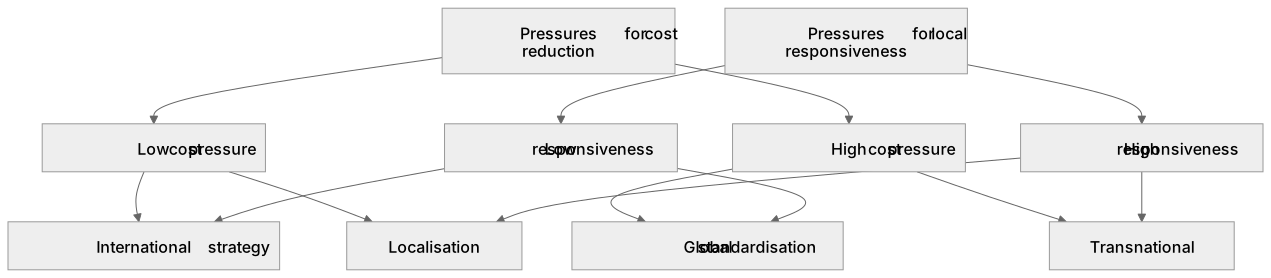
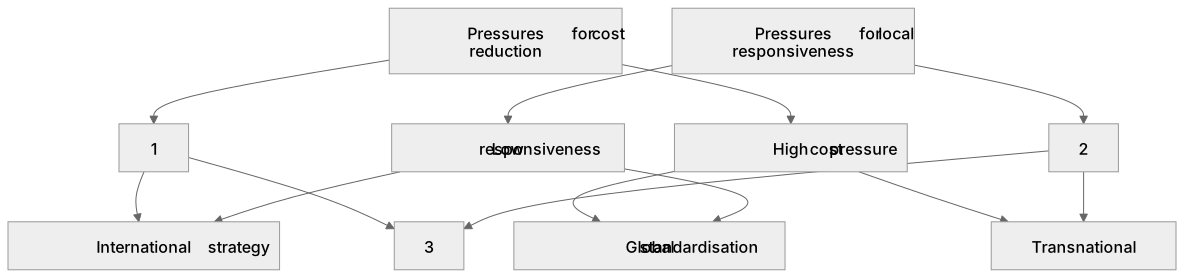
Running a business across borders balances two opposing pressures. Cost reduction pushes towards one standardised product made in a few large plants, cutting unit cost through economies of scale and suiting commodity-like goods. Local responsiveness pushes the other way, towards products, prices and promotion adapted to national taste, distribution and law. Bartlett and Ghoshal's grid crosses the two: low on both suggests an international strategy, high cost pressure alone gives global standardisation, high responsiveness alone gives localisation, and high on both demands a transnational firm that somehow achieves both. McDonald's runs a standard system with an Indian menu, exactly that compromise. The grid is blind to how fast the pressures shift and to head office politics, so say what would move a firm between the boxes.
What earns the marks
- Names both pressures and explains the mechanism behind each, scale economies on one side and consumer taste, law and distribution on the other.
- Places the named firm in a strategy, global standardisation, localisation, international or transnational, and justifies the placing from the case.
- Gives a real adaptation, such as a menu, a formulation, a package size or a payment method changed for one national market.
- Evaluates the cost of adaptation, because every local variant adds stock keeping units, shortens production runs and raises unit cost.
- Explains the transnational compromise: pursuing cost reduction and local responsiveness simultaneously through shared platforms with local finishing.
Common mistakes and how to put them right
Treating the two pressures as a simple choice, when the whole point of the transnational box is that strong firms are pushed by both at once.
Put it right: Treat the pressures as simultaneous and explain how a firm might meet both.
Confusing local responsiveness with translating the packaging, and missing changes to product, price, distribution and after sales service.
Put it right: Define responsiveness across the whole marketing mix, not just language.
Describing a staffing orientation such as ethnocentric staffing with no link to the pressures that made it appropriate.
Put it right: Ethnocentric staffing is a staffing policy, not an organisational structure; connect each staffing or structural choice back to the cost or responsiveness pressure it answers.
Exam tips
- Draw or describe the two pressures as axes in rough working, then argue the position, because examiners reward a justified placing more than a drawn grid.
- Use Hofstede or Handy only where the case gives you evidence about culture, and say what the framework misses.
- For a top level conclusion, argue that the right balance shifts over time and name the trigger that would shift it for this firm.
Try the lesson
The start of the Assessing globalisation and internationalisation: Managing international business (to include: Managing international business should include: pressures for local responsiveness, pressures for cost reduction.) lesson, made from teaching notes for this specification point.
Have a go first
Which of the following best describes pressure for local responsiveness?
Listen
Running a business across borders balances two opposing pressures. Cost reduction pushes towards one standardised product made in a few large plants, cutting unit cost through economies of scale and suiting commodity-like goods. Local responsiveness pushes the other way, towards products, prices and promotion adapted to national taste, distribution and law. Bartlett and Ghoshal's grid crosses the two: low on both suggests an international strategy, high cost pressure alone gives global standardisation, high responsiveness alone gives localisation, and high on both demands a transnational firm that somehow achieves both. McDonald's runs a standard system with an Indian menu, exactly that compromise. The grid is blind to how fast the pressures shift and to head office politics, so say what would move a firm between the boxes. A strong answer earns marks for these points. Names both pressures and explains the mechanism behind each, scale economies on one side and consumer taste, law and distribution on the other. Places the named firm in a strategy, global standardisation, localisation, international or transnational, and justifies the placing from the case. Gives a real adaptation, such as a menu, a formulation, a package size or a payment method changed for one national market. Evaluates the cost of adaptation, because every local variant adds stock keeping units, shortens production runs and raises unit cost. A common slip: Treating the two pressures as a simple choice, when the whole point of the transnational box is that strong firms are pushed by both at once. Instead, treat the pressures as simultaneous and explain how a firm might meet both. Exam tip: Draw or describe the two pressures as axes in rough working, then argue the position, because examiners reward a justified placing more than a drawn grid.
See it
Key words
Say what each word means before you turn the card.
pressures for cost reduction
Try answering aloud or in your head before turning the card.
pressures for local responsiveness
Try answering aloud or in your head before turning the card.
global and transnational strategy
Try answering aloud or in your head before turning the card.
standardisation against adaptation
Try answering aloud or in your head before turning the card.
See every definition
- pressures for cost reduction
- Pushes towards one standardised product made in a few large plants, cutting unit cost through economies of scale and suiting commodity-like goods.
- pressures for local responsiveness
- Pushes towards products, prices and promotion adapted to national taste, distribution and law.
- global and transnational strategy
- High cost pressure alone gives global standardisation, high responsiveness alone gives localisation, and high on both demands a transnational firm that somehow achieves both.
- standardisation against adaptation
- Every local variant adds stock keeping units, shortens production runs and raises unit cost, so adaptation carries a cost.
Label the diagram
Some boxes have lost their names. Pick the right name for each number.
1Box 1
2Box 2
3Box 3
There is more to this lesson
The full lesson goes on to check your understanding and help you earn the marks. Create a free account to carry on, with your progress saved.
A week of Premium from your first lesson · Then the free plan continues · No card, no charge
Test your understanding of Assessing globalisation and internationalisation: Managing international business (to include: Managing international business should include: pressures for local responsiveness, pressures for cost reduction.)
Active recall beats re-reading. Take an instant quiz now to test what you’ve learned and lock it into long-term memory.
A week of Premium from your first lesson · Then the free plan continues · No card, no charge