AQA · A-Level · Business
Course version: 7132 · Version from Sept 2023
Assessing greater use of digital technology: The value of digital technology
Value here means the return a system earns against what it ties up, so the test is financial before it is technological.
- Point 2 of 2
- 3 key terms
Study notes
From the teaching notes for this specification point.
The idea
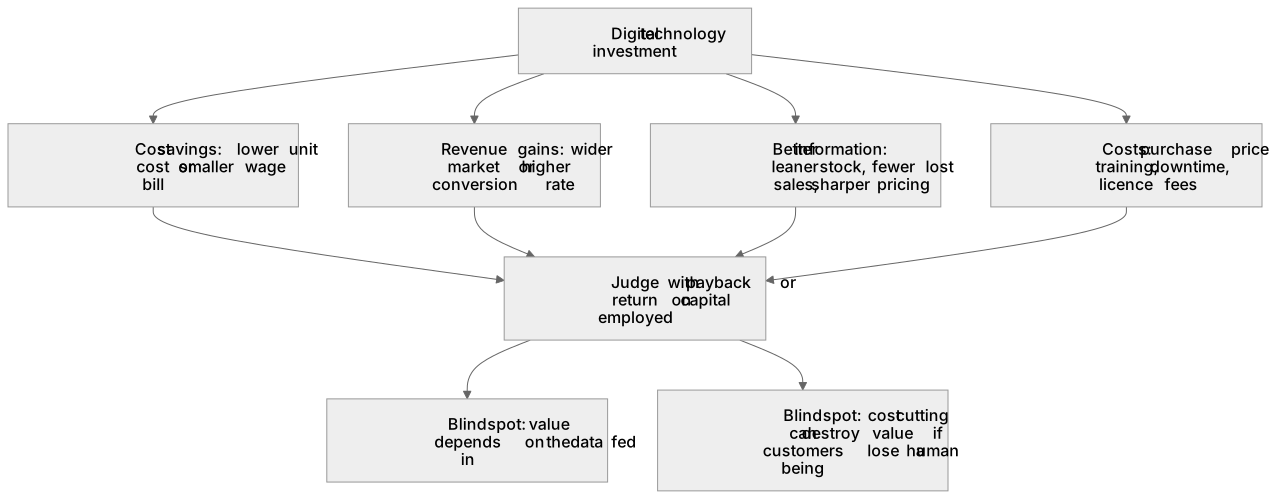
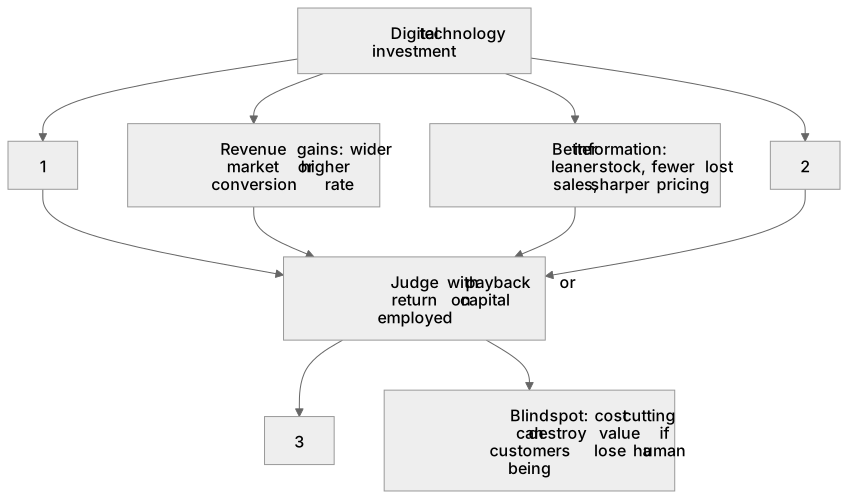
Value here means the return a system earns against what it ties up, so the test is financial before it is technological. Cost savings appear as a lower unit cost or a smaller wage bill, revenue gains appear as a wider market or a higher conversion rate, and better information appears as leaner stock, fewer lost sales and sharper pricing. Set those against the purchase price, the training, the downtime during changeover and the licence fees that never stop, then judge with payback, initial investment divided by net annual cash flow and quoted in years and months, or with return on capital employed, operating profit divided by capital employed multiplied by one hundred. The blind spot is that a system is only as good as the data fed into it, and one bought to strip out cost can destroy value if customers experience it as the removal of a human being.
What earns the marks
- Separating the three routes to value, lower costs, higher revenue and better decisions, and saying which one the case business is actually buying.
- Working a payback period or a return from the appendix figures and then judging that number against the criterion the firm itself states, not against nothing.
- Naming the cost of standing still, such as share lost to a rival that already sells online, because value is always measured against the alternative.
- Qualifying the judgement by time frame, since a system that dents profit this year can lift return on capital employed once volumes rise.
Common mistakes and how to put them right
Quoting a payback period without asking whether it is acceptable here, when a firm with tight cash and a short loan may reject the same payback a cash rich rival welcomes.
Assuming that because a system is new it must add value, when much of the gain is competed away as soon as rivals copy it.
Leaving the human cost out of the sum, so redundancy payments, retraining and a drop in morale never reach the calculation.
Exam tips
- Calculation questions here are usually payback or return on capital employed with the investment in one table and the annual savings in another, so label the units and state the period in years.
- Evaluation marks come from the condition attached, so finish with what would change your answer: a shift in demand, a change in the finance available, or the reaction of the workforce.
Try the lesson
The start of the Assessing greater use of digital technology: The value of digital technology lesson, made from teaching notes for this specification point.
Have a go first
Which of the following best describes digital technology in a business context?
Listen
Value here means the return a system earns against what it ties up, so the test is financial before it is technological. Cost savings appear as a lower unit cost or a smaller wage bill, revenue gains appear as a wider market or a higher conversion rate, and better information appears as leaner stock, fewer lost sales and sharper pricing. Set those against the purchase price, the training, the downtime during changeover and the licence fees that never stop, then judge with payback, initial investment divided by net annual cash flow and quoted in years and months, or with return on capital employed, operating profit divided by capital employed multiplied by one hundred. The blind spot is that a system is only as good as the data fed into it, and one bought to strip out cost can destroy value if customers experience it as the removal of a human being. A strong answer earns marks for these points. Separating the three routes to value, lower costs, higher revenue and better decisions, and saying which one the case business is actually buying. Working a payback period or a return from the appendix figures and then judging that number against the criterion the firm itself states, not against nothing. Naming the cost of standing still, such as share lost to a rival that already sells online, because value is always measured against the alternative. Qualifying the judgement by time frame, since a system that dents profit this year can lift return on capital employed once volumes rise. Exam tip: Calculation questions here are usually payback or return on capital employed with the investment in one table and the annual savings in another, so label the units and state the period in years.
See it
Key words
Say what each word means before you turn the card.
cost savings
Try answering aloud or in your head before turning the card.
investment returns
Try answering aloud or in your head before turning the card.
data quality
Try answering aloud or in your head before turning the card.
See every definition
- cost savings
- A lower unit cost or a smaller wage bill, one of the routes through which digital technology earns a return.
- investment returns
- The return a system earns against what it ties up, judged with payback or return on capital employed.
- data quality
- A system is only as good as the data fed into it, so poor data is the blind spot in judging value.
Label the diagram
Some boxes have lost their names. Pick the right name for each number.
1Box 1
2Box 2
3Box 3
There is more to this lesson
The full lesson goes on to check your understanding and help you earn the marks. Create a free account to carry on, with your progress saved.
A week of Premium from your first lesson · Then the free plan continues · No card, no charge
Test your understanding of Assessing greater use of digital technology: The value of digital technology
Active recall beats re-reading. Take an instant quiz now to test what you’ve learned and lock it into long-term memory.
A week of Premium from your first lesson · Then the free plan continues · No card, no charge