AQA · A-Level · Business
Course version: 7132 · Version from Sept 2023
How decisions in finance improve the competitiveness of the business
Full specification wording
Financial management: how decisions in finance improve the competitiveness of the business
Financial decisions can fund strategies to gain a competitive advantage.
- Point 5 of 6
- 4 key terms
Study notes
From the teaching notes for this specification point.
The idea
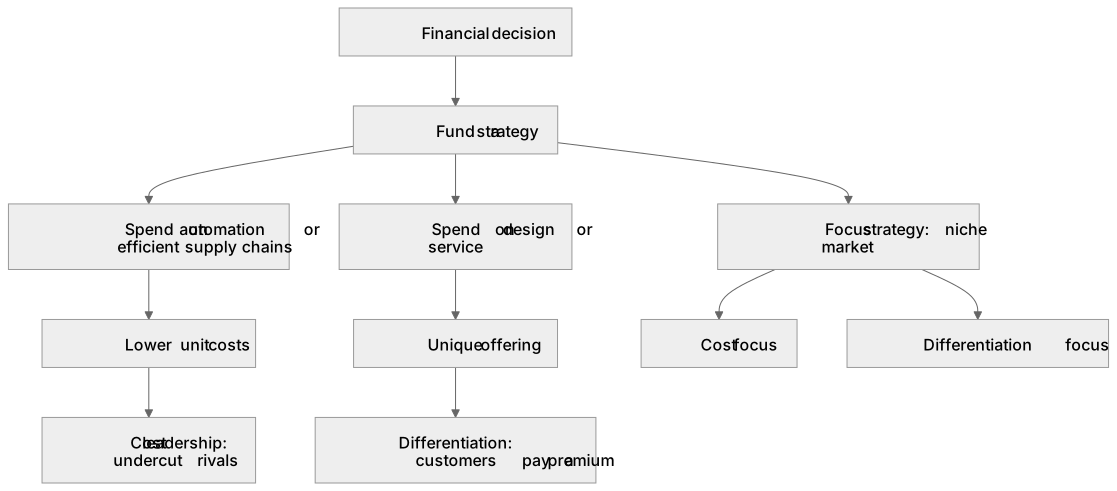
Financial decisions can fund strategies to gain a competitive advantage. Investment in automation or efficient supply chains can lower unit costs, enabling a strategy of cost leadership to undercut rivals. Spending on design or service can create a unique offering, supporting a differentiation strategy where customers pay a premium. Porter's generic strategies model also includes focus strategies, targeting a niche market with either low cost (cost focus) or a unique product (differentiation focus). A firm's ability to fund these strategies depends on its financial health. Return on capital employed (ROCE), which is operating profit ÷ capital employed × 100, indicates the efficiency of past investments, while low gearing provides capacity to borrow for new projects.
What earns the marks
- Choosing one route and following it through, saying whether the spending in the stem lowers cost per unit or raises what the customer will pay, and then naming the competitive consequence.
- Calculating a ratio from the accounts provided, such as return on capital employed or the gross profit margin, and interpreting the movement instead of leaving the figure bare.
- Explaining that a strong cash position is itself a weapon, because it lets a firm survive a price war, buy a failing rival, or pay suppliers early for a discount.
- Recognising the risk, since borrowing to invest raises gearing and creates fixed interest charges that must be met whether or not the investment works.
Common mistakes and how to put them right
Writing that investment makes a firm more competitive without naming the mechanism, when the credit is for the step from lower unit cost to a lower price or a wider margin.
Put it right: Spell out the chain from the spending to the cost or price change and then to the competitive outcome.
Treating cost cutting as free, ignoring what cheaper materials do to quality and what redundancy does to the skills the firm will need again when demand returns.
Put it right: Weigh the saving against the effect on quality, staff skills and future capacity.
Quoting return on capital employed with nothing to compare it with, when the figure only means something against last year, against a rival, or against the cost of borrowing.
Put it right: Set the ratio against a benchmark before drawing a conclusion.
Exam tips
- Ratio questions usually pair a calculation with an assessment, so leave time to say what the figure tells the directors about their competitive position.
- Name relevant competitive strategies, such as Porter's, where they fit, then say what the model ignores (e.g., hybrid strategies), because a supported limitation strengthens the evaluation.
- If the question says improve competitiveness, your conclusion should compare the firm with a named rival, not with its own past alone.
Try the lesson
The start of the Financial management: how decisions in finance improve the competitiveness of the business lesson, made from teaching notes for this specification point.
Have a go first
Which financial decision is most likely to improve a business's competitiveness by lowering its unit costs?
Listen
Financial decisions can fund strategies to gain a competitive advantage. Investment in automation or efficient supply chains can lower unit costs, enabling a strategy of cost leadership to undercut rivals. Spending on design or service can create a unique offering, supporting a differentiation strategy where customers pay a premium. Porter's generic strategies model also includes focus strategies, targeting a niche market with either low cost (cost focus) or a unique product (differentiation focus). A firm's ability to fund these strategies depends on its financial health. Return on capital employed (ROCE), which is operating profit ÷ capital employed × 100, indicates the efficiency of past investments, while low gearing provides capacity to borrow for new projects. A strong answer earns marks for these points. Choosing one route and following it through, saying whether the spending in the stem lowers cost per unit or raises what the customer will pay, and then naming the competitive consequence. Calculating a ratio from the accounts provided, such as return on capital employed or the gross profit margin, and interpreting the movement instead of leaving the figure bare. Explaining that a strong cash position is itself a weapon, because it lets a firm survive a price war, buy a failing rival, or pay suppliers early for a discount. Recognising the risk, since borrowing to invest raises gearing and creates fixed interest charges that must be met whether or not the investment works. A common slip: Writing that investment makes a firm more competitive without naming the mechanism, when the credit is for the step from lower unit cost to a lower price or a wider margin. Instead, spell out the chain from the spending to the cost or price change and then to the competitive outcome. Exam tip: Ratio questions usually pair a calculation with an assessment, so leave time to say what the figure tells the directors about their competitive position.
See it
Key words
Say what each word means before you turn the card.
Porter's generic strategies
Try answering aloud or in your head before turning the card.
return on capital employed
Try answering aloud or in your head before turning the card.
gearing
Try answering aloud or in your head before turning the card.
competitive advantage
Try answering aloud or in your head before turning the card.
See every definition
- Porter's generic strategies
- A model that includes cost leadership, differentiation, cost focus and differentiation focus as routes to competitive advantage.
- return on capital employed
- Operating profit divided by capital employed multiplied by 100, indicating the efficiency of past investments.
- gearing
- Low gearing provides capacity to borrow for new projects, while borrowing to invest raises gearing and creates fixed interest charges.
- competitive advantage
- Gained when financial decisions fund strategies such as lowering unit costs to undercut rivals or creating a unique offering for which customers pay a premium.
Label the diagram
Some boxes have lost their names. Pick the right name for each number.
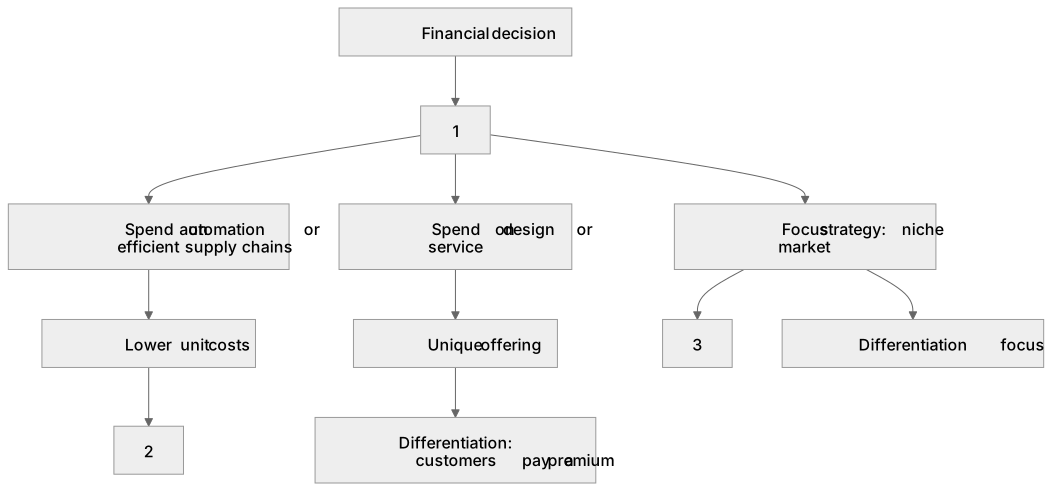
1Box 1
2Box 2
3Box 3
There is more to this lesson
The full lesson goes on to check your understanding and help you earn the marks. Create a free account to carry on, with your progress saved.
A week of Premium from your first lesson · Then the free plan continues · No card, no charge
Test your understanding of Financial management: how decisions in finance improve the competitiveness of the business
Active recall beats re-reading. Take an instant quiz now to test what you’ve learned and lock it into long-term memory.
A week of Premium from your first lesson · Then the free plan continues · No card, no charge