AQA · A-Level · Business
Course version: 7132 · Version from Sept 2023
Improving cash flow and profits: Methods of improving cash flow (to…
Full specification wording
Making financial decisions: improving cash flow and profits: Methods of improving cash flow (to include: Students should be able to assess ways of improving cash flow.)
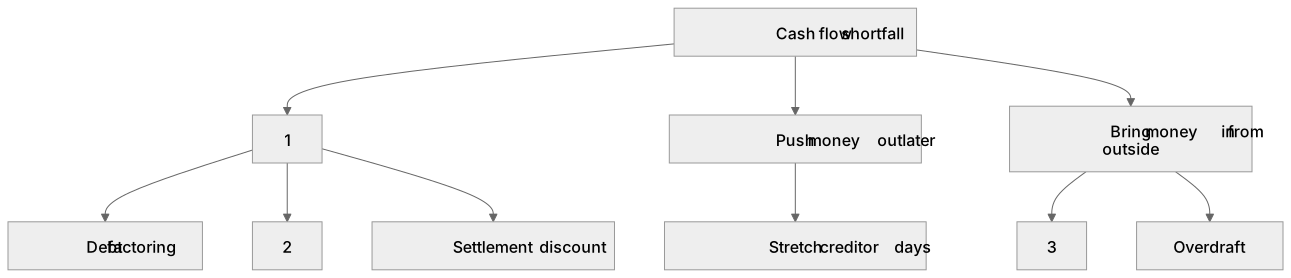
Cash is fixed by pulling one of three levers: bring money in sooner, push money out later, or bring money in from outside.
- Point 1 of 3
- 4 key terms
Study notes
From the teaching notes for this specification point.
The idea
Cash is fixed by pulling one of three levers: bring money in sooner, push money out later, or bring money in from outside. Debt factoring sells the sales ledger for roughly eighty to eighty five per cent of face value now, so cash arrives in days rather than at the end of the credit period. Sale and leaseback turns a freehold into a lump sum and a rent. Tightening credit terms or offering a settlement discount shortens debtor days, while stretching creditor days uses the supplier as a free bank until the supplier reprices or refuses. Each lever costs something, and the strong answers say what: factoring surrenders margin, leaseback surrenders an asset that was appreciating, and squeezing a supplier spends goodwill a small firm may badly need in a shortage. An overdraft covers the gap without touching whatever caused it.
What earns the marks
- Naming a specific method and its mechanism, for example that factoring advances most of the value of an invoice at once, so cash arrives in days rather than at the end of the agreed credit period.
- Quantifying the effect on the forecast where the stem supplies figures, such as showing that halving debtor days moves a named sum into the month in which the overdraft limit would otherwise be breached.
- Weighing the cost of the method against the size and length of the shortfall, because a firm short of cash for one month should not sell an asset it will need for the next decade.
- Matching the method to the cause of the problem, distinguishing a seasonal trough from overtrading or from a product that is simply losing money on every sale.
Common mistakes and how to put them right
Answering with cut costs and sell more, which may improve profit over several months and does nothing for cash this month, because those extra sales would still be made on credit.
Listing four methods with a sentence each rather than choosing one and defending it, which holds an assess answer below the top level however accurate the list is.
Presenting an overdraft as a solution rather than as borrowed time, with no mention of the interest charged or the fact that it is repayable on demand.
Exam tips
- Questions here nearly always supply a cash flow forecast or a short set of figures, so begin from the size and the timing of the gap rather than from a memorised list of methods.
- The mark scheme rewards a choice with a condition attached, for instance that factoring suits a growing order book but not a firm whose customers are a handful of large accounts.
- Do not spend long rebuilding the forecast; the figures are there to be interpreted, and the marks sit in what you conclude from them.
Try the lesson
The start of the Making financial decisions: improving cash flow and profits: Methods of improving cash flow (to include: Students should be able to assess ways of improving cash flow.) lesson, made from teaching notes for this specification point.
Have a go first
Which method of improving cash flow involves a business selling its unpaid customer invoices to a third party in return for immediate cash?
Listen
Cash is fixed by pulling one of three levers: bring money in sooner, push money out later, or bring money in from outside. Debt factoring sells the sales ledger for roughly eighty to eighty five per cent of face value now, so cash arrives in days rather than at the end of the credit period. Sale and leaseback turns a freehold into a lump sum and a rent. Tightening credit terms or offering a settlement discount shortens debtor days, while stretching creditor days uses the supplier as a free bank until the supplier reprices or refuses. Each lever costs something, and the strong answers say what: factoring surrenders margin, leaseback surrenders an asset that was appreciating, and squeezing a supplier spends goodwill a small firm may badly need in a shortage. An overdraft covers the gap without touching whatever caused it. A strong answer earns marks for these points. Naming a specific method and its mechanism, for example that factoring advances most of the value of an invoice at once, so cash arrives in days rather than at the end of the agreed credit period. Quantifying the effect on the forecast where the stem supplies figures, such as showing that halving debtor days moves a named sum into the month in which the overdraft limit would otherwise be breached. Weighing the cost of the method against the size and length of the shortfall, because a firm short of cash for one month should not sell an asset it will need for the next decade. Matching the method to the cause of the problem, distinguishing a seasonal trough from overtrading or from a product that is simply losing money on every sale. Exam tip: Questions here nearly always supply a cash flow forecast or a short set of figures, so begin from the size and the timing of the gap rather than from a memorised list of methods.
See it

Key words
Say what each word means before you turn the card.
cash flow versus profit
Try answering aloud or in your head before turning the card.
debt factoring
Try answering aloud or in your head before turning the card.
sale and leaseback
Try answering aloud or in your head before turning the card.
credit control
Try answering aloud or in your head before turning the card.
See every definition
- cash flow versus profit
- Cutting costs and selling more may improve profit over several months yet do nothing for cash this month, because those extra sales would still be made on credit.
- debt factoring
- Selling the sales ledger for roughly eighty to eighty five per cent of face value now, so cash arrives in days rather than at the end of the credit period.
- sale and leaseback
- Turning a freehold into a lump sum and a rent, though it surrenders an asset that was appreciating.
- credit control
- Tightening credit terms or offering a settlement discount shortens debtor days, while stretching creditor days uses the supplier as a free bank until the supplier reprices or refuses.
Label the diagram
Some boxes have lost their names. Pick the right name for each number.
1Box 1
2Box 2
3Box 3
There is more to this lesson
The full lesson goes on to check your understanding and help you earn the marks. Create a free account to carry on, with your progress saved.
A week of Premium from your first lesson · Then the free plan continues · No card, no charge
Test your understanding of Making financial decisions: improving cash flow and profits: Methods of improving cash flow (to include: Students should be able to assess ways of improving cash flow.)
Active recall beats re-reading. Take an instant quiz now to test what you’ve learned and lock it into long-term memory.
A week of Premium from your first lesson · Then the free plan continues · No card, no charge