AQA · A-Level · Business
Course version: 7132 · Version from Sept 2023
Improving motivation and engagement: The benefits of motivated and engaged…
Full specification wording
Making human resource decisions: improving motivation and engagement: The benefits of motivated and engaged employees (to include: Theories of motivation should include Taylor, Maslow and Herzberg.)
Motivation is the willingness to give discretionary effort, and engagement is the attachment that makes staff care whether the firm wins, so the payoff has to be argued in numbers a marker can…
- Point 1 of 3
- 4 key terms
Study notes
From the teaching notes for this specification point.
The idea
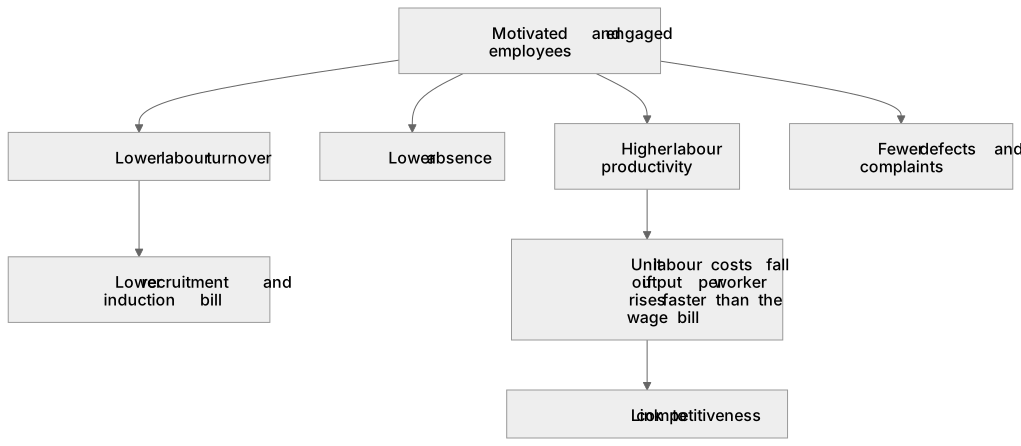
Motivation is the willingness to give discretionary effort, and engagement is the attachment that makes staff care whether the firm wins, so the payoff has to be argued in numbers a marker can see: lower labour turnover and the recruitment and induction bill that goes with it, lower absence, higher labour productivity measured as output per worker per period, fewer defects and fewer complaints. Taylor treats pay as the whole story and fits repetitive, measurable work, but is blind to social need and breeds resentment where quality matters more than speed. Maslow gives a ladder of needs and no way of proving which rung a given worker is on. Herzberg separates hygiene factors, which only stop dissatisfaction, from motivators such as achievement and responsibility, and is blind to the worker for whom money genuinely is the motivator.
What earns the marks
- Naming a benefit and tying it to a figure in the case, for instance labour turnover falling from a fifth of staff a year to under a tenth, and then costing the recruitment and training that is no longer needed.
- Using labour productivity properly as output per worker per period, and showing that if output per worker rises faster than the wage bill then unit labour costs fall, which is the link to competitiveness.
- Applying Herzberg's split, so a pay rise is treated as a hygiene factor that removes a grievance without motivating, while responsibility and recognition are the things that change effort.
- Judging the size of the benefit against the business, because engagement is worth far more in a service firm where staff meet customers than on an automated line where output is set by machine speed.
Common mistakes and how to put them right
Retelling Taylor, Maslow and Herzberg as a history lesson with no mention of the named business, which is knowledge without application and caps the answer low.
Asserting that motivated staff always raise profit, ignoring that the scheme that motivated them has a cost and that demand, not effort, may be what limits sales.
Treating Maslow as a queue everyone stands in together, when a graduate trainee and a long serving machine operator in the same firm are plainly chasing different needs.
Confusing engagement with satisfaction, so a survey saying staff are happy is presented as proof that they are working harder.
Exam tips
- This is almost always asked with an appendix of human resource data such as turnover, absence or output per employee, so open from the figures rather than from the theory.
- Name a theory once and then use it; examiners reward a theory that does work in the argument and give little for a paragraph that only describes the pyramid.
- For assess and evaluate questions, close on which benefit matters most to this firm given its objectives, rather than listing every benefit motivation could ever bring.
Try the lesson
The start of the Making human resource decisions: improving motivation and engagement: The benefits of motivated and engaged employees (to include: Theories of motivation should include Taylor, Maslow and Herzberg.) lesson, made from teaching notes for this specification point.
Have a go first
Which theorist is most closely associated with the use of scientific management to improve employee motivation?
Listen
Motivation is the willingness to give discretionary effort, and engagement is the attachment that makes staff care whether the firm wins, so the payoff has to be argued in numbers a marker can see: lower labour turnover and the recruitment and induction bill that goes with it, lower absence, higher labour productivity measured as output per worker per period, fewer defects and fewer complaints. Taylor treats pay as the whole story and fits repetitive, measurable work, but is blind to social need and breeds resentment where quality matters more than speed. Maslow gives a ladder of needs and no way of proving which rung a given worker is on. Herzberg separates hygiene factors, which only stop dissatisfaction, from motivators such as achievement and responsibility, and is blind to the worker for whom money genuinely is the motivator. A strong answer earns marks for these points. Naming a benefit and tying it to a figure in the case, for instance labour turnover falling from a fifth of staff a year to under a tenth, and then costing the recruitment and training that is no longer needed. Using labour productivity properly as output per worker per period, and showing that if output per worker rises faster than the wage bill then unit labour costs fall, which is the link to competitiveness. Applying Herzberg's split, so a pay rise is treated as a hygiene factor that removes a grievance without motivating, while responsibility and recognition are the things that change effort. Judging the size of the benefit against the business, because engagement is worth far more in a service firm where staff meet customers than on an automated line where output is set by machine speed. Exam tip: This is almost always asked with an appendix of human resource data such as turnover, absence or output per employee, so open from the figures rather than from the theory.
See it
Key words
Say what each word means before you turn the card.
discretionary effort
Try answering aloud or in your head before turning the card.
labour turnover and absence
Try answering aloud or in your head before turning the card.
labour productivity
Try answering aloud or in your head before turning the card.
hygiene factors and motivators
Try answering aloud or in your head before turning the card.
See every definition
- discretionary effort
- The willingness to give this is what motivation means.
- labour turnover and absence
- Both fall as a benefit of motivated and engaged employees, along with the recruitment and induction bill that goes with turnover.
- labour productivity
- Measured as output per worker per period, and a benefit of motivated and engaged employees.
- hygiene factors and motivators
- Herzberg separates factors that only stop dissatisfaction from motivators such as achievement and responsibility.
Label the diagram
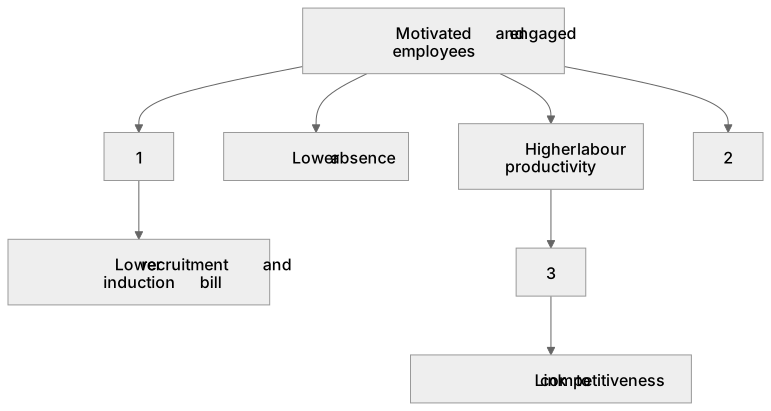
Some boxes have lost their names. Pick the right name for each number.
1Box 1
2Box 2
3Box 3
There is more to this lesson
The full lesson goes on to check your understanding and help you earn the marks. Create a free account to carry on, with your progress saved.
A week of Premium from your first lesson · Then the free plan continues · No card, no charge
Test your understanding of Making human resource decisions: improving motivation and engagement: The benefits of motivated and engaged employees (to include: Theories of motivation should include Taylor, Maslow and Herzberg.)
Active recall beats re-reading. Take an instant quiz now to test what you’ve learned and lock it into long-term memory.
A week of Premium from your first lesson · Then the free plan continues · No card, no charge